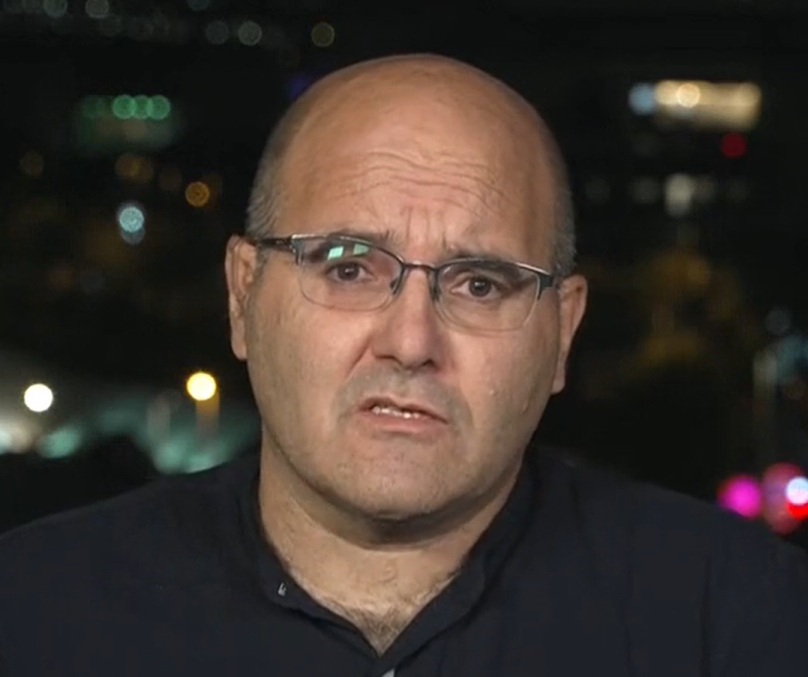

Nir Hasson, veteran journalist at Israel’s far-left Haaretz newspaper, rails routinely against the nation. On October 8, 2026, he published a particularly venomous and extensive article that amounted to a sweeping indictment of Israel. According to Hasson, Israel has turned its prisons for terrorists into “torture camps,” where crimes against humanity are being committed on its behalf.
Yet, the entire article contains not a single piece of independent evidence substantiating the allegations. It relies exclusively on testimonies from released Palestinian security prisoners and detainees, who recount to Hasson what they claim to have experienced during their imprisonment.
At the very end of the article, Israel’s categorical denial of all the allegations is briefly quoted. In other words, in the absence of corroborating evidence, we are left with one person’s word against another’s. Palestinians suspected of security offenses claim they were tortured, without presenting supporting evidence, while the state denies that they were tortured. How are we supposed to determine who is telling the truth and who is lying?
Let’s begin by stating the obvious: this is journalism of an exceptionally low ethical and professional standard, the kind associated with propaganda organizations rather than legitimate news outlets. And this is not merely my definition. It is a standard established by the journalism profession itself. Here are a few examples.
The BBC’s official Editorial Guidelines, Section 3, on Accuracy, explicitly state in paragraph 3.4.4:
“Content producers should be reluctant to rely on a single source.”
Paragraph 3.4.1 establishes another professional requirement:
“Corroborate claims and allegations made by contributors.”
The Reuters Handbook of Journalism addresses the same issue. Under “Sourcing,” it states:
“Cross-check information wherever possible. Two or more sources are better than one.”
The Reuters guidelines further instruct journalists to examine a source’s background, position, and motives, and to try to disprove a story rather than merely confirm it.
The Associated Press guidelines also stand in stark contrast to Hasson’s approach. They emphasize that journalists must do more than simply relay claims made by interested parties. They must assess the credibility of the information, seek additional sources, and produce independent reporting.
Hasson and Haaretz simply brush aside all these basic, self-evident principles of journalistic ethics. Apparently, when their purpose is to vilify Israel, the rules no longer apply.
For anyone still interested in finding some indication of whether Hasson’s latest allegations are true or false, the only remaining option is to examine his previous accusations against Israel and assess their reliability. Unfortunately, there is no shortage of revealing examples.
Starvation in Gaza
For many months, Hir Hasson repeatedly asserted that Israel was deliberately causing mass starvation among the residents of Gaza. Hasson even claimed that there had been an “exponential increase” in the number of starvation deaths in the Strip.
In retrospect, it became clear that Hasson was spreading false Hamas propaganda. Official reports examining the hunger situation in Gaza, both by Israeli researchers and by the United Nations, unequivocally concluded that there was no famine in Gaza. Not only was there no famine, but a study of the food supply found that the amount of calories available to Gaza residents was among the highest in the world, exceeding the internationally accepted humanitarian survival standard, known as the Sphere standard, by tens of percentage points.
It is, therefore, hardly surprising that even according to figures published by Hamas itself, there was no “exponential increase” in starvation deaths in Gaza. In fact, according to Hamas’s own figures, no one in Gaza died of starvation at all.
So what did happen? According to a recent UNICEF report, some Gazans even developed the opposite problem: obesity, particularly among children. So much for the despicable “starvation” lie that Hamas spread through its loyal mouthpiece, Nir Hasson.
Genocide in Gaza
The allegation of genocide—that Israel has been systematically and deliberately exterminating the population of Gaza—has been a central pillar of Hamas propaganda throughout the war.
Hasson has repeatedly amplified the allegation, including by citing an “association of genocide scholars” that, upon closer inspection, turned out to be a ridiculous organization whose listed “scholars” included animals, dead people, and others.
In any case, the accusation that Israel is committing genocide rests on redefining the accepted meaning of genocide so that the label can be applied to Israel, even though no genocide is taking place and the facts on the ground point in precisely the opposite direction.
Throughout the war, Israel has deliberately sought to minimize harm to noncombatants, the very opposite of genocide. It has even set international precedents in limiting civilian casualties during urban warfare.
Israel established a precedent in modern warfare by providing advance warnings before striking legitimate military targets located in civilian areas, allowing civilians time to evacuate and avoid harm.
It organized a mass vaccination campaign against polio for 640,000 Palestinian children in Gaza, allowed enormous quantities of humanitarian aid into the Strip, and assumed responsibility for maintaining a regular supply of water and electricity to its enemies in Gaza.
It is therefore hardly surprising that a consensus has emerged among warfare experts around the world that the accusation of genocide against Israel is baseless.
So much for the genocide lie spread by Nir Hasson.
Hasson also claimed, relying exclusively on Palestinian testimonies and without corroborating evidence, that in May 2025 the IDF bombed a school in al-Bureij and killed 32 Palestinians, including children.
It later emerged that the target was a Hamas command-and-control compound, where senior Hamas operatives from the al-Bureij camp were present at the time of the strike.
His defense of the credibility of the documentary No Other Land follows the very same method condemned by the ethical guidelines of the world’s leading news organizations. It relies on testimonies, in this case even anonymous ones, without a single piece of supporting evidence for the grave accusations being made.
Now Hasson claims that Israel is operating “torture camps.”
How credible is this latest allegation? One indicator is the attitude of the Israeli public. Barely 6% read Haaretz — though its baseless attacks on Israel are relished and replayed globally by the enemies of the Jewish state.