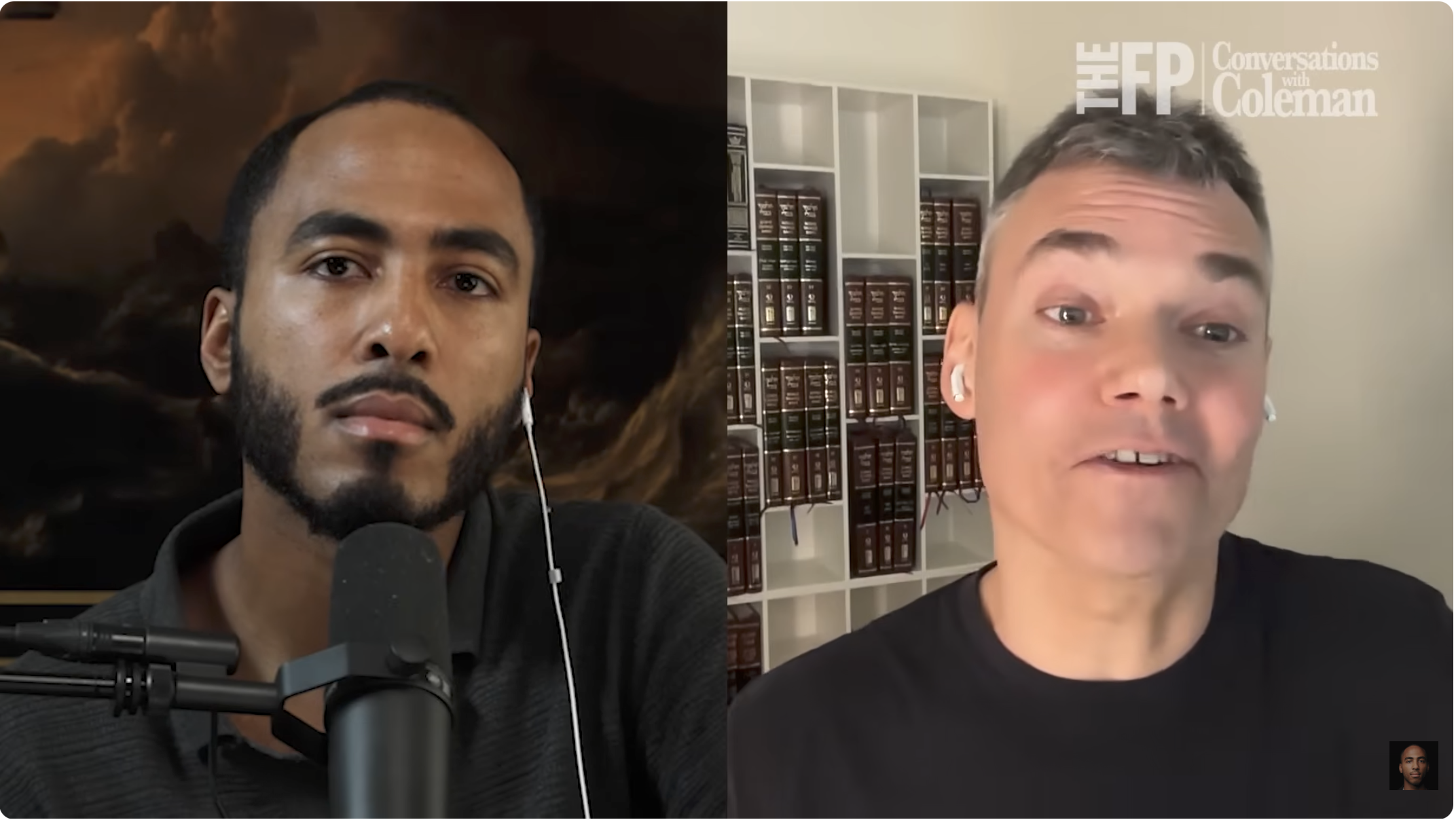

Coleman Hughes of the Free Press has been doing a series of interviews or debates discussing Israel and the Palestinians, including hosting Peter Beinart in June. Hughes did an admirable job of responding to Beinart’s points, including dismantling Beinart’s analogy to apartheid South Africa. There were two points that Beinart made during the podcast that are worth highlighting, as they showcase not only the flaws in his argument, but his underlying mendacity.
Around 45 minutes into the program, Hughes makes the assertion to Beinart that if a binational state were to be created that encompassed Israel, the West Bank, and Gaza, “I think the very likely outcome of that at this moment, at this particular time, would be an extremely bloody civil war.”
It’s difficult to overstate the dishonesty of Beinart’s reply:
So my response would be there is one state now. Israel controls all the land between the between the Mediterranean and the Jordan in different ways, right? And most of the Palestinians under its control don’t even have citizenship. So Jews and Palestinians are living alongside each other in one state in a condition where one group has legal rights and the other group doesn’t. And that I actually think is a much less safe reality for everybody. I think systems that give everybody representation in government are actually much safer because everyone has a nonviolent mechanism for having the government listen to them. And I think, one, I think that, you know, this is very difficult often for people who are on top to recognize, right, white South Africans were convinced that if it was a black government then uMkhonto weSizwe, the military wing of the ANC, would slaughter them. But once black South Africans had the right to vote, actually uMkhonto weSizwe put away its weapons.
Let’s side aside the reasons that “Israel controls all the land between the between the Mediterranean and the Jordan,” reasons Beinart obviously knows but has deemed irrelevant and which were not at play in the South Africa case. And let’s acknowledges as well that Hughes did a great job dismantling the analogy by showing how different the South Africa case was from the Israel case. There was one point that Hughes did not make, which is this: Beinart himself knows very well that it is extremely unlikely that Jews would live in safety and equality in an Arab-majority state.
Beinart knows this, undoubtedly, because for years this probability of violence is what formed the unspoken basis of his critique against Israel.
In 2020, he told CNN’s Fareed Zakaria that Israeli Jewish settlers were making a Palestinian state in the West Bank impossible:
Zakaria: Peter, let me start by asking you, the premise of your argument is that the two-state solution is dead, and while people might feel like this administration has put forward a bad plan or there are other problems, I think there are a lot of people who are still going to say, no the goal is still two states, Israel and Palestine, living separately side by side in peace and security. Why did you come to the conclusion that that basic idea that you had believed in your whole life, is now essentially dead?
Beinart: Fareed, I’ve been hearing people say the two-state solution is on the verge of death my entire adult life. In 1982, the former deputy mayor of Jerusalem, who knew the situation on the ground better than almost all Israelis, said if there were 100,000 settlers in the West Bank, it would be impossible to create a viable and contiguous Palestinian state. There are now 650,000 settlers. Two of Israel’s Supreme Court Justices live in the West Bank; its second most powerful politician, arguably, Avigdor Lieberman, lives there; Israel built its newest medical school last year in the West Bank … The egg cannot be unscrambled ….
In 2012, he wrote in a New York Times op-ed that Israel’s “pro-settler policies” were “sweeping the two-state solution into history’s dustbin.” That same year he told Public Radio’s Fresh Air that “at some point in the future, there will be too many settlers in the West Bank to actually extricate Israel from the West Bank….” (Notably, in that same interview, he called a state with a Jewish majority “a precious legacy.”) Around the same time, he told The Forward that a two-state solution would require removing Jewish settlers from the West Bank.
In other words, Beinart assumed, for so many years, that Jews who lived in the West Bank would never be able to be a part of a State of Palestine. As I’ve written before, Jewish settlements in the West Bank can only be said to make a Palestinian state in the same area impossible if one believes that ultimately Jews cannot live safely and peacefully as a minority in a Palestinian-majority state, which clearly Beinart does.
Of course, he never explicitly asked or answered the question of why, because to do so would have exposed the real root of the conflict.
In other words, Beinart spent years arguing that Jewish settlers in the West Bank will not be able to live as a minority in a Palestinian-majority state in the West Bank, only to then turn around and argue that all Israelis should allow themselves to become a minority in a Palestinian-majority state in all of Israel.
Of course, no one can predict the future with accuracy, but according to his past comments, Beinart knows full well that it is extremely unlikely that the utopia he now champions would ever come into fruition.
Beinart also disingenuously claims the right to vote would be a moderating influence on Palestinians, saying, “even in Israel Palestine [sic] itself, we can see that Israeli Jews are far less afraid of Palestinian citizens [sic] than they are of Palestinians in the West Bank and Gaza…. Why are those Palestinians so much less of a threat to them?” Beinart’s claim that violence will cease if Palestinians have the right to vote, however, is belied by what happened in Gaza. When the people of Gaza were granted independence and autonomy in 2005, the first chance they got, they elected Hamas, a group sworn to violence, which attacked Israel numerous times, culminating in the October 7, 2023 attack.
Beinart’s dishonesty extended to other aspects of his argument as well. To name only a couple of examples: He compared Shireen Abu Akleh, who was accidentally killed in a shootout between the IDF and Palestinian gunmen, to James Wright Foley and Steven Sotloff, two journalists who were kidnapped and intentionally beheaded on video by ISIS. And he claimed that Jews were expelled from Safed in 1948, though Mahmoud Abbas himself stated that the Arabs of Safed, including Abbas’s family, fled because they feared retaliation for having conducted a pogrom against the Jews of Safed in 1929.
Hughes’s knowledge and understanding of the conflict is deep and as noted above, by and large he responded impressively. The whole interview is worth watching.