
When we think of the very first books parents share with kids, what comes to mind are picture books like The Very Hungry Caterpillar, Where the Wild Things Are, and Goodnight, Moon. These are the stories that transport the listener, in Maurice Sendak’s words, “through night and day and in and out of weeks and almost over a year to where the wild things are” – books that take us beyond the here-and-now to the realms of the imagination.
But if you visit your public library or browse the displays at any teachers’ conference today, you’ll notice that some people have other ideas about what picture books should do. If you’re keen on social justice, you can introduce your toddler to the alphabet with a board book titled A is for Activist.
If you’re afraid your two-year-old will grow up racist, you can pick up Ibram X. Kendi’s Antiracist Baby, and lull your child to sleep with the soothing verses “Antiracist Baby is bred, not born / Antiracist Baby is raised / to make society transform.” And if you want to inoculate your child early against any inclination to think well of the Middle East’s only democracy, there are more than a dozen anti-Israel preschool books to help you out.
Even an alphabet book can be turned against Israel, as the Jewish community of Highland Park, New Jersey discovered in 2019. The public library had scheduled a reading by Golbarg Bashi, the author of P is for Palestine. When they learned that the text for the letter I reads: “I is for Intifada. Intifada is Arabic for rising up for what is right, if you are a kid or a grownup,” they balked. Framed as a freedom of speech issue, the event went ahead, on the Sukkot holiday.
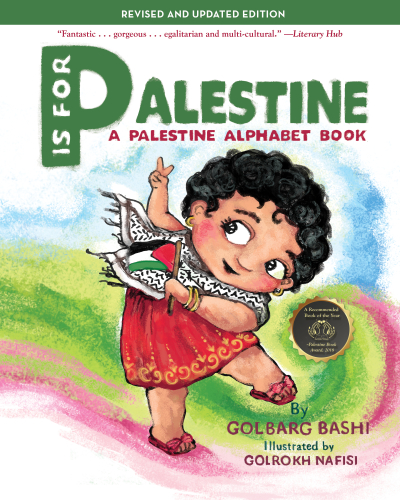
Golbarg Bashi’s propagandistic children’s book triggered extensive media coverage.
Presumably, the good librarians of Highland Park didn’t quite get that the Second Intifada wasn’t a Middle Eastern version of the 1965 Selma to Montgomery march, but rather a succession of suicide bombings targeting Israelis that took the lives of more than 1000 innocents, maiming and injuring many more. Some of the suicide bombers struck buses filled with children on their way to school in the morning. Normalizing terrorist violence isn’t the traditional role of public libraries, but it’s happening today.
Libraries aren’t the only channel for promoting this type of propaganda. The Teach Palestine curriculum, produced in Berkeley, California by the radically anti-Israel Middle East Children’s Alliance, recommends books to schools. Its Executive Director, Zeiad Abbas Shamrouch, has claimed that “Zionists have never abandoned their plan to get rid of Palestinian [sic] completely and to confiscate all Palestinian land.” Teach Palestine’s “Resources” page recommends titles from preschool through high school. The higher the grade level, the more overt and toxic the anti-Israel propaganda becomes.
How did this type of politicized literature gain entry into the world of children’s books? It began with multiculturalism in the 1980s and 90s, as immigrants to North America started to tell stories from their own literary traditions, and as black Americans introduced young readers to African myths and folktales. The inclusion of world literature was not unprecedented – children had always read non-American stories (Heidi, Hans Brinker, and the wonder tales of the Arabian Nights). But with multiculturalism came a wider spectrum of stories – the trickster tales of Anansi the spider, and African, indigenous and Asian versions of Cinderella, all of which broadened the range of the canon.
The Civil Rights movement had already ushered in a wave of literature about slavery, abolition and the Jim Crow era. Paula Fox’s Slave Dancer won the prestigious Newbery Medal in 1974 for its powerful evocation of conditions on a slave ship. The 1977 Newbery winner, Mildred Taylor’s Roll of Thunder, Hear My Cry, told young people what it was like for black Americans in Mississippi under segregation. Politically engaged stories set outside America began to appear as well, like Malala Yousefzai’s I am Malala, by the Pakistani girl shot by the Taliban for promoting education for girls, and Iqbal, the story of the young Pakistani carpet slave murdered by that country’s carpet mafia. With stories from Africa and Asia, a broader vision of social justice had arrived.
Still, there’s never been a sustained propaganda campaign in children’s publishing against any country – not totalitarian China or Russia, not slave-trading Sudan, not anti-Christian Nigeria – with one exception. Since the 1990’s, publishers have released anti-Israel books at an accelerating rate. These books demonize Israel and its people. All the familiar libels – brutal Israeli soldiers, stolen land, apartheid, water theft, killing babies, ethnic cleansing, and, more recently, genocide – make their appearance. And as the writers of these books demonize, they also erase.
They erase Israel from maps, and the Jewish presence in that land from history. It is the aim of these authors to shape the minds of vulnerable young readers, tainting or erasing the word “Israel.” Once they have replaced “Israel” with “Palestine” and “Jews” with “Palestinians” in children’s consciousness, they will have helped incite the next generation to reverse America’s support for Israel’s existence.
Picture Books
Picture books are read aloud to children ages 4 to 6, so they actually have two audiences. While text and pictures may be superficially apolitical, these books often have an author’s note to give the adult reader background on their theme. In the case of anti-Israel books, it’s the author’s note that overtly proffers misinformation about Israel, its people, and its history. Thus, adult readers too imbibe distorted portrayals that fuel enmity towards the Jewish state.
Aya Ghanameh’s These Olive Trees is a prettily-illustrated account of the displacement of a Palestinian family from Balata refugee camp following the 1947-1949 War of Independence. The text draws the young reader’s sympathy to little Oraib, who plants an olive pit in the hope that “one day, when we’re older, I’ll return to you to harvest.” The child who hears this story will see little Oraib as victim of a cruel injustice; after all, she’s been driven out of her home.
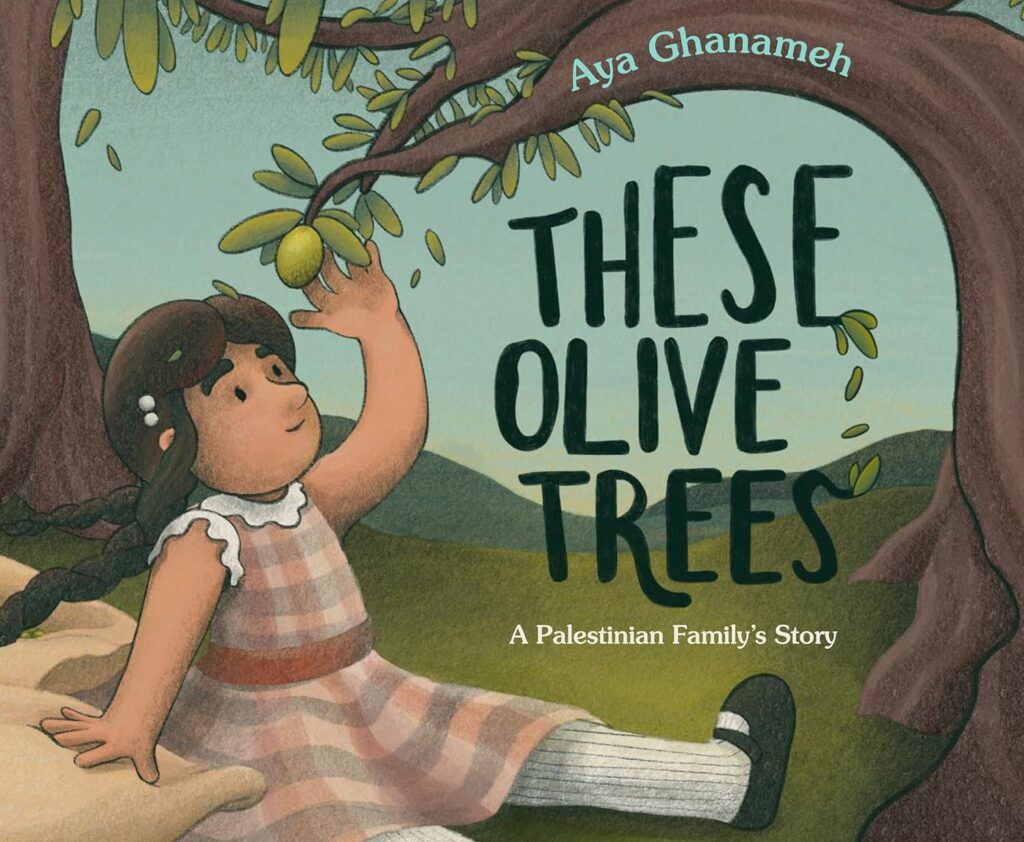
Author Aya Ghanameh promotes false history, concealing the role of Palestinian Arabs in their own plight.
The author’s note is more direct. It treats the word “Israel” as taboo – it’s “the occupying state,” not a real country. And it “informs” the adult reader that Haifa’s Arab population suffered from a “campaign to empty every Palestinian city of Palestinians.” The truth is the reverse. It was Haifa’s Arab leadership that urged the community to flee in 1948, while the Jewish mayor, Shabtai Levy, and the Histradrut labor federation implored Haifa’s Arabs to stay put. But how many parents will be armed with these facts? Clearly, Ghanameh’s editor at Viking wasn’t.
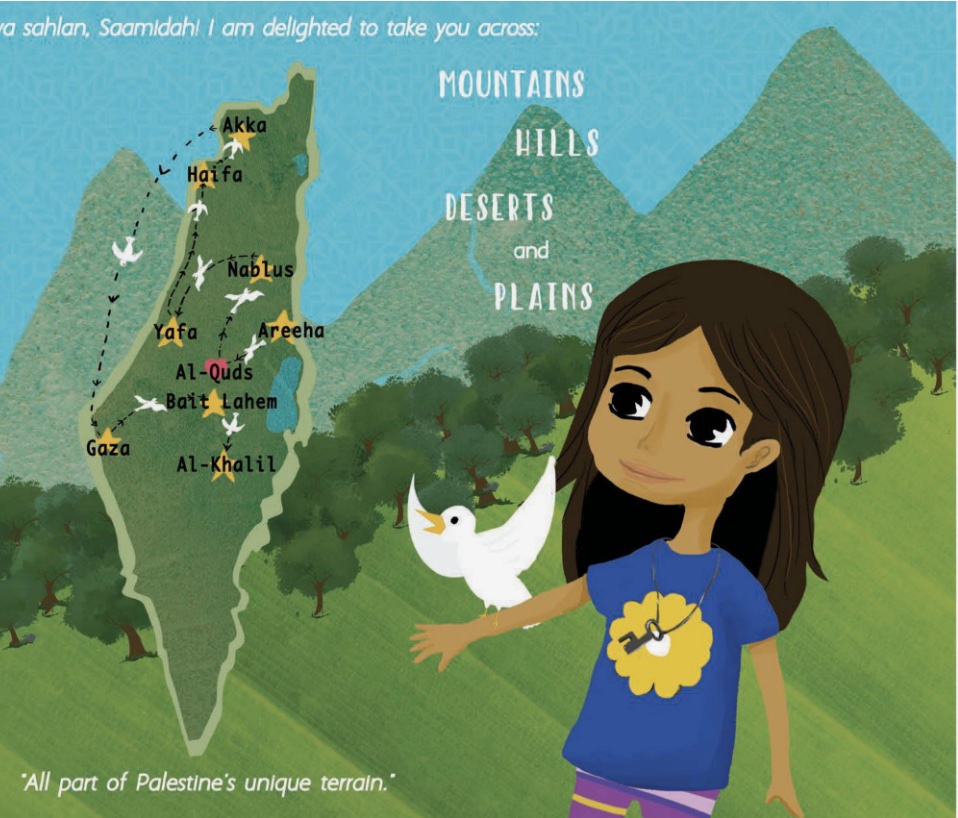
If These Olive Trees erases Israel’s name, Baba, What Does My Name Mean? erases the place altogether. This heavily didactic book takes young Saamidah on a whirlwind tour of a “country” called Palestine. Her tour guide is a white dove named Salam, identified by the narrator as a “bird of peace,” though there is nothing peaceable in this book’s message: It promotes the extinction of an entire country.
The land shown on the map is coextensive with Israel, but the young reader will find “Palestine,” not Israel; “Al-Quds,” not Jerusalem; “Al-Khalil,” not Hebron.
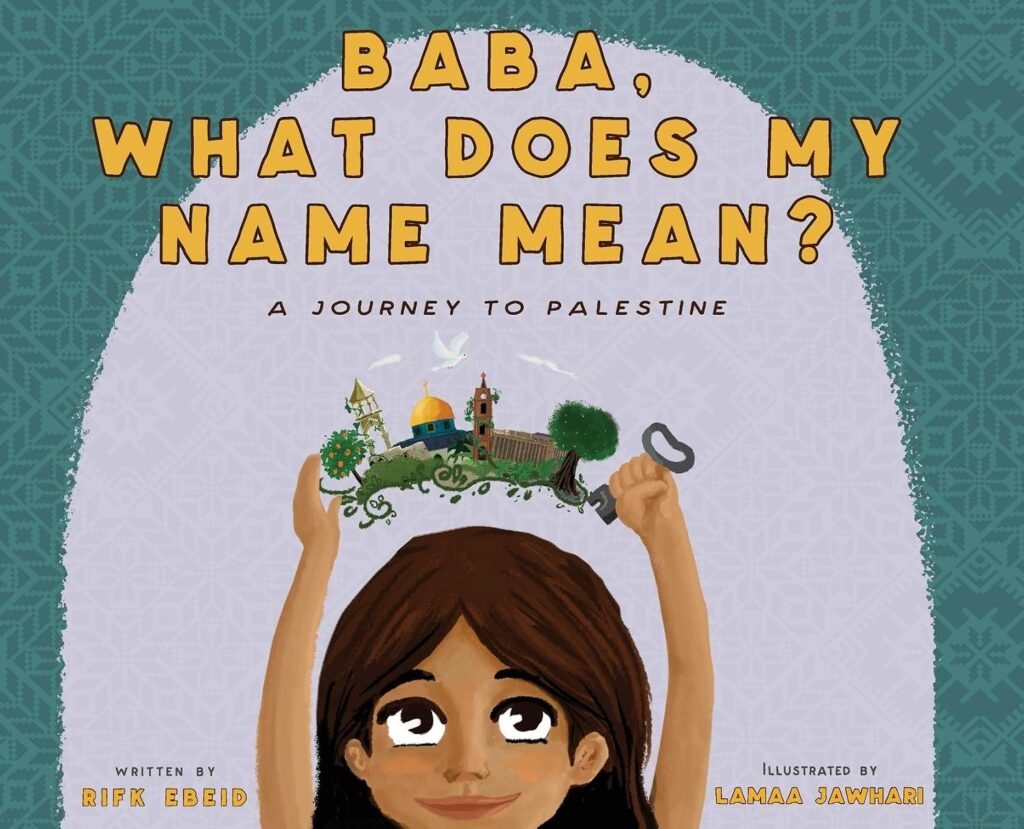
The goal of this book is to teach little children a lie – that there is a country called Palestine, but no country called Israel.
Novels
Because novels engage the reader’s emotions through identification with sympathetic characters, they are uniquely poised to influence susceptible young readers. One of the earliest anti-Israel novels targeting a young adult audience was Habibi, by American-Palestinian poet Naomi Shihab Nye, named Young People’s Poet Laureate for 2019-2021 by the Poetry Foundation.
Set in the post-Oslo period, Habibi recounts the return of a Palestinian-American family to their former home on the West Bank. She shows soldiers demeaning Uncle Daoud at a checkpoint, without explaining the security reasons behind checkpoints – prevention of violent, sometimes fatal, attacks on Israeli men, women and children.
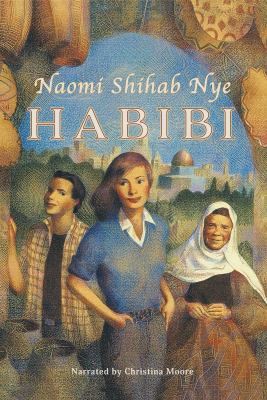
Nye demonizes IDF soldiers for the damage they cause searching Palestinian homes, but fails to explain why the army orders these searches in the first place.
Perhaps to fend off accusations of antisemitism, Nye makes sure there is one good Israeli — a boy named Omer who passes muster, in a predictable formula, by criticizing his own country. At the same time, Nye’s uninformed critique of the Jewish concept of chosenness (she sees it as supremacist, “like teacher’s pet”) plays into a time-worn antisemitic trope.
Habibi strikes many of the chords that will resurface in anti-Israel children’s fiction and non-fiction over the decades. And as the wave of anti-Israel book releases crested in the 2020s, especially in the wake of the October 7th massacre, accusations became increasingly libelous.
Constructing Victimhood
To convey an image of perpetual Palestinian victimhood, authors often mythologize the Palestinian past via gentle, pastoral motifs – farming, olive trees, and traditional foods.
Author Nora Lester Murad is a radical anti-Israel activist who videoed herself shortly after the October 7th massacre ripping down posters of Israeli hostages in Gaza. In Ida in the Middle, her novel for middle grade readers, she offers a more pacific image of Palestinian culture, with a Palestinian-American father chastising his squeamish daughters: “Don’t you know that Palestinian women are farmers? How can you be Palestinian and be scared of some tiny bugs?”
Anne Laurel Carter’s The Shepherd’s Granddaughter is set in Al-Khalil, the Arabic name for Hebron (though neither its Hebrew name nor its Jewish history is acknowledged in the book). Its heroine, Amina, wants to grow up and be a shepherdess, just like her grandfather.
In the self-published Olive Harvest in Palestine, Manal’s father, who owns an olive grove and press, explains: “An olive tree is tough and resilient; its thick roots are entwined deep into the land, just like the Palestinian people.”
But realities about the Palestinian way of life belie this frequently promoted pastoral myth. There’s been a pronounced shift towards urbanization of the West Bank Arab population — from 70 percent rural in 1967 to 75 percent urban in 2018. It seems that, pace pro-Palestinian scholar Edward Said, Palestinian authors themselves stoop to “Orientalism” — the alleged stereotyping of Arabs — when it works to their advantage.
More than parents, it’s grandparents who transmit the Palestinian narrative to the child characters in these books, pulling the story farther back in time to reinforce Arab claims to a land they lived in from “time immemorial.” In Malak Mattar’s picture book Sitti’s Bird, a young Malak ingenuously (or disingenously, given the author’s agenda) asks her grandmother about her caged bird: “’Sitti, are we in a cage too?’ Sitti smiles sadly and says: ‘Habibi, you can fly in your dreams.’”
Alice Rothchild’s Old Enough to Know blackens the image of Israeli soldiers with the grandmother’s account of her family’s expulsion during the War of Independence. She writes:
“I know what that feels like, getting hit in the face.”
“You do?”
“It happened when we left the village, on the long walk east. It was a soldier. We weren’t moving fast enough. I was hungry, really wanted to pick some apricots. I was only ten.”
Zaynab peaked [sic] into the kitchen. “He hit you?”
“He hit me with the end of his rifle.”
The author counts on the reader’s lack of knowledge about the history of Israel’s War of Independence. Reading this account, an open-minded and informed adult might ask, “What was the context for this? Did the incident actually occur? In the Galilee? In Jaffa? When did it happen? Was Israel threatened? Why was the IDF clearing the area of civilians?” A young reader wouldn’t know to ask any of these questions, but would undoubtedly conclude from the account that Israeli soldiers are brutes.
Erasure
It’s not just picture books that replace a real state, Israel, in children’s minds with a mythical one, “Palestine.” Wafa’ Tarnowska’s Amazing Women of the Middle East: 25 Stories from Ancient Times to Present Day was embroiled in controversy in 2021. The arrowhead-shaped country wedged between Jordan and Egypt appeared on an attractive two-page map in the book labeled “Palestine,” not Israel – not even “Israel/Palestine” or “Palestine/Israel.”
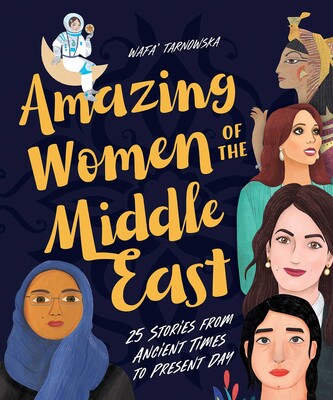
Wafa Tarnowska’s survey of “amazing” Middle Eastern women erased the many remarkable Jewish women from ancient and modern times who lived in Israel and surrounding nations – and also included a map erasing the Jewish state entirely.
Noticing this error, parents, teachers, reviewers, and librarians approached libraries and bookstores to take another look at the inaccurate book. It wasn’t just the map: Among the twenty-five “amazing women of the Middle East,” none was Jewish or Israeli — unless you included the Queen of Sheba.
If Tarnowska had been willing to acknowledge the presence of Jews in the Middle East from the Babylonian exile to today, she could have included various Jewish women, like the beautiful Egyptian Jewish film star of the 1940s Liliane Levy Cohen (known as “Camelia”) or the beloved Baghdadi chanteuse Salima Mourad. It’s probably too much to ask for an anti-Israel publisher to feature Golda Meir, but Tarnowska might have recognized the humanitarian work of Henrietta Szold, founder of Hadassah, whose revolutionary reforms in medical care in Palestine in the 1920’s and 30’s revolutionized health care for both Arab and Jewish children.
Falsifying History
Amazing Women of the Middle East was published by Crocodile Books, an imprint of the Palestinian-American owned Interlink Publishing. Misrepresentation is nothing new to this family business. The morning after the October 7 massacre of Israelis, its current co-director, Hannah Moushabeck, posted the following on Instagram:
“I really want you to think about who has the power in this situation. Is it the people who have one of the most powerful and sophisticated militaries in the world, or is it the people who have been stuck in the world’s largest open-air prison for 75 years. When you reframe what’s happening, you understand why people would retaliate, why people would resist.”
Truth in a children’s book can hardly be expected from someone for whom unoccupied Gaza is falsely labeled an “open-air prison,” and for whom an orgy of murder and rape is mere retaliation.
Like Amazing Women of the Middle East, Crocodile’s We Are Palestinian erases the historical Jewish presence in the Middle East.
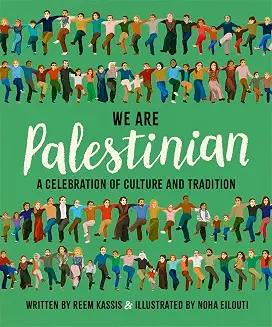
Author Reem Kassis lists peoples who have inhabited the region across millennia – omitting the Jewish nation states that existed in the land for hundreds of years.
In a sidebar to the chapter titled “Ancient History,” author Reem Kassis writes:
Over the last few thousand years, many groups and people have ruled over the land we know as Palestine. Assyrians, Babylonians, Persians, Greeks, Romans, Arabs, Fatimids, Seljuk Turks, Crusaders, Egyptians and Mamelukes all, at one point or another, laid claim to this significant location.
Tellingly, despite vast archeological and contemporaneous textual evidence attesting to the Jews’ centuries-long presence and sovereignty in the land of Israel over the First and Second Temple periods, their rule, presence and impact are entirely unmentioned.
Like The Shepherd’s Granddaughter, Interlink’s Young Palestinians Speak erases Hebron’s Jewish history. Though it notes in passing that Hebron is “a holy city for both Jews and Muslims because of its association with Abraham,” it fails to inform the reader that the “Ibrahimi Mosque” sits on the site of the Cave of Machpelah, the traditional burial site of the Jewish Patriarchs (including Abraham).
The book faults Israelis for being there now, ignoring the long Jewish presence in Hebron that continued until the notorious 1929 pogrom instigated by the antisemitic Palestinian leader, Haj Amin al-Husseini, which saw women raped, children decapitated, 37 people killed and 60 wounded. Is it any wonder that Israeli Jews wanted to correct this historic injustice by returning to Hebron after their victory in the Six-Day War in 1967?
Many pro-Palestinian children’s books present Israel as the aggressor in the conflict, whitewashing entirely the decades of Arab aggression and violence that trigger defensive Israeli responses. In Tasting the Sky, Ibtisam Barakat recalls her family’s flight from their West Bank village during the 1967 war – a harrowing event for a young child. Her family was terrified when the war broke out and a neighbor ran to their house shouting, “After their [the Israelis’] planes attack, they will be combing the area house by house. The word is that they will butcher every living thing that they find.”
In reality, this was a defensive war on Israel’s part against four enemy nations whose leaders openly declared their genocidal intentions against the Jews:
“Our basic objective will be to destroy Israel,” declared Gamal Abdel Nasser, May 26, 1967
“In the event of a conflagration, no Jews whatsoever will survive,” bragged Ahmed Shukeiri, future chairman of the PLO.
“Butcher[ing] every living thing” was not the Israelis’ objective, although genocide appears to have been the explicitly stated goal of Israel’s enemies. Indeed, if Israel’s goal had really been to dispossess the Palestinians, why was Barakat’s family permitted to return to their home in Ramallah after an absence of only four months and thirteen days?
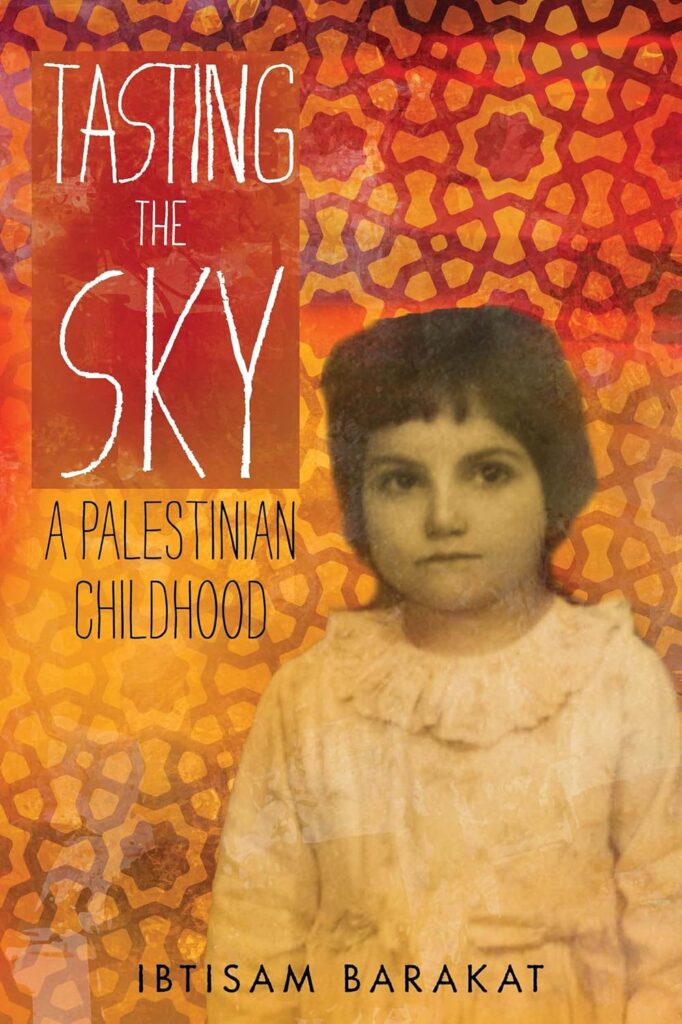
In Tasting the Sky, Ibtisam Barakat inverts the reality, omitting the stated genocidal intent of Palestinian Arabs and Arab armies to annihilate the Jews in 1948.
Erasing Terrorism
If Jewish presence in the land of Israel is erased in many anti-Israel books, so is Arab terrorism. Ahlam Bsharat’s young adult novel Code Name: Butterfly, published in Arabic in 2009 and released in English in 2016, made the International Board for Books for Young People Honor List in 2012. Yet this book takes a peculiar twist on the term “martyr,” defined in the book’s glossary as “someone who dies or is killed while supporting the Palestinian cause.”
Curiously, the word “terrorist” is missing from Bsharat’s glossary, so we don’t learn why any of the victims of Israeli gunfire she cites sympathetically might have been targeted. Dalal Mughrabi, for example, is a “martyred Palestinian freedom fighter.” Young readers won’t learn that Mughrabi was a terrorist who led the 1978 Coastal Road Massacre, a bus hijacking in which 35 Israeli civilians, including thirteen children, were murdered and 71 injured.
If young adults read Ahed Tamimi’s autobiographical They Called me a Lioness (co-authored with Dena Takruri), there’s a lot they won’t learn here as well – about the author, the golden-haired poster child of “resistance.” (Tamimi gained notoriety for slapping an IDF soldier in her West Bank village at age sixteen, in 2017).
Tamimi whitewashes her virulent words and conduct to claim, absurdly, she is emulating peacemakers like Martin Luther King and Ghandi.
She presents herself and her family as non-violent campaigners for Palestinian human rights, in the tradition of Gandhi and Martin Luther King — a dubious claim, in light of Tamimi’s many statements, including her response to the October 7th massacre.
She said: “We are waiting for you in all the West Bank cities from Hebron to Jenin – we will slaughter you and you will say that what Hitler did to you was a joke. We will drink your blood and eat your skull.“
Nor would an advocate of non-violence have appeared, as Tamimi did back in 2015, at a conference attended by leading representatives of Hezbollah, Islamic Jihad and Hamas.
Libels
Israel is regularly libeled in children’s books, accused of land theft, apartheid, ethnic cleansing, genocide, and even archeological malpractice. Without a rounded understanding of the conflicting versions of Middle Eastern history, without some grasp of what armies have to do to contain terrorism, without any familiarity with how Israel’s Supreme Court navigates the tricky tension between human rights and Israel’s security, and without a granular picture of how Jews, Arabs, Christians, Circassians, Druze and others live out their daily lives, often collaboratively and peacefully, in Israel and the territories, children’s book reviewers (whose evaluations guide acquisitions librarians in selecting books), simply don’t recognize these libels as such.
Instead, they judge books on how well a story will grip readers and on what they call the “relatability” of characters. Farther up the food chain, publishers’ acquisitions editors with little knowledge of the Middle East are also influenced more by storytelling factors than by historical accuracy.
There’s also a demand from schools for books that aim at a balanced treatment of the conflict, so numerous books are selected for their themes of friendships between Jewish and Arab characters, with titles like Yaffa and Fatima: Shalom, Salaam and A Moon for Moe and Mo.
This trend is likely what moved the editors at Harper Collins to accept Wishing Upon the Same Stars for publication. In this middle grade novel, Palestinian-American Yasmeen Khouri’s family moves from Detroit, with its large Arab community, to San Antonio, Texas. She befriends Ayelet Cohen, a Jewish girl, who shares her sense of being different. The two outsiders bond readily.
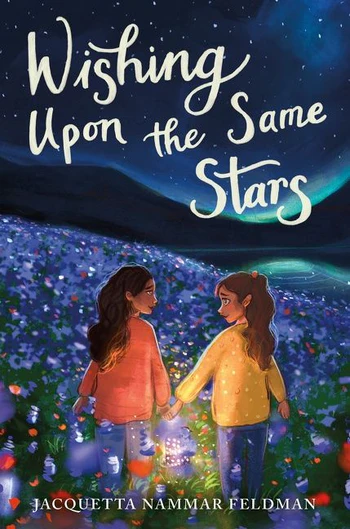
The impulse to erase facts that underscore Palestinian aggression and responsibility in order to present an image of shared humanity misrepresents the reality.
By the end of the book, they “discover” that Jews and Palestinians share communal traumas – the Nakba and the Shoah. It should be obvious that the two events are not historically or morally equivalent. The obtuse, false comparison fuels misunderstanding. The “Nakba” refers to mass displacement; the Shoah refers to mass murder.
Jody Sokolower’s Determined to Stay: Palestinian Youth Fight for Their Village is a catalogue of anti-Israel libels for young adult readers. The book is an account of the visits Sokolower and her daughter Ericka made to the Silwan (Siloam) quarter of East Jerusalem between 2009 and 2013. Sokolower works with Teach Palestine, a project of the Middle East Children’s Alliance mentioned earlier.
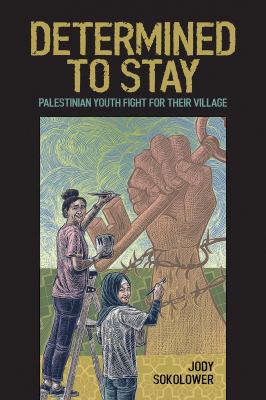
Author Jody Sokolower promotes “intersectionality,” a propaganda device that falsely likens Palestinian grievances against Israel to Black Americans concerns about racism.
Sokolower solicits the sympathies of teenage readers by drawing a parallel between black American youths harassed by police and Palestinian youths on the West Bank. She quotes Areen, a 16-year-old girl from Silwan: “The police stop us all the time.” An African American boy echoes the sentiment: “I feel like I have a bullseye on my back. Every man in my family has spent time in prison. Some days I think no matter how hard I work in school, how careful I am in the street, I’m going to end up there, too.”
“That’s how children in Silwan feel, too,” agrees Sokolower, using progressive “intersectionality” theory to link American racial issues to “oppression” of Palestinians.
Neither mother nor daughter appear to understand how education works in Israel and the West Bank. Ericka criticizes Israel for having “segregated” schools, charging, “The schools are separate; Palestinians don’t have the same legal rights as Israelis; everything is segregated.”
Ericka blurs the distinction between the West Bank and Israel. The Palestinian Authority and UNRWA have long run their own schools in the West Bank, even developing their own textbooks, notorious for demonizing Israel.
Meanwhile, the use of the term “segregated” to describe Israel’s separate streams is a transparent ploy to smear Israel with a racially-loaded American term. Israel isn’t America, and Ericka overlooks a critical difference between the two countries – bilingualism. Israeli Arabs speak Arabic, and Israeli Jews speak Hebrew.
The Public Education Law of 1953 (updated in 2000) requires schools to “recognize the unique language, culture, history, heritage and traditions of the Arab population groups in the State of Israel.” When Israeli parents enroll their children in school, they select the stream they prefer among four options: Arab, secular Jewish, religious Jewish, or Haredi. These streams exist to allow parents to transmit their language, religious observance or non-observance, and culture to their children. Unlike in the segregated American South, where the state imposed segregation on all communities, in Israel it is parents who determine in which language and culture their child will be educated.
This is no different from the practice in bilingual Canada, where parents get to choose between French and English education. No one would dream of calling separate French and English schools in Ontario segregated; they exist to transmit a family’s culture, language, and religion to the next generation.
Interestingly, there is some mixed schooling in Israel as well. The Yad B’Yad (Hand in Hand) network of schools offers bilingual and bicultural education to Arab and Jewish students in six locations: Jerusalem, Galilee, Wadi Ara, Haifa, Jaffa and Kfar Saba. IASA, the Israel Academy for Arts and Science, is a residential school for gifted students of all nationalities. Leyada is an elite high school affiliated with Hebrew University attended by Arab and Jewish students. In Ramle, the Yigal Alon Multidisciplinary High School is one of the Amal schools, a network within mixed communities across the country. All of these schools receive public funding as well as private philanthropy.
Genocide and Apartheid
If drawing a parallel between the “Nakba” and the Shoah is morally obtuse, accusing Israel of genocide is obscene. Sim Kern’s Genocide Bad, commissioned by Hannah Moushabeck for Interlink from a Jewish author who disparages the Jewish people’s attachment to their land, is designed to appeal to a young, ill-informed readership. Grabbing young readers from the get-go with its cool title, the book proceeds to label Israel a “settler colonial apartheid ethnostate,” then moves on to the genocide smear.
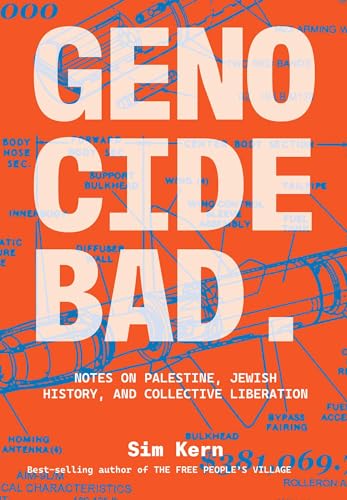
Jewish author Sim Kern joins the chorus of anti-Israel voices hurling the genocide lie – without data or evidence.
Kern fails to establish the libelous genocide claim against Israel, providing no evidence, for example, for the crucial dimension of intent to eliminate the Palestinian, or Gazan, people – the sine qua non of Article II of the United Nations Genocide Convention. Kern operates via slurs, not evidence, so statistics are never presented.
In fact, the civilian-to-combatant death ratio in Gaza was 1.4:1, as demonstrated by analyst Salo Aizenberg. This is lower than that achieved by the US and its allies in Iraq and Afghanistan – who were never accused of genocide. There’s also the glaringly obvious evidence that Israel has never, since capturing the West Bank in 1967 and suffering unremitting attacks since then, attempted to exterminate the 2.5 million Arabs living there, the same people as the Gazans.
But there’s a reason Israel’s enemies fling around the “G” word (the most serious crime a nation can be accused of) so freely, and that is to cancel out Jewish victimhood generally and especially as compared to their experience under the Nazis ( a documented genocide) by equating the state of Israel to Nazi Germany. Unfortunately, the word may stick with gullible young readers, tarnishing Israel’s image in their eyes on the basis of nothing more than racial slurs. That seems likely what Interlink Publishing intended when it commissioned this book.
Poisonous Mushrooms
There is nothing new about using children’s books to shape children’s minds. When Lewis Carroll had Alice recite “How doth the little crocodile“ in Alice’s Adventures in Wonderland, he was parodying Isaac Watts’s moralistic poem “Against Idleness and Mischief,” the type of preachy verse a Victorian child would have been raised on. Victorian and Edwardian children’s authors preached cleanliness, hard work, and obedience in their stories and poems.
The Nazis knew the value of children’s books as well. Ernst Hiemer’s Der Giftpilz (The Poisonous Mushroom), published by Nazi propagandist Julius Streicher in 1938, caricatured Jews as ugly, lecherous capitalists luring innocent Aryan children with the words “Here my little one, you get something very sweet, but as a reward you both must come with me.”
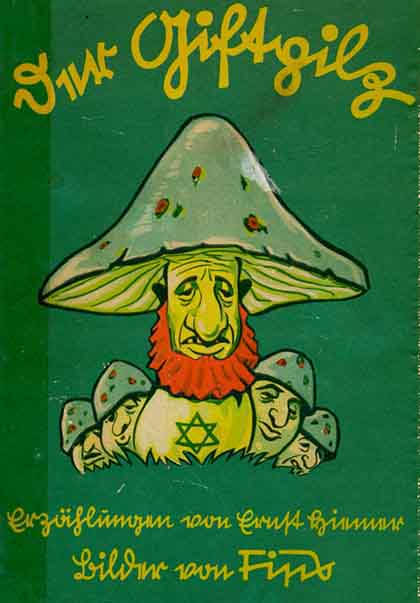
Indoctrinating children with negative and frightening beliefs about Jews has a dark history.
The text warned its young readers, “Just as it is difficult to distinguish between a poisonous mushroom and an edible mushroom, it is difficult to distinguish between a good Jew and a lying, thieving Jew.”
Unlike this Nazi tract, today’s anti-Israel children’s books don’t explicitly name Jews; they simply erase their historical presence in the Jewish homeland – and slander their modern nation as well. Elimination of the Jews from the world was the Nazis’ goal, and they prepared their children to accept that genocide as a moral necessity.
By the evidence of today’s many anti-Israel children’s books there is a similar effort today: To teach a generation of young people to accept Jewish extinction.
Good Kids’ Books about Israel
Many Jewish parents and educators are concerned about the burgeoning number of anti-Israel and factually false children’s books making their way into classrooms and libraries. They may be hesitant to push for banning such books, given the negative connotations of that practice, but they’re insisting that books disseminating misinformation – erasing Israel from maps of the Middle East, or presenting Israel as the aggressor in the Six-Day War – simply don’t pass muster. To counter this trend, many Jewish parents are looking for titles that present a picture of the real Israel. They want books that showcase more than just Israel’s importance as a safe haven for persecuted Jews. They want books that are true to life in portraying the Jewish state and that convey accurate history.
They also want to share its geographical splendor and its historical and multicultural richness with their children. Newly published books of this kind can be hard to find, especially since October 7th. Increasingly, Jewish authors have faced subtle forms of discrimination: review bombs (orchestrated campaigns of negative reviews), exclusion from book panels, and canceled readings. Book agents are increasingly reluctant to promote books that portray Israel positively because publishers aren’t interested.
Fortunately, in the world of children’s publishing, Jewish publishers like Kar-Ben and Apples & Honey have stepped up to the plate. Here’s a selection of recent children’s and young adult titles that parents can recommend to teachers and librarians:
For a Picture of Israel’s Ethnic Diversity:
The Henna Helper, by Tami Lehman-Wilzig, illus. Yinon Ptahia (Apples & Honey): Gali learns from her savta (her grandmother) about the Yemenite henna party that takes place a week before her sister’s wedding.
Roadside Seder, by Anna Levine, illus. Naama Lahav (Apples & Honey): When a fallen tree branch blocks an Israeli highway just before the Passover seder, a diverse group of stranded Israeli travellers celebrates the Passover seder together, sharing the traditional Passover customs of their families.
To Learn about Israel as a Refugee Haven:
On the Wings of Eagles, by Tami Lehman-Wilzig, illus. Alisha Monnin (Apples & Honey): The story of how Alaska Airlines pilots rescued Yemenite Jews, flying them to the newly-founded Israeli state between 1949 and 1950.
Shoham’s Bangle, by Sarah Sassoon, illus. Noa Kelner (Kar-Ben): The story of how one grandmother’s ingenuity rescued the family’s heirloom bangles from confiscation by Iraqi officials as the family fled to safety in Israel in 1951 with Operation Ezra and Nehemia. Yuvi’s Candy Tree, by Lesley Simpson, illus. Janice Lee Porter (Kar-Ben): Based on a story told to the author, this is an account of one Ethiopian family’s harrowing trek and flight to Israel during Operation Moses in 1984, as Israel rescued persecuted Ethiopian Jews and flew them home.
To Learn about Israel’s Wars:
Heroes of October 7th : Heroic Stories for Children, by Hadassa Ben Ari, illus. Tehila Bar-Hama (Yedioth Ahronoth/Chemed): A collection of true stories, told with care for young readers’ sensitivity to traumatic events, of Israelis who performed heroic acts during the October 7th pogrom.
The Six-Day Hero and Beni’s War (Kar-Ben), by Tammar Stein: Two nuanced, gripping stories of heroism in the Six-Day War and the Yom Kippur War.
For a Picture of Israeli History and Geography:
A Feather, a Pebble, a Shell, by Miri Leshem-Pelly (Kar-Ben): A young Israeli girl explores the varied landscape of Israel from seacoast to desert, examining shells, feathers and pebbles as she goes.
The Miracle Seed, by Martin Lemelman (Eerdmans): A graphic novel tracking the true story of a Judean date seed uncovered from ancient times and resurrected in the present.
The Treasure of Tel Maresha, by Tammar Stein (Apples & Honey): A fascinating time travel novel that uses an archeological dig as a vehicle for today’s Becca to travel back to the Maccabean period in Jewish history, meet her namesake Rebeka, and learn about the tensions between Greeks and Jews over 2000 years ago.
Zvuvi’s Israel, by Tami Lehman-Wilzig, illus. Ksenia Topaz (Kar-Ben): Zvuvi the fly journeys through the entirety of Eretz Yisrael, lighting upon a wide range of famous and lesser-known sites.
About the Author:
Marjorie Gann is a children’s author and book reviewer. Her book Five Thousand Years of Slavery (Tundra, 2011), co-authored with Janet Willen, was named a 2012 Notable Book for a Global Society by the International Reading Association. She was principal reviewer of anti-Israel children’s books for the Camera Education Institute. A retired teacher, she contributed an essay on teaching the history of world slavery to The 1867 Project: Why Canada Should be Cherished, Not Cancelled, published by Canada’s Aristotle Foundation, where she is a Senior Fellow. Her essay “Empty Shelves: The Noxious Politics Behind a Canadian School Board’s Massive Book Purge” was published by C2C Journal in December, 2023.