
For several months now, the situation on the Gaza front has presented a deceptive picture. On the surface, it appears largely static, with few major developments. Yet beneath the surface—and above it as well—a great deal is happening.
What follows is a concise assessment of the situation in Gaza, from both the Israeli and Hamas perspectives.
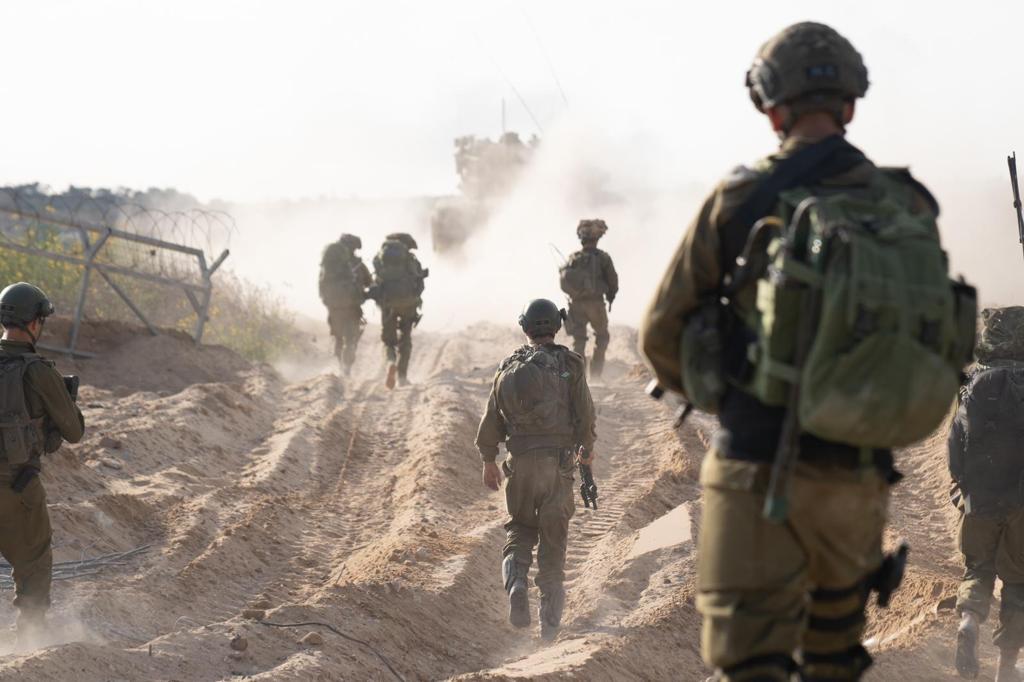
According to current estimates, the Israel Defense Forces (IDF) control approximately two-thirds of the Gaza Strip, with instructions to expand their hold to roughly 70% of the territory.
This means that the entire eastern half of the Strip, bordering Israel, along with extensive areas in the north and south, is under Israeli military control. Palestinians are prohibited from entering these areas. Buildings identified as terrorist infrastructure have been demolished, and the IDF is constructing access roads and permanent military positions.
Israel’s commitment to protecting its civilian population in the western Negev requires maintaining a situation in which Gaza’s Palestinian population is concentrated in the western part of the Strip, bounded to the north, south, and east by Israeli-controlled territory.
From time to time, the IDF carries out targeted operations to destroy terrorist infrastructure beyond the line of contact, also known as the “Yellow Line,” named after the large yellow concrete blocks marking its location. The most recent such operation took place last week.
One of the IDF’s major operational achievements is that Israel has now gone more than a year without losing a soldier to Hamas fire in Gaza. The last casualty, IDF reservist Ephraim Feldbaum, was killed on October 28, 2025, near Rafah, when Hamas terrorists emerged from a tunnel despite the ceasefire and fired an RPG at an Israeli military vehicle.
While the IDF maintains an uncompromising approach toward Hamas, it exercises extraordinary caution in dealing with the civilian population. One indication is the relatively low proportion of women and children killed by Israeli fire in Gaza over the past year. According to international reports, approximately 100 of the more than 1,000 Palestinians killed were women or children. In other words, for every woman or child killed by Israeli fire, more than nine Palestinian men of fighting age were killed.
Who are these Palestinian men?
Throughout almost the entire past year, the IDF has reportedly targeted killings of Hamas operatives on a nearly daily basis, frequently involving more than one incident per day. These operatives are closely monitored and eliminated in precision airstrikes while riding motorcycles, traveling in cars, or hiding in tents and buildings.
They fall into two broad categories.
The first consists of Hamas operatives involved in planning terrorist attacks as part of the organization’s efforts to rebuild its operational capabilities. Most are relatively low-ranking field operatives, but some are senior commanders.
Among them was Izz al-Din al-Haddad, who succeeded Mohammed Sinwar as Hamas’s military commander and was killed in May, and his successor, Mohammed Odeh, who was killed approximately a week later.
In early September, Israeli special forces penetrated deep into Hamas-controlled territory and captured Muin al-Arabid, the head of Hamas’s internal security apparatus, transferring him to Israel for interrogation.
In the days following his capture, intelligence reportedly obtained from his interrogation led to the identification and elimination of several senior Hamas figures, including Raed Saad, head of Hamas’s weapons production headquarters, Nael Abu Obeid, commander of the Rafah Brigade and head of operations, and other senior commanders.
The second category belongs to one of the largest operations in the history of Israel’s security establishment—and one of the most extensive targeted-killing campaigns in modern military history.
It is known as Operation NILI, an acronym for the Hebrew phrase Netzach Yisrael Lo Yeshaker—”The Eternal One of Israel Does Not Lie.” The phrase expresses the deeply rooted Jewish belief in Israel’s enduring existence and the Jewish people’s ability to overcome attempts to destroy them.
Operation NILI is a joint undertaking by the Shin Bet and the IDF, authorized by the Israeli government, with the objective of eliminating every terrorist who infiltrated Israel on October 7, 2023.
Using advanced facial-recognition technology to analyze tens of thousands of photographs and video recordings of terrorists filmed inside Israel that day, Israeli intelligence identified approximately 6,000 infiltrators.
Some 1,600 were killed inside Israel during the invasion, leaving approximately 4,400 others as targets of a continuing manhunt.
According to the latest figures released nearly two months ago, approximately 4,000 of the 6,000 terrorists who invaded Israel on October 7 have already been killed, while the pursuit of the remaining 2,000 continues.
Given the reported targeted killings over the past two months, it is reasonable to assume that several dozen more have since been removed from that list. The IDF and Shin Bet continue to identify, track down, and eliminate additional perpetrators.
Another major, prolonged episode has also reached its conclusion in recent months: the deaths of the Hamas terrorists trapped in the tunnels beneath Rafah.
When the ceasefire took effect on October 10, 2025, Israeli forces took up positions along the Yellow Line, leaving an estimated 150–200 Hamas terrorists, according to Israeli intelligence assessments, trapped in an extensive tunnel network beneath eastern Rafah, an area under Israeli control.
They had no way to return to Hamas-controlled territory without risking capture or death.
Hamas demanded their release, but Israel refused and tightened the siege. Gradually, food and water supplies in the tunnels ran out.
Notes and diaries left behind by the terrorists and subsequently recovered by Israeli troops described the severe hunger and thirst they experienced.
“How terrible the thirst is,” one note read. “We have only seven dates left.”
By the end of December 2025, an estimated 30 terrorists remained alive. The others had reportedly succumbed to starvation and dehydration, or were captured or killed while desperately attempting to emerge from the tunnels, fight Israeli forces, or flee toward Hamas-controlled territory.
During the first months of 2026, the IDF continued to report eliminating small groups of terrorists attempting to escape from the besieged tunnels. In recent months, Palestinian families have periodically announced the deaths of relatives who had been among the Hamas operatives trapped underground.
To achieve this extensive level of operational control, the IDF has also relied on local Palestinian militias cooperating with Israel.
These forces are broadly divided into five militias, representing five clans. According to recent reports and research, Israel supplies some of these groups with weapons, equipment, intelligence, and training, and has even deployed armed drones to support them during clashes with Hamas.
The militias have assisted Israeli forces in locating tunnels, arresting Hamas operatives, and killing members of the organization’s security apparatus.
Israel has evidently succeeded in helping establish several armed Palestinian centers of power opposed to Hamas, including beyond the Yellow Line. These groups increase the military and intelligence pressure on the organization, although they have yet to develop into an independent governing alternative.
*****
One of the clearest civilian expressions of the IDF’s ability to contain Hamas in Gaza is the remarkable recovery of the Israeli border communities devastated during the October 7, 2023, invasion.
According to data published by the Tekuma Administration, established to oversee the reconstruction of the western Negev, the region’s population has not merely returned to its prewar level three years after the invasion. It has grown by approximately 10%.
Population growth in the area is now running at 2.5 times the national average, while demand for housing has surged by a factor of 3.5, naturally contributing to a significant rise in local housing prices.
The reconstruction process is not yet complete, particularly in the two kibbutzim that suffered the most devastating attacks, Be’eri and Nir Oz. Nevertheless, there can be little doubt that Israel’s Gaza border region is experiencing a remarkable demographic and physical revival.
Meanwhile, on the other side of the border, Hamas is rebuilding.
In the approximately 30% of Gaza that remains under its control, where the Strip’s civilian population is now concentrated, the organization is gradually restoring its capabilities.
Hamas remains far from posing the kind of threat to Israel it once did. Indeed, the successive eliminations of its senior commanders have gone unanswered by so much as a single bullet or rocket fired into Israel.
Nevertheless, recent figures indicate that Hamas is steadily rebuilding its strength.
The organization currently commands approximately 30,000 armed operatives, most of them young recruits with little meaningful military training, alongside some 50,000 employees in its civilian administration.
It is also attempting to restore substantial sections of its underground tunnel network in the territories it still controls.
Economically, too, Hamas remains operational. According to Israeli media reporting, the organization generates approximately 250 million shekels per month through taxation of businesses and levies associated with goods and humanitarian aid entering the Strip.
The central question concerning Gaza’s future, however, depends heavily on who forms Israel’s next government. If a government is formed that’s dependent on the Arab Joint List, the likelihood is such a government will end Operation NILI and begin a retreat to Israel’s October 6, 2023, lines, potentially forfeiting security gains achieved during the war, and handing a victory to Hamas.
The chairman of the Arab Joint List has explicitly declared that, if the decision were his, he would firmly oppose continued military operations and targeted killings. If a government is formed without the Arab Joint List it is likely a substantially different course would be pursued.