
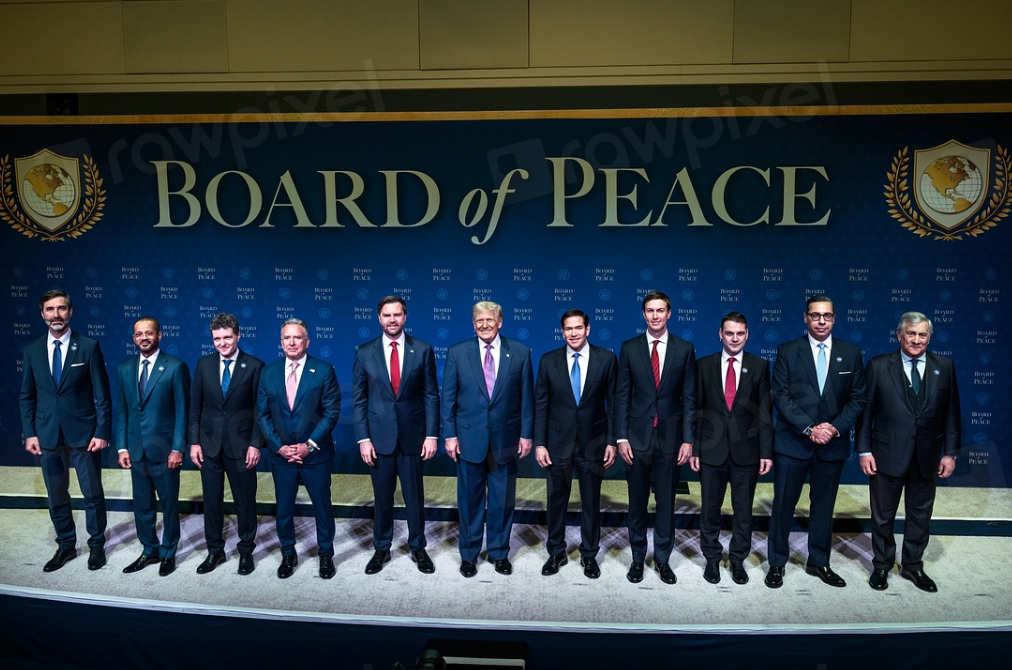

For the better part of a year, the Trump administration has been devising and publicizing multi-point plans designed to complete Israel’s campaign against Hamas in Gaza. The technicalities can be convoluted, but the framework’s gist is that a temporary technocratic, Palestinian-run National Committee for the Administration of Gaza (NCAG) will replace Hamas governance, and a temporary International Stabilization Force (ISF) will deploy to help train a new Palestinian police force, gradually leading to the withdrawal of Israeli troops from the Strip. A so-called “Board of Peace” (BOP) chaired by Trump and other international leaders will oversee NCAG and redevelopment funding, pending the Palestinian Authority’s (PA) successful “reform program.”
The White House revealed this concept in its September 2025 20-point “Comprehensive Plan to End the Gaza Conflict.” Aspects of it were constructive, including clauses mandating Hamas’s exclusion from future Gazan governance, the terror group’s permanent destruction of “all military, terror, and offensive infrastructure, including tunnels and weapon production facilities,” and the release of every hostage Hamas held at the time (albeit in exchange for Palestinian prisoners, including convicted murderers). The plan also permitted an Israeli “security perimeter presence [in Gaza] that will remain until Gaza is properly secure from any resurgent terror threat” – a common-sense measure considering that Hamas could only carry out an act of genocide in Israel in the first place because of egregious lapses in border security.
The policies become less promising, however, in the wake of the latest document – the BOP’s July 2026 “Roadmap for Completing the Implementation of President Trump’s Comprehensive Peace Plan in Gaza.”
While the September 2025 plan permitted an Israeli security perimeter in Gaza, the new document mentions no such thing and touts the goal of “securing the complete Israeli withdrawal from Gaza Strip” in the very first clause.
Additionally, the latest roadmap shifts the “disarmament” goalposts. The September 2025 pledge that Hamas’s military assets will be “destroyed and not rebuilt” has now evolved into a “process to decommission and store heavy weapons, military production sites, depots of weapons, and tunnels” under NCAG’s purview. To note one historical precedent, this stands in contrast to the disarmament process established by the 1998 Good Friday Agreement between Britain and the Republic of Ireland, which led to either destruction of Irish armed groups’ weapons or rendering them permanently unusable.
To make matters worse, the process to store Hamas’s weapons will only commence “after completing the remaining commitments under Sharm Sheikh Protocol, the entry of NCAG and deployment of ISF.” (The new framework also punts the responsibility of regulating “personal weapons” to NCAG and “relevant Palestinian laws,” laying the groundwork for a clear loophole.)
The Sharm Sheikh Protocol was a six-point agreement that Israel and Hamas signed on October 9, 2025 to facilitate the final hostages-for-prisoners exchange and halt intensive combat. The very first sentence proclaimed an “end to the war in the Gaza Strip.”
In other words, the Trump framework would render the decommissioning and storing of Hamas’s war-making capabilities – not destruction, as originally pledged – contingent on an Israeli military stand-down. Adding insult to injury, such a process would “be linked to an Israeli withdrawal, in phases, from the areas under its control in Gaza.” As Israeli journalist Khaled Abu Toameh put it:
Why should a terrorist organization that carried out the October 7, 2023 massacre in Israel be allowed to dictate the conditions of its own disarmament? No country fighting ISIS or al-Qaeda would first withdraw its forces and only then hope terrorists voluntarily surrender their weapons. Hamas should not be negotiating the terms of its defeat. It should be compelled to unconditionally surrender and disarm.
Indeed it should be. But the administration’s approach is making that outcome less likely. To understand why, a fundamental truth needs to be acknowledged: Israeli military force is the most effective check on Hamas’s power that has ever existed.
Contrary to the oft-repeated claim that Israel’s “occupation” empowers Hamas by angering Palestinians and providing the terror group a justification for violence, Hamas and other groups committed to Israel’s destruction gain power in Palestinian areas that Israel evacuates. After Israel unilaterally evacuated Gaza in 2005 and Palestinian cities in the West Bank following the Oslo Accords, terrorist groups committed to Israel’s destruction filled the vacuum. Suicide bombings and other terrorist atrocities orchestrated largely from recently-evacuated Palestinian West Bank cities killed more than 1,000 Israelis between 2000 and 2005. (The campaign of brutal violence is known as the Second Intifada.) Hamas quickly usurped power in Gaza from the PA in 2007 after a brief civil war. In post-2005 Gaza, nearly two decades of Israeli restraint and relatively meager military action allowed Hamas to grow in power, culminating in October 7. By contrast, the IDF’s Operation Defensive Shield in the West Bank during the early 2000s and Operation Swords of Iron in Gaza after October 7 decimated terrorist infrastructure and rendered mass casualty attacks against Israelis less likely.
These dynamics persist because Hamas and its allies are committed to Israel’s destruction, not a mere Israeli withdrawal from certain Palestinian areas. When Israel relinquishes land, eliminationist terrorist organizations exploit the territorial gains to continue their war efforts. In other words, Hamas is unappeasable. The group presents a security problem, not a diplomatic one.
Yet, ever since the post-Cold War era, the United States has attempted to solve the Israeli-Palestinian conflict diplomatically. The “two-state solution” paradigm, which every U.S. president from Clinton to Trump has indulged, calls for Israeli land concessions to a future Palestinian state in the West Bank and Gaza. With Palestinian hopes for self-determination fulfilled, the pretext for violence would disappear, so the thinking goes. Whenever conflict erupts in the meantime, American officials incongruously acknowledge “Israel’s right to defend itself” against terror while also encouraging Israeli restraint and an end to the “cycle of violence.”
The formula repeatedly fails because it ignores the zero-sum nature of the conflict between Israel and Hamas (and other terrorist groups such as Palestine Islamic Jihad). Always compelled to stand down short of a decisive victory, Israel grants Iran-backed terrorist groups time and space to rebuild during lulls in fighting.
The BOP’s latest “roadmap” repeats the same pattern. By kneecapping Israel’s military apparatus – while Hamas holds power over roughly half of Gaza – and obliging Jerusalem to yield to yet another diplomatic effort to “solve” the conflict with the Palestinians, the risk that Hamas will rebuild, guaranteeing future high-intensity warfare, is extremely high.
The bureaucracies outlined in the roadmap are unlikely to interrupt this pattern. Questions abound; for example, how will NCAG confirm that Hamas has handed over all its weapons for storage? Is there a database of weapons in Gaza that they can reference? Furthermore, with the loophole that does not bar “personal” weapons, do efforts to disarm Hamas even matter?
Perhaps most importantly, who will enforce the roadmap’s provisions for decommissioning weapons should Hamas attempt to skirt them (a near certainty)? Certainly not the ISF, which, per the roadmap, “shall not perform any police mission or missions related to the Palestinian society.” Presumably, then, the ISF-trained Palestinian police are expected to forcibly confiscate arms. But what is there to suggest that they would be more effective than, for example, Israeli counter-terror units, which are among the world’s most elite? Would Palestinian police truly be willing to use coercive measures against Hamas, risking injury, death, and the ire of Palestinians who might accuse the force of traitorous “collaboration” with the Zionist enemy? In a similar vein, will Palestinian police work to prevent further assassinations by Hamas against members of clans that have worked with Israel – another near certainty given that the clans are also expected to disarm?
Indeed, there are already reasons for skepticism. According to reports from January 2026, NCAG head Dr. Ali Shaath has said, “We are Palestinian minds, not weapons.” It’s a curious statement considering that the recent roadmap specifies, “All police weapons shall be transferred to the responsibility and authority of NCAG upon its entry into Gaza and the assumption of its missions.”
Furthermore, how will anyone ensure that the new police force does not simply constitute Hamas in new uniforms? The roadmap calls for “comprehensive vetting” of new recruits but outlines no concrete standards. Who makes the final decisions? Will Israel be able to vet and veto individual candidates?
None of this inspires confidence, nor does past performance of similar schemes. After the 2006 war between Israel and Iran-backed Hezbollah in Lebanon, United Nations Security Council Resolution 1701 called for “no weapons or authority in Lebanon other than that of the Lebanese State” and lauded “the unanimous decision by the Government of Lebanon … to deploy a Lebanese armed force of 15,000 troops in South Lebanon as the Israeli army withdraws behind” the state’s southern boundary. The resolution also praised Beirut for its request for “the assistance of additional forces from the United Nations Interim Force in Lebanon (UNIFIL) as needed, to facilitate the entry of the Lebanese armed forces into the region.” Needless to say, the Lebanese military and UNIFIL neglected to stop Hezbollah’s tremendous military growth over the next two decades. It was Israeli military fortitude after October 7 that weakened the terror group substantially, and it is the IDF’s current buffer zone in southern Lebanon that shields northern Israeli communities from an October 7-style attack.
In today’s West Bank, the PA exercises civil and security control over major Palestinian cities, yet regular IDF incursions are nonetheless necessary to interrupt terrorist plots and stem the flow of Iranian weapons to terrorist organizations. The PA is far too impotent to control the problem on its own despite ample western funding since the Oslo Accords and even efforts by high-ranking U.S. Army officers to train PA police (which Palestinian officials ignominiously shuttered in 2010).
Without such Israeli freedom of action in Gaza, the NCAG/ISF framework is a recipe for repeating the failed Lebanon model in the territory, as the “legitimate” government and police stand aside while Hamas replenishes its arms. In fact, that is likely Hamas’s plan. As analyst Yaakov Lappin has written:
The model for Gaza that Hamas appears willing to adopt is directly inspired by Hezbollah’s former status in Lebanon, where the terrorist group maintained absolute military control despite the existence of a nominally sovereign Lebanese government.
…
Hamas would likely seek to replicate Hezbollah’s former setup in Gaza. If successful, this would allow it to rebuild its military capabilities while keeping Israel diplomatically constrained from taking decisive action.
Any attempt by Israel to neutralize Hamas in such a scenario would be met with international outcry over violating the sovereignty of the “recognized governing authority” of Gaza – even if that authority had no real power. Any international peacekeeping force would suffer the same fate as UNIFIL in Lebanon, and be reduced to a toothless observer that is used by terrorists as human shields in exchanges of fire with Israel.
The consequences of such an outcome would be disastrous. Hamas would use the time bought by a ceasefire to rearm with weapons from Iran, smuggle in military technology, and likely begin rebuilding its tunnel and rocket system. Under the cover of an internationally approved governing body, Hamas could enhance its military capabilities with impunity. This is precisely what Hezbollah did in Lebanon, amassing a vast arsenal while using the Lebanese government as a shield against Israeli action.
Breaking this mold requires a paradigmatic shift among U.S. policymakers. The goal should be to help Israel win wars against genocidal Islamist groups (as the United States did against ISIS in President Trump’s first term), not to offer ephemeral support that collapses, under ginned-up domestic political pressure, into toothless conflict management. A scenario in which Hamas feels compelled to unconditionally surrender, disarm, and dismantle itself will nullify the possibility of a future war the group can start via genocidal massacre.
Washington must adopt two new approaches to accomplish this.
First, administrations of both parties must abandon any planned deployment of international forces to Gaza, as well as shed the aversion to indefinite Israeli military occupation of land within the territory and continued use of military force against Hamas elements. There is a straightforward strategic rationale for this policy – as an organization that fuses religious zealotry with blood-and-soil hypernationalism, Hamas values land. As the group’s founding charter declares, “the land of Palestine is an Islamic Waqf consecrated for future Moslem generations until Judgement Day. It, or any part of it, should not be squandered: it, or any part of it, should not be given up.” If Hamas understands that refusal to capitulate will spur ever greater Israeli control of Gaza pending its unconditional surrender and disarmament, the group’s leaders might start to change their calculus. By contrast, confidence that U.S. leaders will, as in the past, encourage an Israeli withdrawal from Gaza short of an Israeli victory eliminates any incentive for Hamas to unconditionally lay down its arms.
Second, Washington should diplomatically isolate Hamas, not legitimize it through endless summitry and “negotiation” on the international stage. Diplomatic processes in which Turkey and Qatar – both of which support Hamas and host its prominent members – advocate on Hamas’s behalf teach the group that spectacular violence garners respect and prestige, not ostracism. Instead of negotiations with Hamas backers that produce convoluted “roadmaps” and plans hamstringing Israel, Washington should work with Israel and other anti-Hamas democracies to draft surrender terms that Hamas must accept or face continued Israeli military pressure. Then, it should make further arms sales to Turkey and Qatar contingent on their exclusion from any diplomacy related to Israel and the Palestinians, as well as extradition of Hamas leaders to either the United States or Israel to stand trial for acts of genocide.
Other cases demonstrate the utility of diplomatically isolating an adversary. For instance, some historians argue that the Soviet Union’s decision to join the war against Imperial Japan during the Second World War deprived Tokyo of a potential neutral mediator with the United States, thereby helping compel Japan’s surrender.
More recently, the diplomatic and financial isolation of the brutal Sri Lankan terrorist group Liberation Tigers of Tamil Eelam (LTTE, known colloquially as the Tamil Tigers) – along with a confluence of several other factors – led to the terror group’s defeat at the hands of the state’s military in 2009, ending a 26-year-long civil war. During prior years, continual international mediation secured pauses in fighting which, as scholar M.D. Nalapat has noted, the LTTE merely exploited to recoup its losses (Hamas’s modus operandi), guaranteeing future combat. However, the tide shifted after 9/11; with international opinion widely hostile to terrorist tactics, opposition to Sri Lankan military efforts was much less salient, and Western governments undertook extensive efforts to hobble the LTTE’s funding streams. Seventeen years following LTTE’s surrender, the terror group has not revived.
Hamas must either disarm and dismantle itself, or it must be dismantled as were the Tamil Tigers and ISIS, to enable successful execution of post-Hamas plans envisioned by Washington, Jerusalem, and like-minded allies – ideally installation of an Adenauer-esque Palestinian politician determined to maintain a monopoly on the use of force and to lead his or her people toward reconciliation with Israel. Should Hamas and other Palestinian elites choose not to take this path toward a better future, Washington should steadfastly support Israel’s efforts to defend its citizens against a terrorist organization of unfathomable genocidal evil.
Jihadist groups the world over believe that free democracies are spineless and will ultimately grow exhausted given enough pressure on the battlefield. It is the responsibility of Israel and the United States to convince Hamas that the equation is, in fact, the opposite.