
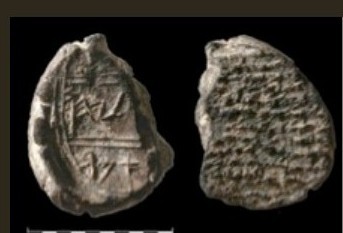

Senior Fellow Hanan Amiur’s The Six-Lie War is a handbook for understanding and refuting key lies weaponized against the Jewish state. It was published in Israel in 2025 where it was a best seller and released in English in 2026. (Pictured above is the Imer Seal, direct evidence of the First Temple, dating from 6th-7th century BCE)
Chapter One: “The Jews Have No Right to the Land”
“They haven’t found a single stone to prove the Temple was there [on the Temple Mount in Jerusalem],” so claimed Palestinian Authority Chairman Yasser Arafat in a 2002 interview with Al-Hayat, as part of his long-standing effort to undermine the Jewish people’s connection to their homeland. Ten years later, on February 26, 2012, at the “Conference for the Defense of Jerusalem” held in Qatar, Arafat’s successor as leader of the movement, Mahmoud Abbas, expanded on this claim: “They say they had a Temple 2,000 years ago—I challenge that claim.” According to Abbas, the Jewish Temples weren’t even located in Jerusalem—they were in Yemen.
At the heart of the Jewish-Arab conflict lies a basic question: Who is the owner around here? To whom does the Land of Israel belong? To the Jewish people, to the Arab nation, or perhaps to both? According to the Palestinian narrative, ancient Jewish history in the Land of Israel is a modern fabrication—fairy tales designed to justify the existence of a Hebrew state. Zionism, in their view, is a colonialist project launched by Western powers, which granted the Jews a strip of Middle Eastern land as compensation for the Holocaust and antisemitic persecution. The Land of Israel—or “Palestine,” as the Arab residents of the region call it—has belonged to them, and only to them, since the dawn of time.
Are the Palestinians right?
In the following chapter, we will embark on a riveting journey that dismantles the Palestinian claim at its root. Along the way, we will explore three fundamental rights that the Jewish people possess to the Land of Israel—rights that are recorded in their name and cannot be denied.
The first is the historical right, derived from the Jewish people’s rich and well-documented origins in their homeland, stretching back some 3,200 years. It was on the basis of this right that David Ben-Gurion demanded Jewish sovereignty over the Land of Israel, declaring, “Our deed of ownership to the land is the Bible.” From this historical foundation, the other rights emerged and developed until they stood independently.
The second is the political right, based on clear and unequivocal international recognition of the Jewish people’s right to establish a national home in Israel. The Jewish people achieved this international recognition through a remarkable diplomatic effort—the story of which will be told later on in this chapter.
The third is the property right, based on the broad-scale land acquisition efforts of the Zionist movement in the decades preceding the establishment of the state. As shown in documents, land surveys, and official records, the Jews purchased large portions of land in the country with full payment, from private owners, at a time when the land was largely desolate, riddled with disease and swamps, and inhospitable to human settlement.
The fourth right—the right of blood and victory in war—will be addressed in the next chapter.
And so, we begin our journey. Fasten your seatbelts
The Historical Right
In 1947, shortly before the establishment of the State of Israel, a young Bedouin shepherd from the Ta’amra tribe was chasing after a goat that had strayed from his herd in the Judean Desert near Jerusalem. During the chase, the shepherd noticed a dark crevice in the rock and suspected the goat had slipped inside. He threw a stone into the crevice, but instead of startling the goat, he heard the unexpected sound of shattering pottery. Curious, the boy wriggled into the crevice in search of the source of the unusual sound—and deep inside, he discovered what would later be revealed as the treasure trove of the Dead Sea Scrolls, preserved inside large clay jars. As is often the case with archaeological treasures, the scrolls passed through various hands and changed ownership before ultimately making their way back into Jewish possession and being entrusted to the research institutions of the young State of Israel. In the years that followed, searches expanded to additional caves in the area, leading to the discovery of hundreds more scrolls, dated to the third century BCE, containing most of the books of the Bible—the Book of Books of all humanity—in ancient Hebrew script.
Many scholars believe that the Dead Sea Scrolls, written on parchment and documenting the early history of the Jewish people in the Land of Israel, were hidden in the caves by Jews fleeing Jerusalem on the eve of exile.
The trove of hidden scrolls, miraculously preserved for some 2,000 years, is considered one of the most significant archaeological discoveries of the 20th century. They were first exhibited at the Library of Congress in the United States and later in dozens of other countries around the world. Today, they are housed at the Israel Museum in Jerusalem.
This is just one among many findings that bear witness to the Jewish people’s bond with their land and prove their historical right to it. Over the past several centuries, tens of thousands of artifacts have been uncovered across thousands of excavation sites throughout Israel. From simple clay jars in remote Jewish villages to entire complexes brimming with relics of the past—like Masada in the Judean Desert—these findings speak volumes. We’ll mention a few of the most prominent discoveries.
In 1880, two schoolboys from Jerusalem decided to try crossing the subterranean Siloam Tunnel, located south of the Temple Mount near the Old City. They entered the narrow passage and began moving through it until one of them slipped into the cool waters flowing deep within the mountain. As he stood up, he noticed strange markings on the wall. The boy, who studied at the school run by German archaeologist Conrad Schick, quickly told his teacher what he had seen beneath the earth. Schick rushed to the site, barely squeezing through the narrow opening, and deep inside the tunnel he discovered the Siloam Inscription, carved into the stone wall in ancient Hebrew script.
The famous inscription describes the moment of encounter between two teams of Jewish diggers who worked on King Hezekiah’s water project—Hezekiah being one of the most prominent kings of the biblical kingdom of Judah. The undertaking, which involved tunneling through solid rock, brought water from the Gihon Spring outside the walls of ancient Jerusalem to the Pool of Siloam within the city. The teams dug toward one another from opposite ends, and the inscription records the moment they met, completing the massive engineering feat, dated to around 700 BCE: “while there remained three cubits to be cut, the voice of a man could be heard calling out to his neighbor… and on the day when the tunnel was being cut out, the stone-cutters struck each man in front of his neighbor.” Under Ottoman law, antiquities discovered within the empire were considered government property, and the Turks took possession of the inscription. It is still on display today at the Istanbul Archaeology Museum—a message carved in stone attesting to Jewish rule in Jerusalem nearly 3,000 years ago.
A hundred years later, not far from the Siloam Tunnel, two remarkable silver scrolls were discovered inside a burial cave near the walls of Jerusalem. The scrolls contained text in ancient Hebrew script and were rolled up like cigarette butts. After years of painstaking decipherment, the hidden text was finally revealed: an ancient version of the biblical priestly blessing, including the words: “The Lord lift up His countenance upon you, And give you peace.” The ancient scrolls, recognized as the oldest Hebrew text ever found, were buried in the cave some 2,600 years ago and likely served as a Jewish amulet, worn on a necklace for protection. The archaeologist who found them, Professor Gabriel Barkay, considered them the most important discovery of his life.
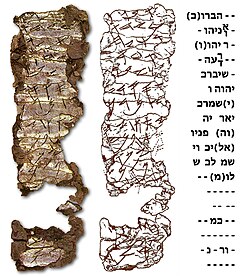
In 1979, Professor Gabriel Barkay discovered two silver scrolls with the priestly blessing from Numbers 24-26 dating before the Babylonian exile.
Jerusalem, as the political and religious center of ancient Israel, abounds with archaeological findings from the biblical period. A visitor to the archaeology wing of the Israel Museum can view a stone that once fell from one of the Temple walls, bearing the inscription “To the place of trumpeting” in the familiar ancient script—a reference to a site at the corner of the Temple where trumpets were sounded. Alongside it is the Temple Warning Inscription, written in Greek, a kind of ancient warning sign forbidding foreigners from passing beyond the partition that encircled the Temple.
And not only in Jerusalem: from the northern Golan Heights to the southern Negev, the archaeology of the Land of Israel continues to astonish with greetings from the distant past. At Tel Dan, in the northern Hula Valley near the Lebanese border, an especially ancient Aramaic victory stele was discovered, dating to the 9th century BCE. It bears the inscriptions “King of Israel” and “House of David.” The stele recounts the deaths in battle of Joram, king of Israel, and Ahaziah, king of Judah. This extrabiblical mention of the House of David—written by a foreign king who fought the inhabitants of the land—confirms the existence of the ancient kingdom and the political power of Israel in that era.
Further south, near the city of Shechem in Samaria, archaeologists uncovered Joshua’s altar on Mount Ebal, mentioned in the Bible and dated all the way back to the 13th century BCE, when the ancient Israelite tribes conquered the land. Excavations of the ancient altar revealed remains of animal bones that had been sacrificed there, which were quickly identified as belonging only to animals considered kosher under Jewish law, with no traces of pig. The strict observance of kosher species by those who used the altar, along with other clearly Hebrew features found at the site, strengthen the conclusion that this is silent testimony to the biblical Ceremony of the Blessing and the Curse, which took place at the entrance to the land, at the end of the Israelites’ wanderings in the desert.
The Palestinian response to the discovery of these finds was measured and scholarly: they sent bulldozers to the site in an attempt to destroy it. This was not the only instance in which Palestinians, intent on severing the Jewish people’s connection to their land, sought to damage Israel’s unique archaeological heritage. We’ll return to this later.
The Israeli archaeological discoveries mentioned here are just a drop in the bucket. To these we must add the findings from ancient Samaria, Gamla in the Golan Heights, Tzippori in the Galilee, Khirbet Qeiyafa in the Elah Valley, Beit She’arim at the gateway to the Jezreel Valley, and many more.
From Jerusalem to Rome
The Jewish story of the Land of Israel is told not only through local archaeology, but also through discoveries across distant lands. As every tourist visiting Rome knows, the suppression of the Great Jewish Revolt against the Roman Empire in 66 CE is commemorated to this day even in the land of the victors. A stone relief depicting Roman legionnaires crowned with laurel wreaths, carrying off spoils from conquered Jerusalem and from the Temple they destroyed, is carved into the ancient Arch of Titus—and draws millions of visitors from around the world, an eternal memorial and unmistakable testament to the Jewish connection to Jerusalem. The Temple menorah, borne on the shoulders of Jewish captives in that relief, would—nearly 2,000 years later—become the official emblem of the modern State of Israel. Other international artifacts, such as the Black Obelisk of Shalmaneser III, the Mesha Stele, Sennacherib’s Annals, and many more, are displayed in the world’s leading museums as enduring testimony to the legitimacy of Israel’s claim.
Yet despite this vast archaeological corpus standing firmly in Israel’s corner, the Palestinians have launched a war of memory against common sense and historical fact, in the hope that a lie repeated often enough might eventually take root, no matter how baseless it is.
At the end of 1999, the Muslim Waqf, which under Israeli decision has served as the civilian authority on the Temple Mount since the Six-Day War, conducted an aggressive excavation using heavy machinery deep within the mountain—the most important archaeological site in the world. This illicit and hasty excavation, carried out within the system of hidden chambers and underground halls of the Temple Mount, destroyed a unique trove of archaeological remains: relics of the First and Second Temples. Hundreds of trucks removed the excavated soil and dumped it at various sites and landfills around Jerusalem, deliberately mixed with modern construction debris to make it harder for archaeologists to salvage any findings. But even this deliberate and sweeping act of destruction failed to erase the archaeological record. The memories of religions are far longer than the memories of men—and any attempt to erase them inevitably exposes both the perpetrators and their aims. Once news of the archaeological disaster emerged, thousands of Israelis volunteered for a national rescue effort that would continue for over twenty years. Under the guidance of archaeologists, they began sifting through the discarded soil.
Through painstaking labor, the volunteers uncovered a tremendous wealth of archaeological finds from the era of the ancient Jewish kingdoms. Countless coins, ritual and domestic pottery, inscriptions on parchment, stone and iron, jewelry, utensils, weapons—all offered renewed proof of a vibrant Jewish life in Jerusalem stretching back 3,000 years. The Palestinians had set out to erase Jewish history from the heart of the mountain, but their reckless act ended up helping to reveal it.
The deliberate destruction of archaeological evidence in an effort to sever a people’s connection to its homeland is an unforgivable crime. For more than 1,500 years, since the exile of the Jews, the Land of Israel lay in relative desolation, a frozen time capsule. It was conquered by one empire after another, but the land remained sparsely inhabited, and none of its occupants sought to unearth evidence of ancient civilizations.
It was only in the latter half of the 19th century that modern archaeology began to take an interest in the land, investigating its mysteries and initiating excavations. First came Christian researchers from Europe, and later, the Jews returning to their homeland. These Jews sought their memories in the soil—and soon found them, alive and well, reinforcing the ancient traditions. This deep Jewish attachment to the land endured throughout the long years of exile. It is no coincidence that Jerusalem is mentioned 669 times in the Bible, while in the Quran it is not even mentioned once. And it is no surprise that throughout Israel, not a single archaeological find has ever been uncovered attesting to an ancient Palestinian heritage.
The Hebrew story of the Land of Israel, incidentally, is not the exclusive domain of Jewish tradition. It is shared by the Christian tradition in the New Testament, which recounts the life of Jesus son of Joseph the Jew in places like Bethlehem, the Sea of Galilee, and Jerusalem. It is shared even by the Muslim tradition in the Quran, which declares that “Allah bequeathed the land specifically to the Children of Israel.” All three of these great traditions record in their sacred texts the profound historical bond between the People of Israel and their homeland.
Israel or Palestine?
If this land was indeed the land of Judah and Israel from time immemorial, how did the name “Palestine” take hold?
The Life of Hadrian, an ancient biography of the Roman emperor found in the Historia Augusta, provides a detailed account of the circumstances under which Israel was given its foreign name. Several decades after the Temple was destroyed by Titus, the Jews of the Land of Israel launched a new revolt under the leadership of Simon Bar Kokhba. The Roman Emperor Hadrian, enraged by the rebellion’s successes and the Jews’ recapture of Jerusalem in 135 CE, assembled the vast legions of Rome from across the empire to crush the revolt and destroy the Kingdom of Judea and its capital of Jerusalem once and for all. Some scholars believe that as much as a full third of the Roman army was gathered in this small territory to ensure victory.
But Hadrian was not content merely to suppress the rebellion; he sought to erase every trace of Jewish sovereignty and nationhood. As part of this effort, he changed the imperial name of the province from Provincia Judaea to Provincia Syria Palaestina, borrowing the name from biblical Philistia—the land of the Philistines—sworn enemies of ancient Judea. Thus, in an attempt to sever the Jews’ historical connection to the land, “Palestine” received its name at the hands of the Roman Empire.
Provincia Judaea may have changed its name, but its ancient cities and towns slipped from between Rome’s fingers. To this day, the Land of Israel is dotted with countless Arab towns and villages whose names are near-perfect transliterations of the ancient Jewish settlements on whose ruins they were built.
Thus, the biblical Jewish city of Be’erot, mentioned in the Book of Joshua as a major city in the territory of the Tribe of Benjamin, is now home to al-Bireh, the administrative center of the Palestinian Authority. On the ruins of the ancient Jewish village of Eshtemoa, south of Hebron—also mentioned in the Book of Joshua—now thrives the Palestinian village of as-Samu in the Judean Desert. Kibbutz Gvat in the Jezreel Valley was established on the lands of the abandoned Palestinian village Jebata, which itself had been built on the ruins of the ancient Jewish town of Gvat, cited in the Talmud. Just a few kilometers east lies Kibbutz Ginegar, which restored the name of the ancient Jewish settlement—also from Talmudic times—on whose site the Palestinians had built the village of Jinjar. On the lands of ancient Jewish city of Tzippori in the Galilee, the Arabs established the town of Saffuriyah. The biblical town of Adoraim in the Hebron Hills became the modern Palestinian town of Dura. In Bethlehem—the birthplace of King David and Jesus of Nazareth, and the burial site of the Matriarch Rachel—thrives to this day the Palestinian city of Bethlehem. Jericho, the city near which the Israelites crossed the Jordan and began the conquest of the land, retained its name even under Palestinian rule. Ancient Jewish Gaza became Razzah, as it is known in Palestinian Arabic, and the name of Jenin, the largest city in northern Samaria, is simply a variation of the biblical Jewish town of [Ein] Ganim. The Israeli city Kfar Saba was established on the ruins of the Palestinian village Kafr Saba, which itself had been built atop the ancient Jewish town of Kfar Saba, mentioned 2,000 years ago in the writings of Josephus. The city of Beersheba, referenced as early as the Book of Genesis, passed into Arabic as Bir es-Seba and was later restored to its original Hebrew name as a modern Israeli city.
All across the land, many such locations preserve this same phenomenon: ancient Hebrew names passed down, nearly unchanged, into the Arabic names of the settlements built atop their ruins. These linguistic echoes are a reminder that it was the people of Judea who were here first—not the people of the Arabian Peninsula.
Unlike the modern Palestinian narrative, so devoted to waging war against Jewish history, the older Arab inhabitants of the land—who over time bestowed Arabic versions of the original names on local settlements—did not live in a state of total war against historical truth. It seems they never imagined that the question of historical ownership of the land would someday arise. Unintentionally and without agenda, they preserved the history inscribed in the very ground beneath their feet.
A telling anecdote on this point occurred just one year before this book was written. One night in the spring of 2024, IDF soldiers entered the kasbah in the center of the Palestinian village of Sa’ir, in the Hebron Hills, to arrest a Palestinian terrorist preparing an attack on Israeli civilians. Sa’ir was built atop the ruins of the Jewish city of Zior, mentioned in the Book of Joshua as the second Jewish city in the tribal territory of Judah after Hebron, and the kasbah was constructed over the ancient tell[1] of that same city. During the arrest, soldiers discovered an ancient lintel above a doorway—bearing, to their surprise, a large and clearly carved depiction of a Jewish Temple menorah. An expert archaeologist was called to the scene and identified the remarkable stone as a relic from the ancient city of Zior, thousands of years old. And so, unwittingly, even Palestinians engaged in terrorism had preserved an ancient Jewish symbol, one that gleamed before their eyes every day as they passed it by.
The matter was well summarized by pacifist John Haynes Holmes, one of the founders of the American Civil Liberties Union, in his book Palestine To-Day and To-Morrow: A Gentile’s Survey of Zionism (1929):
This is the country to which the Jews have come to rebuild their ancient homeland… On all the surface of this earth there is no home for the Jew save in the mountains and by the well-springs of his ancient kingdoms. Everywhere else the Jew is an exile… Scratch Palestine, anywhere, and you find Israel… [There is] not a road, a spring, a mountain, a village, which does not awaken the name of some great king, or echo with the voice of some greater prophet… [The Jew] has a higher, nobler motive in Palestine than the economic… this mission is to restore Zion; and Zion is Palestine.
A Living, Breathing Tradition
The historical bond between the Jewish people and their land has been preserved not only in the “dead stones” of archaeology, but also in the living, breathing customs of their national culture and religious tradition.
One distinctive custom, which took root in the early days of exile and appeared in halakhic sources nearly 2,000 years ago, is observed at the Jewish wedding: at the very peak of joy, just as the new family is being formed, the groom recites two verses from the Book of Psalms: “If I forget thee, O Jerusalem, let my right hand forget its skill. Let my tongue cleave to the roof of my mouth if I do not remember thee, if I do not set Jerusalem above my highest joy”. He then shatters a glass underfoot, as an expression of sorrow for the destruction of Jerusalem. This custom, in which the groom pledges never to forget the holy city, is practiced at every Jewish wedding to this day.
The recitation of “If I forget thee” at Jewish weddings is just one expression from an entire trove of ancient Jewish rituals, customs, songs and works, all centered on memory, yearning, and longing for return to the ancestral land. From birth to death, these traditions accompany the Jew, reminding him of his homeland and stirring his love for it. A striking cultural example of this phenomenon is the body of poems known as Zionides, written in ancient Hebrew by Jewish poets over a thousand years ago. These songs are still sung at family Shabbat meals to this day, and some have even been covered and re-recorded by prominent Israeli artists. To give just one example, rock star Berry Sakharof, often called “the prince of Israeli rock,” released an album in 2009 titled Adumei HaSefatot (Crimson Lips), dedicated entirely to ancient Hebrew liturgical poetry. The album achieved gold status, and several of its tracks climbed national radio playlists.
Is there another spoken language in the world whose speakers sing pop hits the lyrics of which were written thousands of years ago? Is there any other phenomenon which even resembles this in global culture?
In 1 Maccabees, written near the time of the Hasmonean revolt, we find an exchange between Simon the Hasmonaean—the second son of Matityahu—and the envoy of King Antiochus IV. The envoy reproaches Simon over the Hasmonean conquests in the land.
“You are occupying Jaffa and Gezer,” the Seleucid complained to the Jew more than 1,800 years ago, voicing grievances identical to those raised by the Palestinians today, “and the citadel in Jerusalem, cities that belong to my kingdom. You have devastated those regions and brought great trouble to the country. You have seized control of many places in my kingdom.”
Simon’s reply is the same answer Zionists give to the Palestinians today:
We have never taken land away from other nations or confiscated anything that belonged to other people. On the contrary, we have simply taken back property that we inherited from our ancestors, land that had been unjustly taken away from us by our enemies at one time or another. We are now only making use of this opportunity to recover our ancestral heritage.
Indeed, nothing has changed.
Memory Becomes Action
The profound bond between the Jewish people and their homeland—as well as their persistent refusal to relinquish the longing to return to Zion, despite the length of the exile and the vast geographic dispersion—created fertile ground for the revival of the Zionist idea: the restoration of national life in the Land of Israel.
Throughout the medieval period, Jews did immigrate to the Land of Israel from around the world in small groups. But in the early 19th century, in 1808, there was a significant turning point: the first major wave of Jewish immigration—or Aliyah, in Jewish parlance—arrived in the land. This wave was composed primarily of Jews from Lithuania in Eastern Europe, the Maghrebi community of North Africa, and the Yemenite Jewish community of the Arabian Peninsula. As a result, the Jewish population in the land grew from just a few thousand, concentrated in the four holy cities of Jerusalem, Hebron, Tiberias and Safed, to a renewed and expanding settlement numbering close to 30,000 Jews.
Several years later, influenced by the surge of European nationalist movements, the Zionist idea began to gain momentum in Europe and Russia. The great wave of immigration to the Land of Israel named the First Aliyah, which began in 1882 and continued until the end of the century, doubled the size of the Jewish population and led to the establishment of agricultural settlements in frontier regions and swampy areas across the country. After nearly four hundred years under the rule of the declining Ottoman Empire, a new reality was beginning to take shape in the Land of Israel.
In the years that followed, the Zionist awakening gave rise to additional waves of immigration—each larger than the last—fueled by national sentiment and the desire for Jewish sovereignty and independence. My father, a Jewish teenager raised in Mexico, was one of those hundreds of thousands of Jews who immigrated to Israel in the previous century. His parents had fled to Mexico from Poland on the eve of the Second World War, but he resolved to move to the Land of Israel rather than settle permanently in North America. In 1955, when he was just seventeen, he packed a suitcase, bid farewell to his parents and siblings, and boarded a ship bound for Israel to begin a new life there. He came alone, without knowing a word of Hebrew. Later on, like so many Jewish families around the world, his parents and siblings followed him and settled in Israel as well.
In contrast to this wave of Jewish demographic growth, the Arab population of the land remained relatively stable throughout the four centuries preceding Zionism, numbering around 45,000 families—approximately 300,000 individuals in total. This figure appears in the first population census conducted by the Ottoman conquerors after taking control of the land in 1525, and it remained consistent across all subsequent estimates, censuses, and assessments conducted through the mid-19th century. 300,000 people spread out over 13,000 square miles amounted to a land that was, for all intents and purposes, almost entirely empty.
Intellectuals, Captivated by an Idea
Though the idea of Jewish return to the homeland drew its strength from religious tradition, it also cast a powerful spell over assimilated Jewish intellectuals—many of whom, at the time, were still deeply embedded in European high society.
“After an estrangement of twenty years, I am back with my people,” wrote the assimilated thinker Moses Hess at the opening of his book Rome and Jerusalem: The Last National Question (1862), “I have come to be one of them again, to participate in the celebration of the holy days, to share the memories and hopes of the nation, to take part in the spiritual and intellectual warfare going on within the House of Israel.” Hess, who had seemingly integrated into the European elite and even worked alongside Karl Marx, Friedrich Engels, and the leaders of the socialist movement, came to understand that such integration was ultimately futile: “Mask yourself a thousand times over, change your name, religion and character … so that people may not recognize the Jew in you… it is of no avail.”
At that same time, another assimilated Jew, Dr. Max Nordau—a Hungarian-born physician and respected writer in European cultural circles—was living in Paris. One day, a Jewish mother and her sick son came to his clinic. Nordau, secular and estranged from his roots, examined the boy. During their conversation, he discovered that the child did not attend a regular French school but studied in a cheder—a traditional Jewish primary school. The revelation stirred something like revulsion in the enlightened doctor, who responded to the two with coldness and hostility. But what began as alienation gave way, over the course of the encounter, to surprise—and then to a profound personal reckoning. As Nordau would later recount to his Zionist friend Abraham Shalom Yahuda, the conversation with that boy became a formative moment that changed his life. When he asked the child what he had learned that day in cheder, the boy eagerly told him the story of “Rachel the Matriarch” from the Book of Genesis: her burial on the road to Bethlehem, and the biblical promise of the prophet Jeremiah that her children would return to their borders—in other words, return from exile to the Land of Israel.
Nordau, who had never encountered the Bible in such a vivid and intimate way, was shaken by his own ignorance of his people’s heritage. The child—“eight or ten years old”—possessed a command of his people’s history, and spoke of it with such immediacy, as if it were unfolding here and now, that it shook Nordau to his core. Nordau turned to the window and began to weep. “I wiped my cheeks before turning back to face them and said to myself: A people that have children like this—who live their history so fully—have a brilliant future awaiting them. Later that week, I came across a notice in the newspaper: ‘If the fate of the Jewish people matters to you, if antisemitism pains you, if you seek a solution—please contact the undersigned to consult. Dr. Theodor Herzl.’ I answered at once.”
And so, from generation to generation and across the globe, the ancient bond between the Jews in exile and the Land of Israel endured. It was on the wings of this connection that the political right grew out of the historical one.
The Political Right
Out of the historical right we have seen thus far, the modern political right was born.
The historical right—rooted in a national memory thousands of years old—created the cultural, spiritual, and ideological conditions necessary for the emergence of the political right. The physical conditions, however, were supplied by the Land of Israel itself, which was, for the most part, desolate and empty.
Official reports, population censuses, travel journals, and other historical documents accumulated over centuries concerning the Land of Israel all painted the same picture: a miserable, neglected land, mired in swamps, ravaged by disease and natural disasters, inhospitable to settlement, and largely abandoned. In the words of James Finn, the British consul in the Land of Israel, in a memo he sent to London in 1857: “The country is, for the most part, empty of inhabitants to a remarkable degree.”
Mark Twain, who visited the region in 1867, compiled his impressions into the timeless classic The Innocents Abroad, or The New Pilgrim’s Progress (1869). “Of all the lands there are for dismal scenery,” Twain wrote, “I think Palestine must be the prince. The hills are barren… the valleys are unsightly deserts… The Dead Sea and the Sea of Galilee sleep in the midst of a vast stretch of hill and plain wherein the eye rests upon no pleasant tint, no striking object, no soft picture…” Twain did not spare his sarcasm: “It is a hopeless, dreary, heart-broken land… I would like much to see the fringes of the Jordan in spring-time, and Shechem, Esdraelon, Ajalon and the borders of Galilee—but even then these spots would seem mere toy gardens set at wide intervals in the waste of a limitless desolation.”
Did the Jews, as the Palestinians claim, descend upon a flourishing and inhabited Arab land and seize it for themselves, as part of a colonialist campaign? At least according to Twain, the answer is unequivocal: not in the least. His visit to the region preceded the First Zionist Aliyah by several decades, and the reality his words evoke leaves little doubt:
Palestine sits in sackcloth and ashes. Over it broods the spell of a curse that has withered its fields and fettered its energies… Nazareth is forlorn; about that ford of Jordan where the hosts of Israel entered the Promised Land with songs of rejoicing, one finds only a squalid camp of fantastic Bedouins of the desert; Jericho the accursed, lies a moldering ruin, to-day, even as Joshua’s miracle left it more than three thousand years ago; Bethlehem and Bethany, in their poverty and their humiliation, have nothing about them now… Renowned Jerusalem itself, the stateliest name in history, has lost all its ancient grandeur, and is become a pauper village… The noted Sea of Galilee… was long ago deserted by the devotees of war and commerce, and its borders are a silent wilderness… The advertised title of the expedition—“The Grand Holy Land Pleasure Excursion”—was a misnomer. “The Grand Holy Land Funeral Procession” would have been better—much better
Twain’s vivid description captures the land’s final days of desolation, just before the return of the Jewish people and the beginning of the agricultural, urban, and industrial development they brought with them. The growing awareness of the land’s abandonment only strengthened the national sentiment of Jews in the Diaspora—a sentiment which at the time was already approaching a boiling point. Indeed, the birth of the political Zionist movement was the product of a convergence of opportunities and historical forces: the wave of nationalist awakening that swept Europe during the Revolutions of 1848 ignited the Jewish national consciousness and kindled new hopes for Jewish sovereignty. Added to this were the intensifying hardships caused by modern antisemitism, and the emerging realization that the solution was within reach—in the form of a land lying empty, awaiting their return.
The Odyssey to Political Recognition
Nothing came easily. The Zionist diplomatic campaign to secure political rights to the land encountered countless obstacles, objections, doubts, and setbacks. But perseverance, strategic maneuvering, a willingness to compromise, political acumen, and the skillful leveraging of the movement’s assets—all these brought the international community to a clear and binding conclusion:
The Jewish people have full political rights to their land, grounded in the force of their historical right.
This dramatic recognition of the Jewish people’s claim was the culmination of a Zionist chess match that spanned two turbulent and fateful decades—from the earliest diplomatic efforts of the solitary visionary Herzl, through the Balfour Declaration and the signing of the San Remo Resolution—which transformed what had once seemed no more than a dream or fantasy into a concrete and recognized international political reality.
A Viennese Visionary, Drifting into Madness
In the summer of 1895, Dr. Benjamin Ze’ev Theodor Herzl—the Austrian-Jewish journalist who would become the founder of political Zionism—was on a family vacation in the Austrian resort town of Bad Aussee. His preoccupation with the Jewish question, his fears of the dark fate awaiting the Jews, and his search for a solution had already, by his own description, become something of an “obsession.”
In Herzl (1975), the biography by Amos Elon, one scene from that summer vacation is recounted: on the walls of a lakeside bathhouse in Aussee, Herzl noticed antisemitic graffiti alongside messages left by Jewish youths. “God,” read one scrawled reply in the handwriting of one such boy, “sent Moses to us and shall take the hands of all our Jews and lead them back to the Promised Land.” The words struck Herzl like a bolt of lightning. He copied them into his notebook. Upon returning to Vienna, he began, as a well-connected European journalist and editor, a campaign of diplomatic outreach to world leaders, communities, and organizations. He presented them with his plan, sought formal expressions of support, and gradually wove around himself a network of recognition, understanding, and dissemination of his political idea.
Herzl traveled to Paris, where he met with the chief rabbi of France and Dr. Max Nordau, enlisting both in his cause. He then continued on to London, where he met the famed Anglo-Jewish author Israel Zangwill, who was swept up in Herzl’s enthusiasm and introduced him to the Jewish elite of Britain, who in turn were captivated by the idea.
A few months later, in an intense, two-month writing marathon, Herzl completed Der Judenstaat, or The Jewish State (1896), the book that would become the foundational manifesto of the Zionist claim to political rights to the Land of Israel.
Herzl was convinced that he had conceived the idea of a Jewish state independently. But at the very same time—hundreds of miles away—the same idea had begun to take shape in the minds of other Jewish intellectuals, who viewed with alarm the rising tide of antisemitism in Eastern Europe and, in contrast, the first signs of Jewish resettlement in the Land of Israel. One such thinker was the Russian-Jewish intellectual Dr. Leon (Judah Leib) Pinsker, whose pamphlet Auto-Emancipation (1882), published some fourteen years before The Jewish State, proposed a strikingly similar solution to the same problem.
Response to Herzl’s The Jewish State was mixed. The bold vision laid out in the book ignited excitement and hope among many Jews, while at the same time evoking ridicule, scorn, and even fear of potentially catastrophic consequences. No publishing house, including those that had released Herzl’s previous works, was willing to publish the manifesto. In his diaries, Herzl described giving the manuscript to “one of my oldest and dearest friends,” who began to weep as he read, for he was “convinced that I had lost my mind”. The editors of the Viennese Jewish newspaper where Herzl was employed warned him that publishing the book could gravely endanger not only his own safety but the survival of Austria’s Jewish community as a whole, and they even hinted he might lose his position if he insisted on proceeding with its publication. The Austrian prime minister, to whom Herzl sent a copy, dismissed Zionism as an idea that would appeal only to “chatterers of limited intelligence.” Emperor Franz Joseph I of Austria called Herzl an “ingrate” in response to the book’s publication. The chief rabbi of Vienna, Dr. Moritz Güdemann, withdrew his support. Former German Chancellor Otto von Bismarck called the book “gloomy delusions.” On and on the list continued—one demoralizing reaction after another from leading figures of the time, who dismissed the book and yet, in doing so, attested to the influence of its well-known Jewish author.
“No one in Vienna was ever ridiculed as Herzl was following the publication of The Jewish State,” wrote the prominent Austrian-Jewish author Stefan Zweig, who described the book as a “foolish and obtuse text.”
But Herzl was a visionary, a bold innovator, driven by the inner fire that motivates great individuals to launch the great movements of history. He understood that the laughter and derision of the crowd are the lot of those who see farther than others—and steeled himself to ignore them.
“There is no despair in the world at all,” said another great Jew, Rabbi Nachman of Breslov, nearly a century earlier—and Herzl took this to heart, throwing himself anew into his political advocacy. He traveled to Constantinople to meet with the Ottoman prime minister. From there he returned to Paris, where he met with Baron Rothschild, then the richest man in France. Rothschild expressed reservations about Herzl’s proposal, warning, “It is not good for the eyes to be bigger than the stomach.” But Herzl did not relent. After winning the support of the king of Bulgaria, he resolved to launch a weekly newspaper dedicated to the cause and to convene the first Zionist Congress in the city of Basel. “At Basel I founded the Jewish state,” Herzl wrote in his diary. “If I said this out loud today l would be greeted by universal laughter. In five years perhaps, and certainly in fifty years, everyone will perceive it.” He was right.
In the autumn of 1898, Herzl toured the Land of Israel at the invitation of Kaiser Wilhelm II of Germany. He arrived at the head of a Zionist delegation he had assembled, hoping to assess whether the vision of Jewish return to the land had practical potential. In his visits to the new settlements, he saw that the first wave of immigration had already begun to take root. At the same time, the swamps and disease, along with various natural disasters, had left large parts of the land empty of inhabitants.
Unlike Mark Twain, Herzl was especially moved by Jerusalem. “Jerusalem wrapped in a thin veil of moonlight, with its wonderful skyline,” he wrote in his diary two days later, “made a tremendous impression on me. The silhouette of the citadel of Zion, the tower of David – magnificent. The streets were filled with groups of Jews strolling in the moonlight.”
What to Twain had appeared a “pauper village” left a “deep impression” on Herzl. Twain came to observe; his account was objective. Herzl came to return; his account was subjective—an impression born of what Israel’s national anthem would later call nefesh Yehudi homiyah—“the soul of the Jew yearns still.”
In the European Spring of Nations, Herzl saw a fleeting opportunity—a political moment that had to be seized—set against the storm clouds of antisemitism gathering over the continent, soon to break with lethal force upon a defenseless Jewish people. If the peoples of Europe demanded national self-determination, Herzl reasoned, then the Jewish people, too, could demand national self-determination of their own.
Herzl arrived at this position only after rejecting two earlier solutions.
The first was a rejection of nationalism altogether, in favor of a class-based, supra-national identity—a solution proposed, for instance, by fellow Jew Karl Marx. Unlike Marx, however, Herzl recognized that national feeling was stronger than class consciousness and that it ran deep in the human soul. The Greek or the German would not surrender his national identity—certainly not for an abstract, cosmopolitan working class.
The second solution was voluntary assimilation, the full absorption of Jews into the nations among whom they lived. But the spread of antisemitism, despite Jewish efforts to assimilate, made clear to Herzl that this too was no viable path.
Thus, Herzl arrived at the Zionist solution: a political demand, presented to the nations of the world, for the Jewish people’s right to national self-determination in an independent territory in their ancestral land.
When he returned from his visit to the Land of Israel, Herzl continued to advance his diplomatic agenda in the years that followed. He saw the impending collapse of the Ottoman Empire and planned to use its dissolution as a window of opportunity to obtain, from its successors, the political right to establish a Jewish state in Palestine. He pursued this goal tirelessly and through many channels. He negotiated with the weakening Ottoman government, with the increasingly powerful British colonial office, with the king of Italy and the pope—seeking political and religious recognition for his plan—and with senior officials of Czarist Russia, from whom he sought to obtain permission for Russia’s Jews to emigrate to the Land of Israel.
Thin, hunched, sickly and frail, Herzl still managed to bring before the next Zionist Congress the so-called Uganda Proposal, which envisioned relocating the Jews to an African territory as a temporary “night shelter” from the persecution they faced—a stopover en route to the Land of Israel. Herzl advanced the idea partly in the shadow of the traumatic Kishinev pogrom, which had taken place in Bessarabia in 1903, during which dozens of Jews were brutally murdered and hundreds of homes, synagogues, and businesses were destroyed. The proposal met with fierce opposition. “If the British are the nation I believe them to be,” said Dr. Chaim Weizmann to Herzl, “they will offer us something better.” Herzl was persuaded and withdrew the proposal from the agenda. Not long afterward, in the summer of 1904, at just 44 years old, Herzl died—leaving the entire Zionist movement stunned, mourning, and fearful for the future of its grand idea.
The visionary of the Jewish state was gone, but the vision to which he had devoted his life lived on in the hands of his disciples and successors, who continued to fight upstream to secure the Jewish people’s political right to their land from the nations of the world.
Weizmann and Aaronsohn
“A heavy burden has now fallen upon my shoulders,” wrote Dr. Chaim Weizmann in his diary following Herzl’s death. At the time, Weizmann was a promising British biochemist, a central figure in the Zionist movement, and a prominent leader within the British Jewish community. A close associate of Herzl, Weizmann carried forward the mission with a methodical and calculated approach, one that remains, to this day, a model of statesmanship and diplomacy.
In Chaim Weizmann: A Biography (1986) by Norman Rose, the Zionist leader’s diplomatic efforts are described in detail. Weizmann undertook a campaign among senior officials in the British Foreign Office, seeking their recognition of the Jewish people’s political right to the Land of Israel, which at that time was still under the control of the rival Ottoman Empire. In the lead-up to Britain’s 1906 general elections, Lord Arthur James Balfour—then just a candidate for office—requested a meeting with Weizmann in hopes of securing the support of British Jewry.
In their meeting, Weizmann laid out the central tenets of his passionate Zionist worldview. Balfour struggled to understand the insistence on Palestine in particular. To illustrate the point, Weizmann asked him: “Would you accept Paris instead of London?” Balfour replied, “But, Dr. Weizmann, London is ours.” Weizmann answered without hesitation: “But, Lord Balfour, Jerusalem was ours when London was still a swamp.”
In hindsight, Balfour admitted that this exchange planted in his mind the seed of recognition that the Land of Israel was destined for the Jewish people, and that this destiny must be realized through legitimate political means.
But the leaders of the British government were not moved to help the Jews solely out of goodwill. In 1914, the First World War broke out—and during the war, Britain gained a strategic edge thanks to two Zionist scientists: Chaim Weizmann and Aaron Aaronsohn.
Weizmann, then a faculty member at the University of Manchester, succeeded in developing a low-cost, biologically based method for producing acetone—an essential component in the manufacture of cordite for British munitions. His breakthrough solved a critical bottleneck in Britain’s wartime arms industry and proved vital to its success in the First World War. Both Minister of Munitions David Lloyd George and then–First Lord of the Admiralty Winston Churchill became personally acquainted with Weizmann as a result of the discovery.
Aaron Aaronsohn, a botanist, had already gained international acclaim a decade earlier for discovering “the mother of wheat”—a wild strain of wheat from which modern varieties were cultivated over millennia. His discovery opened the door to scientific improvements in wheat breeding, enhancing crop resilience and thereby strengthening global food security.
But Aaronsohn, a resident of the northern town of Zikhron Ya’akov—where he had discovered the wheat strain in a field—made a very different kind of contribution to Britain.
He founded and led the NILI espionage network, a Jewish intelligence organization that provided the British with invaluable information ahead of their campaign to wrest the land from the Ottomans. Due to his tactical and strategic insight and his grasp of the military balance, Aaronsohn offered the British priceless advice, which proved decisive in their victories over the German and Ottoman forces in the region. Aaronsohn advised them to deceive the enemy and enter the country via Beersheba, which was poorly defended, rather than through fortified Gaza. He even supplied a map of the wells along the proposed invasion route. On one of his visits to the Cairo headquarters of British General Edmund Allenby—where he had gone to deliver intelligence—Aaronsohn met a young British intelligence officer, Colonel Sir Mark Sykes, who held him in high regard and expressed his deep appreciation for his work.
Aaronsohn, a rare prodigy who had reportedly devoured some 30,000 books in his short lifetime, leveraged his global scientific reputation to deceive the Ottomans on behalf of the British. After a devastating locust plague swept through the Land of Israel, he offered the Ottoman authorities scientific assistance in combating it. In this new role, he gained access to all parts of the country, including military sites. This allowed him to gather exceptional intelligence, including the communication code used between the Ottomans and the Germans, which he passed on to the British. “He was our best agent in the Middle East during the war,” his British colleagues later testified. “The NILI network was the finest human intelligence (HUMINT) source we had in Palestine,” declared a British military intelligence official in a formal report. “Without the Aaronsohn group, it is doubtful whether General Allenby would have defeated the Ottomans.”
But Weizmann and Aaronsohn did not stop at aiding Britain’s war effort. They used their access to the highest levels of the ruling empire, and the moral debt owed to them by the British—to promote the Zionist vision and push for action. At one point, Britain’s Minister of Munitions, Lloyd George, asked Dr. Weizmann what he wanted in return for his groundbreaking invention. “A homeland for my people,” Weizmann replied. George, an evangelical Christian and devout believer in the Bible, was moved by the answer, and took it deeply to heart.
Weizmann’s Campaign
Following Britain’s victory in the war, Dr. Chaim Weizmann, representing the Zionist leadership in Britain, submitted a formal proposal to His Majesty’s Government: to recognize the Jewish people’s political right to their land, and to affirm the right of Jews from all over the world to immigrate to and settle in the Land of Israel. At the time, Jews still comprised a minority in the country, while Arabs formed the majority.
In late October 1917, the British Cabinet approved a response to the proposal. A few days later, the letter was formally delivered by Lord Balfour—by then the British Foreign Secretary—to Lord Rothschild, a representative of the Zionist movement. “His Majesty’s Government views with favour the establishment in Palestine of a national home for the Jewish people,” declared the now-famous declaration that would alter the course of the land’s history.
The drafters of the declaration, including Sir Mark Sykes, consulted throughout the process with their longtime confidants Weizmann and Aaronsohn, who waited anxiously in an adjacent room, reviewing draft after draft. Once the final text was signed, but before it was made public, it was presented to U.S. President Woodrow Wilson, who also gave his approval.
Thus, with the signature of its Foreign Secretary and the support of additional powers such as the United States, France, and Italy, Britain—then the preeminent global power—declared the Jewish people’s right to establish a national home in the Land of Israel, and affirmed their natural ownership of the land to which they had returned.
The declaration made clear that Jews—and only Jews—held national rights in this territory, while the other inhabitants would enjoy civil rights alone in the future Jewish state. The territory promised to the Jews was expansive and included, at the time, the fertile lands east of the Jordan River, territory later severed by Churchill and handed over to the Hashemite family of Hussein bin Ali, which became the ruling dynasty of Jordan.
Thirteen years after Herzl’s death, his vision had come to life.
Roughly two and a half years after the Balfour Declaration, in the spring of 1920, the victorious Allied powers convened in San Remo, Italy, to discuss the division of the defeated Ottoman Empire’s territories. At the conference, which also decided on the creation of 22 Arab states, the Land of Israel was assigned to the British as a Mandate, with a clear and singular purpose: to implement the Balfour Declaration and create the conditions necessary for establishing a Jewish national home.
The preamble to the Mandate charter stated that it was based on the international recognition of “the historical connection of the Jewish people with Palestine.”
Article 2 of the Mandate required Britain to ensure political, administrative, and economic conditions conducive to the establishment of the Jewish national home.
Article 6 instructed Britain to encourage Jewish immigration to the Mandate territory and the close settlement of Jews throughout the land, including on public lands and uncultivated lands not required for public use.
Article 7 mandated that Britain enact a nationality law that would facilitate the acquisition of citizenship by Jews taking up permanent residence in the country.
Article 11 authorized the British administration to manage the land in a manner that would promote concentrated Jewish settlement and agricultural development across the territory.
While the Mandate recognized the civil and religious rights of the non-Jewish population, it made no mention whatsoever of political or national rights for them.
Thus, with the decision of the Allied powers and their explicit instructions to Britain regarding the purpose of its Mandate in the Land of Israel, the Balfour Declaration was transformed from a diplomatic statement of intent into a binding international agreement. Britain was now obligated to establish a Jewish state on both sides of the Jordan River and to promote Jewish immigration to it.
At the time, Jews made up just 10 percent of the country’s population, and the Jewish people remained scattered across the globe. Yet the victorious powers—who, under international law, held sovereignty over the territory—made clear that the future state would be the homeland of all the Jews of the world. At the request of then–Prime Minister Lloyd George, George Adam Smith, Rector of the University of Aberdeen, drew the map of the land designated for the Jews according to the biblical kingdoms of David and Solomon and the tribal inheritances of the Twelve Tribes of Israel.
Two years later, in the summer of 1922, the League of Nations officially granted Britain the Mandate for Palestine. All 51 member states supported the decision, which reiterated “the recognition of the historical connection of the Jewish people with Palestine, and of the grounds for reconstituting their national home in that country.” It emphasized Britain’s obligation to encourage close Jewish settlement on state lands and to use the Mandate for the purpose of establishing a Jewish state across the entire land. The East Bank of the Jordan—comprising the majority of the territory—was excluded from the Mandate and handed to Abdullah, who was appointed the first king of the new Kingdom of Jordan. This was the first partition of the Land of Israel, and it was done unilaterally.
The Great Missed Opportunity
The early 1920s marked one of the most painful and tragic missed opportunities in Jewish history. In 1920, Herbert Samuel, a Jew with Zionist sympathies, arrived at the port of Jaffa as Britain’s first High Commissioner for Palestine. Acting in the spirit of the Balfour Declaration and the San Remo accords, he immediately offered to help make possible the existence of a Jewish state across the entire territory, including the East Bank of the Jordan (which, as noted, was later torn away from Israel and gifted to the Hashemite dynasty). He even went so far as to declared that, in his view, the foundation of a Jewish state and the absorption of Jewish immigrants from around the world was the very essence of his mission.
But the thirteen million Jews living in the world at the time did not respond to his call, but instead chose to stay put. Eight million of them were living in poverty, without civil rights and under severe restrictions in Russia and Eastern Europe. When given the opportunity to leave, they chose to migrate West—mostly to the United States. The Leninist revolution, too, dealt a blow to this rare window of opportunity. Lenin and the Jewish revolutionaries aligned with him viewed Zionism as a bourgeois movement. By arresting and deporting Zionist activists to Siberia, they effectively severed millions of Russian Jews from the path to mass immigration to the Land of Israel. By contrast, the educated Jews of Germany were deeply rooted in the dream of Western liberalism under the Weimar Republic, which offered them full integration and dazzling prospects for success in society and culture. Dark storm clouds were already clearly visible on the horizon, but most failed to see them. The Land of Israel, then regarded by many as a remote and impoverished patch of Asian earth, held little appeal. “People of Israel, where are you?” cried Dr. Chaim Weizmann. His cry echoed, unanswered.
As time went by, the political offer extended by the nations of the world to the Jews steadily eroded. In 1937, the British government’s Peel Commission proposed partitioning the land west of the Jordan into two states—one Jewish, one Arab. 75 percent of the territory was designated for the Arab state; only 18 percent for the Jewish state. To make matters worse, more than a third of the projected population of the tiny Jewish state would consist of Arabs. The remainder of the land would fall under international control.
The Jews initially opposed the proposal, viewing it as a stark retreat from the promises of the Balfour Declaration. Even Winston Churchill, then a member of Parliament, opposed the plan and warned his friend Weizmann not to accept it, arguing that a Jewish state so small could not survive.
Yet despite their misgivings, the Jews ultimately accepted the Peel Commission’s offer. “It’s an extraordinary solution,” Weizmann told his personal secretary. “We must think only of one thing—saving as many Jews from Europe as we can.”
But though the Peel proposal left the vast majority of the land in Arab hands, the Arabs categorically rejected it.
Ten years later, as Israel stood on the brink of statehood and war loomed over its future, the international community proposed yet another compromise—this time under the auspices of the newly established United Nations .In 1947, the UN Special Committee on Palestine (UNSCOP) visited Kibbutz Beit HaArava in the Jordan Valley and was astonished to see Jewish farmers doing the impossible—growing tomatoes in saline soil that had never produced anything. The committee was persuaded: the Jews could run a state, an economy, and an agricultural system even in the most challenging terrain.
UNSCOP’s partition plan granted the Jews some 62 percent of the territory, while 38 percent was allocated to the Arab state. But most of the land designated for the Jewish state was desert, while the biblical heartland and most of the fertile land fell within the Arab territory. Jerusalem, placed under international control, was torn away from the future Jewish state.
This proposal, too, was exceedingly generous to the Arabs—and they rejected it as well. On September 29, 1947, the representative of the Arab Higher Committee presented the Palestinian rejection to the UN General Assembly’s Ad Hoc Committee: “In the opinion of the Arab Higher Committee,” he declared, “this report cannot serve as a basis for discussion… The Arabs of Palestine are determined to resist any scheme that seeks to partition or fragment their country.”
Despite Arab opposition, the UN General Assembly approved the partition plan two months later by a large majority. In response, Lebanese representative Charles Malik recited the ancient Jewish oath, “If I forget thee, O Jerusalem, let my right hand forget its skill,” a seeming declaration of Arab allegiance to Jerusalem, echoing the same vow Jews had sworn for generations. “If you go on saying it for another two thousand years,” Abba Eban replied, “perhaps then we’ll begin to believe you.”
A fierce internal political debate erupted within the Jewish community between the camp of compromise and the camp of refusal, over the question of accepting or rejecting the offer. “The United Nations has decided to carve up our homeland,” declared Menachem Begin, leader of the revisionist minority and advocate of military resistance, as he called to reject the proposal. “It is clear to anyone unwilling to sell his homeland for a few fleeting comforts, or to abandon his people for temporary peace, that this ‘partition solution,’ if implemented, will amount to a historic national disaster. The Jewish people must prevent such a catastrophe. The Irgun calls upon all loyal sons of the people and the land… to save the nation from ruin and the land from division. All of Zion is ours. The Jewish people, in their millions, will return to Zion. The banner of Hebrew liberty will fly over Jerusalem and over Amman.”
Despite the deep rift and the painful concession of the land’s heart, once again the camp of compromise prevailed—and once again, the Jews accepted the partition plan. “The proposed map is a nightmare,” the leaders of the Yishuv—the pre-state Jewish community in the Land of Israel—told David Ben-Gurion. “I wish that this nightmare comes true,” he replied. On the Arab side, the response remained the same. The Palestinian Arabs rejected the partition plan outright, and then declared total war on the Jewish community in the Land of Israel.
Drama at the UN
How was the UNSCOP partition plan adopted by the UN General Assembly? This, too, is a dramatic chapter in the history of Zionism. For the resolution to pass, the Jews needed a two-thirds majority; the Arabs, by contrast, needed only a third to block it. The political skill shown by the Jewish representatives, compared to the negligence and amateurism of their Arab counterparts, was described somewhat ruefully in retrospect by the Saudi delegate to the UN:
While the Arabs napped in arrogant indifference, the Jews applied relentless pressure through transatlantic phone calls to heads of state, urging them to change the planned votes of their representatives, offering economic and other inducements. The Arabs left the matter to chance and relied on the goodwill of the delegations. For the Jewish people, politics was not a gamble—it was a science. So they employed every technique possible to win the vote.
Two days before the vote, scheduled for late November 1947, it became clear from the speeches given by member-state delegates that the Jewish side lacked the two-thirds majority required. The resolution was headed for defeat. At that moment, Zionist representatives turned to their allies among the Latin American delegations with an urgent request: filibuster. “Read the Bible from the podium if you have to,” one Jewish envoy instructed a South American delegate. “Recite Psalms, quote the promises of Isaiah—just buy us time.” The Arab representatives, sensing the shift, shouted for a vote. But at exactly 7 p.m., the President of the Assembly adjourned the session and postponed the vote by two days—precious time that was used for an all-out pressure campaign on the swing votes. Every possible strategy was deployed, including locating influential local Jews close to national leaders and enlisting their help in persuading delegations.
The drama continued until the very last moment. The vote itself lasted just three minutes. In the end, the resolution passed: 33 in favor, 13 against, and 10 abstentions. Among the supporters were both superpowers—the United States and the Soviet Union—despite being at the very beginning of what would become a long and bitter Cold War between them. Against all odds, the Jewish people had somehow united the two great rivals, if only for a moment. Surprisingly, one of the abstentions came from Britain itself—the very Britain that had pledged, just thirty years earlier, to help the Jewish people establish their state. History moves in strange ways.
On that fateful day, November 29, 1947, tens of thousands of Jews broke into spontaneous dancing in the streets of the Land of Israel. National joy spilled into the public square. In a symbolic gesture, Italian Jews gathered near the Arch of Titus, across from the ancient stone relief depicting the beginning of exile, for a mass prayer of thanksgiving for its end. It was clear to all that from a legal standpoint as well as a political one, the Arab decision to reject the partition plan had cost them any further international support. The Jewish acceptance of the UN proposal, by contrast, turned their political right to the land into an unshakable fact. But Israel’s trials in pursuit of its political legitimacy were not yet over.
Eddie Jacobson of Missouri’s Guest Appearance in the Skies of Zionism
About six months after the UN adopted the partition plan in November 1947, the British Mandate was drawing to a close, and with it came the anticipated declaration of the State of Israel. At that moment, the first phase of Israel’s War of Independence was raging across the land. Then, unexpectedly, the U.S. representative to the United Nations delivered a vague and equivocal speech, heightening fears of an American withdrawal from the partition plan. Rumors circulated about an alternative proposal for an international trusteeship to oversee the territory.
Additional reports suggested that U.S. Secretary of State George Marshall had grown disappointed in the Jewish military performance during that phase of the war, further fueling fears that the United States was preparing to back away. The tide of battle seemed to be turning in favor of the Arabs, and the pressure from Washington to prevent the establishment of a Jewish state began to mount.
Once again—just as during the Balfour Declaration thirty years earlier—a swift political maneuver was needed to ensure the implementation of the plan. Fortunately for the leaders of the Jewish community, Dr. Chaim Weizmann—the same Weizmann of Balfour Declaration fame—was still involved in Jewish political affairs. The elderly and ailing Weizmann was rushed to Washington on the assumption that President Truman, who had stubbornly refused to meet with any Zionist leader, might agree to receive the elderly world-renowned scientist.
Weizmann arrived, but Truman refused to see him. The situation had once again grown urgent. But Zionist strategists were not easily discouraged. Truman’s former wartime comrade and one-time business partner was quickly located: a Jewish haberdasher from Missouri named Eddie Jacobson, a man Truman still held in high esteem.
Jacobson was called into action. His mission was simple and clear: convince his friend Truman to agree to meet with Weizmann. In the second volume of his memoirs, Years of Trial and Hope (1956), Truman later recalled how his old friend Eddie—“it would be hard to fine a truer friend”—entered the room and said nothing. “In all my years in Washington he had never asked me for anything for himself,” said Truman. After a long silence, Jacobson finally told Truman he had to meet with Weizmann.
Truman refused. The meeting between the two old friends began to turn tense, and they could not reach an agreement. Finally, Jacobson waved towards a small replica of President Andrew Jackson in Truman’s office. “He’s been your hero all of your life, hasn’t he?” said Jacobson. “You have probably read every book there is on Andrew Jackson… I have never met the man who has been my hero all of my life, but I have studied his past as you have studied Jackson’s. He is the greatest Jew alive, perhaps the greatest Jew who ever lived… I am talking about Dr. Chaim Weizmann… He has travelled thousands of miles to see you, and now you are putting off seeing him. That isn’t like you”.
Truman gave in. “You win, you baldheaded son-of-a-bitch,” he said, “I will see him.” Truman agreed to the meeting, under one condition: that Weizmann be brought in through a side entrance so the meeting couldn’t be used for publicity.
Weizmann was brought in through a side door, met with the president, and persuaded him to support the imminent declaration of a Jewish state in Tel Aviv. But the ordeal was not yet over. The very next day, to the astonishment of the Zionist movement, the international community, and President Truman himself, U.S. Ambassador to the United Nations Warren Austin stunned the Security Council by announcing that the United States was withdrawing its support for the creation of a Jewish state. Instead, Austin erroneously declared that the U.S. now favored a temporary international trusteeship under the auspices of the UN. Truman, outraged, called his adviser at six o’clock the next morning. “Get over here immediately,” he said. “Something has gone terribly wrong.”
The mistake was corrected within minutes of Israel’s declaration of independence, when President Truman became one of the first world leaders to publicly recognize the new Jewish state.
“This Government has been informed that a Jewish State has been proclaimed in Palestine,” Truman announced. “And recognition has been requested by the government thereof. The United States recognizes the provisional government as the de facto authority of the new State of Israel.”
Following Truman’s lead, other world leaders quickly recognized the newly established state. The political right that Zionism had pursued with tireless determination for nearly fifty years, through crises and setbacks, had become an irreversible fact.
***
The Zionist movement did not content itself with the historical right etched into the Jewish people over thousands of years, nor with the political right—hard-won through the labor and ingenuity of brilliant statesmen.
Alongside the cultural and social efforts to awaken the Jews to return to their ancestral homeland, and alongside the pursuit of international political recognition, the Zionist movement also worked to establish a third right—more practical and rooted in the land itself: the right of ownership.
The tenuous connection of the local Arab population to the land, combined with their willingness to sell it for the substantial sums offered by the Zionists, enabled the formation of a modern proprietary right of the Jews to the Land of Israel. Thus began a massive campaign of land purchases, conducted with full payment, from Arab owners. It was a campaign that also involved no shortage of maneuvering and obstacles.
How does an Arab sell land to a Jew? The answer lies ahead.
The Proprietary Right
Jewish acquisition of land in the Land of Israel began nearly a century before the advent of modern Zionism. At first, small parcels were purchased informally by private individuals or wealthy patrons. Over time, however, the process became increasingly institutionalized and widespread. The first documented purchase took place in 1807—and, as it happens, on a plot of land that today lies at the very bleeding heart of the ongoing conflict.
One acre was purchased by Rabbi Chaim Yeshua Bajaio, head of the Sephardi Jewish community in the city of Hebron, as an addition to the longstanding Jewish presence in the city. He paid 1,200 grush (a form of Ottoman currency) for the land, received a deed of ownership from the local Sharia court, and built homes on it for members of his community. Some 120 years later, during the 1929 Hebron riots, Arab residents of the city massacred the Jews, looted their property, expelled the survivors, and built the municipal wholesale market atop the ruins. But the legal ownership of the land did not change, and the deed is still valid to this day.
Small, local purchases like Rabbi Bajaio’s characterized Jewish land acquisition throughout the 19th century, growing in number as the Yishuv expanded. But the real momentum came several decades later, when the Zionist movement transformed the “redemption of the land”—the organized purchase of land in the ancestral homeland—into an organized, deliberate, and ambitious national campaign.
Article 6 of the Mandate Charter, ratified in 1922, stated that the British government would “shall encourage… close settlement by Jews on the land, including State lands and waste lands not required for public purposes.” Given that public lands were already designated for Jewish use, the Zionist land acquisition effort focused primarily on purchasing privately owned plots—mostly from Arab landowners.
The campaign’s point of origin might be traced to the winter of 1884, when the first waves of Jewish immigrants from Eastern Europe arrived on the shores of the Land of Israel. That same year, a secret conference was held in the city of Katowice in the Silesian region of Germany (today part of Poland), attended by dozens of Jewish leaders from the Hovevei Zion (“Lovers of Zion”) movement. Officially, the gathering was held in honor of Sir Moses Montefiore’s hundredth birthday—but during the proceedings, a Jewish professor of mathematics at the University of Heidelberg named Zvi Hermann Schapira presented a new idea: the creation of a national fund for purchasing land in the Land of Israel.
The basic concept was to harness the emotional bond between the Jewish people and their ancestral land for a global fundraising effort—collecting savings, inheritances, bequests, and donations from Jews around the world for the noble cause of reclaiming their ancestral homeland. Thirteen years later, at the First Zionist Congress, Schapira again presented the proposal, and it was referred for further discussion. Herzl endorsed the plan, and four years later, in the ceremonial opening speech of the Fifth Zionist Congress in Basel, announced its implementation: the establishment of the Jewish National Fund (JNF), created to acquire land in the Land of Israel for Jewish settlement.
Fifteen years later, in a March 1917 article in the Hebrew-language newspaper Ha-Tsfira, one of the delegates to that congress recalled the historic moment: “I remember that evening well,” he wrote, describing the stirring atmosphere in the conference hall during the announcement of the Fund’s creation. “It was difficult to maintain calm and quiet. There was a hushed reverence throughout the hall, upstairs and down, as if everyone sensed that they were witnessing a moment of great historical weight.”
Just one minute after the motion passed, the Viennese delegate Johann Kremenezky rushed to the podium and, overcome with emotion, announced a personal donation of ten pounds sterling to the new fund. Herzl and his aide followed with contributions of their own, as did many of the other delegates.
To promote the cause, the Fund issued a “Zion Stamp” bearing images of the Land of Israel. Over 30 million copies were printed and distributed throughout the Jewish world, to be affixed to envelopes—a kind of grassroots advertising campaign for the purchase of lands. Small blue metal charity boxes, known as Blue Boxes, were produced at a metalworks factory and sent to countless homes and Jewish institutions across the globe. The money collected from them also went to the Fund. A Golden Book was also inaugurated to record the names of major donors.
These initiatives were as much educational and symbolic as they were financial. To attract significant donations, it was decided that the names of large contributors would be published in Die Welt, the official newspaper of the Zionist movement. For many years, donor lists appeared weekly in a dedicated section.
“Every opportunity must be seized,” urged Zionist leader Menachem Ussishkin in a broadside calling for support. “Every meeting, every gathering of friends, every celebration and party must serve as a moment for raising funds and winning hearts for the Jewish National Fund.” Twenty years later, Ussishkin himself would lead the JNF and oversee its most significant land purchases from Arab owners.
By 1904, three years after its founding, the Jewish National Fund had accumulated enough money for its first acquisition: land in the plains of Kfar Hittim in the Lower Galilee, the site where Saladin had once defeated the Crusaders and ended their rule in the land after 200 years. Later that same year, the Fund purchased several thousand acres in the Ayalon Valley—where, according to the Bible, Joshua commanded the sun to stand still—as well as around Lod, home of many Jewish sages in the late Roman period. One of the most important early acquisitions followed shortly thereafter: a parcel on Mount Scopus overlooking Jerusalem from the east, where the Hebrew University would eventually rise—an academic institution that, as of this writing, ranks consistently among the top 100 research universities in the world and has produced eight Nobel laureates and one Fields Medalist.
These purchases marked the start of a whirlwind, four-decade-long campaign of land acquisition throughout the country. Zionism’s top professionals joined forces in a single mission: to purchase every possible plot of land at full price, and to establish on it whatever was needed for the national Zionist revival: villages or cities, farms or schools. The phrase “full price” is in fact an understatement. In February 1930, Heinrich Margolis, deputy director of the Anglo-Palestine Bank, lamented how Arab effendis (wealthy landowners) exploited Jewish capital and eagerness to buy land, demanding up to thirty times the market value for their properties. Such was the Jewish desire for their ancestral soil.
A comprehensive study by American historian Kenneth W. Stein of Emory University in Atlanta, Georgia, titled “Zionist Land Acquisition: A Core Element in Establishing Israel,” details how by this method, the Jewish National Fund alone purchased 250,000 acres of land from Ottoman effendis and wealthy Arab families—such as the Lebanese Sursuk family—all before the State of Israel was established. An additional 250,000 acres were purchased privately by Jews, bringing the total amount of privately owned Jewish land to around 500,000 acres—nearly 10 percent of the country’s territory.
And what of the land that remained in Arab hands? A 1951 report submitted by the UN Conciliation Commission for Palestine included a precise mapping of properties abandoned by Arabs during the War of Independence. According to the committee’s data, and corroborated by British Mandate records, the total amount of abandoned private Arab land was approximately 670,000 acres, or about 14 percent of the country’s territory.
Most of the remaining land was classified as mewat—wasteland or desert, unused for agriculture and designated under Ottoman law as public land. Ownership passed from the Ottoman Empire to the British Mandate, which, as per the Mandate Charter, was explicitly tasked with allocating such land for “close Jewish settlement.”
The Jewish campaign of land acquisition was accompanied by significant demographic shifts that reduced the extent of privately held Arab land through patterns of population movement. Large waves of Bedouin migration from the south and Arab migration from the north, along with pilgrims who settled in the land and soldiers from various armies who remained behind, were offset by equally large waves of departure by those unable to withstand the hardships of life in a land plagued by anarchy at the edge of the declining Ottoman Empire, and by the ravages of drought, earthquakes, malaria, and fever.
Arab Migration Follows the Jews
Over the two generations preceding the rise of Zionism, a significant portion of the Arab population in the land turned over. A small core of Arabs had indeed lived in the country for generations, mostly in the hill regions, weathering waves of migration, plunder, depletion of natural resources, and natural disasters. But many others came and went.
In 1863, the English geographer and naturalist Reverend Henry Tristram toured the land and recorded his impressions in a book titled The Land of Israel; a Journal of Travels in Palestine, Undertaken with Special Reference to Its Physical Character (1865). With a keen eye, Tristram identified the early signs of Arab migration to the country, which paralleled the beginnings of Jewish immigration. He wrote of numerous Egyptian migrants he encountered throughout the land. These were Egyptians who had fled forced labor imposed by the Egyptian regime to construct the Suez Canal. Yet at the time, the waves of Arab migration to the land—like the Jewish waves—were only just beginning.
Later, during the First World War, high Ottoman demand for labor to build military camps, roads, railways, and ports brought more Arabs from across the region to the Land of Israel. Year by year, the trend grew stronger. Out of this society of migrants emerged what would become today’s Palestinian society.
“We are a people of migrants,” admitted Hamas Interior Minister Fathi Hammad in a 2012 interview with Al Jazeera. “Half the Palestinians are Egyptians, and the other half are Saudis,” he told the interviewer.
In fact, Hammad understated the ethnic diversity of the Palestinian migrant society. In her carefully researched book From Time Immemorial: The Origins of the Arab–Jewish Conflict over Palestine (1984), American journalist and television producer Joan Peters documented how the economic boom brought on by the Jewish settlement movement contributed to a growing and diversified Muslim population in the land. A revealing data point appears in the official Palestine Census of 1931, compiled by a British officer named E. Mills and published in Alexandria in 1933. According to the report, no fewer than 23 different languages and dialects were recorded among Muslims in the country that year.
Peters identified another key pattern in the large-scale population shifts of the time. She divided the country into three zones: areas of dense Jewish settlement, areas of sparse Jewish presence, and areas with no Jews at all. She then tracked population growth between 1893 and 1947. The results were stark: in districts with a dense Jewish population, non-Jewish population growth was five times higher. In sparsely Jewish areas, it was two-and-a-half times higher. In areas without any Jews, it grew by less than a factor of two.
In other words, Arabs were drawn to the rapid economic development driven by the Jewish population—and their growth rate correlated directly with Jewish proximity. The primary factor driving the expansion of Arab migration was the expansion of Jewish immigration, Jewish presence, and the Zionist movement’s energetic, organized effort to purchase and cultivate land across the country.
In the words of Malcolm MacDonald, British Colonial Secretary during the Mandate era:
“The Arabs cannot say that the Jews are driving them out of their homeland… Had not a single Jew come to Palestine after 1918, the Arab population… would have remained at the level it reached under Turkish rule.”
MacDonald was referring to the Jews’ willingness to leave the established cities and purchase malarial swampland from Arab landowners, draining and reclaiming it to build flourishing communities. This pioneering Zionist enterprise became a magnet for Arabs from neighboring lands, who saw the opportunities it created.
In his book Man and the Soil: The Story of the First Four Decades of Nahalal (1965), Shmuel Dayan, one of the founders of the Israeli moshav Nahalal in the Jezreel Valley, recalled a conversation he had while scouting the area with a “local elder,” in an early tour of the area before the founding the moshav. Dayan asked the old man,
– “Grandfather, what are these ruins?”
– “A village that was destroyed.”
– “What kind of village?”
– “A German one.”
– “And where are they now?”
– “Dead.”
– “Why can’t people live here?”
– “Bad wind and bad water. Anyone who drinks the water stiffens up and dies within three days.”
The state of Arab land cultivation at the time the Zionist pioneers sought to purchase it was, by modern standards, astoundingly rudimentary. As Kaddish Luz, one of the early settlers of Degania—the first kibbutz in the Land of Israel, founded in 1906—described the transformation of one of the most fertile regions in the Land of Israel, the Jordan Valley:
We bought part of the land from a Persian effendi and part from local villagers. In the Jordan Valley, it was common for residents to change every few years. The climate was harsh, the land was poor, the swamps, the heat, and the poverty forced many of the residents to seek their livelihood elsewhere. One could hardly blame them. When I came to Degania, there wasn’t a single tree in sight. Not even a single dunam of land was irrigated! This, despite the fact that they lived beside the Sea of Galilee, the Jordan River, and numerous natural springs.
The prosperity brought on by Zionism is well documented in demographic data. In the first British census, conducted in 1922 at the start of the Mandate, there were 557,000 Arab Muslims and Christians living in the country. By 1947, just 25 years later, that number had risen by 120 percent to 1,314,000. A closer look at the breakdown tells the story: the overwhelming majority of that explosive Arab population growth occurred in cities near the major centers of Jewish settlement—particularly around Tel Aviv, Jerusalem, and Haifa.
Prosperity and Envy, Hand in Hand
In addition to Jewish development in the major cities and urban centers, the main focus of land acquisition efforts was what were then swampy expanses across the country. Not only in Nahalal and the Jezreel Valley, but also in the Hula and Hefer Valleys, the coastal plains, the Sharon region, Hadera, Petah Tikva, and Rehovot—areas that, prior to the arrival of the Zionist pioneers, were plagued by swamps, rocky slopes, desert thorns, and shifting sands. “There are two or three small clusters of Bedouin tents,” wrote Mark Twain about the Hula Valley as he saw it while traveling through the Holy Land, “but not a single permanent habitation. One may ride ten miles, hereabouts, and not see ten human beings. To this region one of the prophecies is applied: ‘I will bring the land into desolation; and your enemies which dwell therein shall be astonished at it. And I will scatter you among the heathen, and I will draw out a sword after you; and your land shall be desolate and your cities waste.’ No man can stand here… and say the prophecy has not been fulfilled.”
A stark example of the deadly danger posed by the swamps before Jewish efforts to drain them can be found in the infant mortality statistics of the Arab village of Malha, which housed outcast families from the fringes of the Palestinian society of the time near the swamps of the Hula Valley. According to data cited by researcher Aryeh Avneri in his book The Claim of Dispossession: Jewish Land-Settlement and the Arabs 1878–1948 (1982), between 1930 and 1940 infant mortality stood at 100 percent—not a single child reached the age of two. Mortality rates began to decline with the establishment of the first Jewish settlements in the Hula Valley in 1939 as part of the “Tower and Stockade” campaign—a rapid, defensive settlement strategy used to establish new communities overnight—and with the pioneers’ anti-malaria efforts, which steadily reduced illness rates even in neighboring Arab villages.
The early 20th century was a time of demographic transformation in the Land of Israel. Waves of Jewish immigration, driven by the vision of a Jewish state, grew rapidly. Within just a few years, the Second Aliyah, which was halted by the outbreak of World War I in 1914, doubled the Jewish population, bringing it close to 100,000. Alongside this trend, land purchases increased substantially. It quickly became clear to the Zionist leadership that the official Arab opposition to the idea of a Jewish state stood in total contrast to the ongoing willingness of Arab landowners to sell land to Jews without restriction.
In March 1921, British Colonial Secretary Winston Churchill visited the country. In his book Churchill and the Jews: A Lifelong Friendship (2007), historian Sir Martin Gilbert recounts Churchill’s admiration for the success of the new Jewish settlements. Gilbert describes how, in Churchill’s eyes, the Jews had turned “the most desolate land, surrounded on all sides by ruined fields and poorly cultivated plots, into a fertile and prosperous rural estate, where poor soil had been replaced by good crops and well-tended fields—all the result of twenty or thirty years of effort by the Jewish community that had settled there.”
Churchill also observed that “around the Jewish colony, Arabs live in houses with tiled floors instead of mud huts—showing how culture spreads outward from this center to the surrounding region.”
Yet the Jewish prosperity, though it benefited the Arab population, provoked deep resentment. Envy is natural and human. No one likes to see land they recently sold transformed into a flourishing garden by its new owner. What was less natural—or humane—was their murderous response.
In 1921, Arabs murdered dozens of Jews in protest against what they termed “dispossession from their lands.” In the aftermath of these events, a formal investigation was conducted to determine the number of Arabs allegedly dispossessed. Moshe Sharett—a senior figure in the Zionist movement and future foreign minister—described the investigation in his political diary. According to Sharett, the so-called “dispossessed” were invited to submit claims to the Mandate authorities, and it is reasonable to assume that Arab propagandists ensured that anyone with a grievance would come forward. The Director of the British Department of Development at the time, Lewis French, compiled a list of claims and identified 3,188, of which about 1,000 were submitted by village headmen. The British legal advisor reviewed the claims and reached a conclusion: 2,520 were rejected, 570 were approved, and 88 remained in doubt.
In other words, the British investigations revealed that the actual legal ownership of land by Arabs was minimal relative to the inflated ownership claims—many of which extended to unworked desert lands.
“The Sheikhs Were Eager to Sell Land”
Roughly half of the State of Israel’s territory in 1948 consisted of the Negev desert. As in most countries around the world, under both Ottoman and British Mandate law, desert lands are considered state property. In Nevada, to give just one example, the federal government owns about 85 percent of the land—not including lands owned by the state of Nevada or local authorities. Even in California, the federal government owns 45.8 percent of the land.
As in Nevada, under Ottoman rule the Negev was classified as “dead land” and thus belonged to the sultan. This land regime was preserved by the British when the Mandate for Palestine was established in 1922, and land previously owned by the sultan was transferred to the British government and its representative, the High Commissioner.
Although it was an arid desert, the Negev represented a vital land reserve for the Zionist movement and was therefore a top priority for acquisition. The task was taken up by Yehoshua Hankin, one of the leading figures of practical Zionism, fluent in Arabic and an expert in land acquisition. Beginning in the early 20th century, Hankin purchased large tracts of land—including the Jezreel Valley, the city of Rehovot, and the Hefer Valley. In 1926, he settled in Beersheba, the administrative capital of the Negev.
To understand Hankin’s ingenuity, one must first note that Negev lands were government property unless Bedouin sheikhs could provide proof of continuous cultivation. Only if they could demonstrate that they had worked the land were they allowed to register it in their name and sell it. Zionist land redeemers saw this as an opportunity.
“The sheikhs were eager to sell land,” recounted Hiram Danin, Hankin’s close aide in Beersheba between 1926 and 1936, the years during which Hankin purchased vast tracts of the Negev. “Because they couldn’t prove they were cultivating the land, we were asked to plow it ourselves in order to show government officials that it was being worked and thus could be sold to us.”
A comprehensive study in Hebrew by researcher Nakdimon Rogel titled Hankin’s Project: A Chapter in Futile Diplomacy (2003) reveals how, using various methods—including cultivating land on behalf of the Bedouins—over the course of four decades, Hankin succeeded in purchasing roughly 185,000 acres of land using funds from the Jewish National Fund. He accomplished this virtually single-handedly. In recognition of his monumental contribution, cities across Israel named streets and public buildings in his honor.
The Arabs Take Notice
As the campaign to redeem the land progressed, Arab resistance grew increasingly violent. As in the riots of 1921, in the summer of 1929—under the same pretext of “dispossession from their lands”—Arabs launched the bloody 1929 Hebron riots: an organized assault on the Jewish community that lasted for a week and claimed the lives of over one hundred Jews. The attacks destroyed towns and communities that had thrived before the violence.
In the wake of the attacks, the British Mandate government established a commission of inquiry (the Shaw Commission) to examine the Arab claims. The commission’s report stated:
We think that the Jewish companies are not open to any criticism in respect of these transactions. In paying compensation, as they undoubtedly did, to many of the cultivators of lands which they purchased in the Plain of Esdraelon, those companies were making a payment which at the time of the transactions the law of Palestine did not require. Moreover, they were acting with the knowledge of the Government.
By the early 1930s, Arabs had begun to understand the strategic significance of Jewish land acquisition and launched counter-efforts to buy up land from Arab landlords before the Jews could. The Grand Mufti of Jerusalem, Haj Amin al-Husseini, even issued a fatwa—an Islamic legal ruling—prohibiting Muslims from selling land to Zionists or participating in such sales, and declared that those who sold land to Jews were apostates who would be barred from burial in Muslim cemeteries. But neither the threats nor the fundraising campaigns succeeded in stopping the Jewish land purchases. In his extensive study, Professor Kenneth W. Stein describes how a special team formed by the British High Commissioner in the 1930s to assess the scope of Jewish land purchases was met with obstruction when, embarrassed by the scale of the transactions, Arab notables refused to cooperate. The Jews, too, withheld information, hoping to protect the anonymity of sellers—past and future.
The scope of the phenomenon and its dramatic impact on land ownership were described with pained honesty in the Arab press of the time. Fear and despair over the scale of land sales to Jews—and anger at the failure of Palestinian leadership to respond—were reflected in countless columns and editorials.
On January 19, 1931, the Palestinian Al-Iqdam wrote:
We are selling our lands to the Jews without remorse. Land brokers are busy day and night with their base trade, without the slightest shame. Meanwhile, the nation is preoccupied with protests. Where are we headed? When we look at the amount of Arab land being transferred daily into Jewish hands, we realize that in the end we will have to leave this land. But to where? Will we go to Egypt, the Hijaz, or Syria? How will we live there, after selling our ancestral land to our enemies? No one will show us mercy, for we have lost our land with our own hands.
A year and a half later, on August 21, 1932, Al-Jami’a al-Islamiyya warned:
Because the Jews are alert and our leaders are asleep, the Jews are buying the land.
A month later, on September 2, the paper added:
The Arabs will never view these sales as legal, even if the Jews hold title deeds. When the political situation changes, the Arabs will demand their lands back, because they were sold under highly unusual circumstances.
On September 16, 1932, a different newspaper, Al-Jami’a al-Arabiyya, cautioned:
There is no doubt that the issue of land sales is one of the greatest dangers threatening the future of the country.
Nearly two years later, on May 24, 1934, the same paper was forced to concede:
The situation is unbearable, and our lands are now easy prey for the invaders. The number of brokers grows by the day among both the rich and the poor, all dazzled by the Zionists’ gold.
On March 25, 1935, Al-Difa’a declared the Jewish land purchase campaign effectively irreversible. “If those brokers and land sellers tried to return the money to the Jews, would they return our land?” the writer asked. “They would never do so, because land lasts forever—it was created by God—whereas money does not remain and was created by the Devil.”
Yosef Weitz, a senior figure in the Jewish National Fund at the time, summed it up clearly: “The Arabs’ willingness to sell exceeds our capacity to purchase.”
A Purchasing Campaign Cut Short
To the Zionist movement’s dismay, the trend was interrupted in 1939. The Arabs of the land, having just concluded three bloody and turbulent years of the Great Arab Revolt—in which hundreds of Jews were murdered—frightened the British with the scope of their violence, and this fear translated into a major political concession. Following the revolt, the British Mandate government issued the White Paper, granting the High Commissioner, Sir Harold MacMichael, sweeping powers to restrict the sale of Arab lands to Jews.
Senior officials in the Colonial Office explained that it was their duty “to prevent the Arab landowner from parting with his land. He must, in effect, be protected from himself.” Lord MacMichael added: “The purpose of these regulations is not to protect any individual Arab landowner, but rather Arab land as a whole.”
By then, nearly 500,000 acres had already been purchased by Jews—enough to build cities, towns, kibbutzim, and moshavim—but the publication of the White Paper brought the land purchase momentum to a near halt. One can only imagine how many more hundreds of thousands of acres might have been acquired had the British not shut down the land redemption campaign at its peak.
Despite the chilling effect of the White Paper, the Jewish effort to purchase land never ceased entirely. It continues even today in key areas such as Jerusalem’s Old City. Even now, selling land to Jews is illegal under Palestinian Authority law, and the penalty is death. Many Palestinians suspected of selling property to Jews have been tortured to death in interrogation rooms, executed after brief trials, thrown to their deaths from rooftops, or gunned down or beaten to death in the streets.
When Palestinian Authority President Mahmoud Abbas came to power in the early 2000s, he stopped signing execution orders for convicted land sellers, commuting their sentences to life in prison with hard labor and no possibility of parole. Even so, many of these prisoners died in Palestinian jails as a result of brutal abuse by fellow inmates and guards. A fatwa issued by the Palestinian religious authorities forbids their burial in Muslim cemeteries.
Either way, what’s done cannot be undone. The achievements of the land redemption movement transformed the face of the Zionist project.
Three Thousand Years, Three Rights
And so, we come to three rights. The Jewish people’s historical right to the Land of Israel—stretching back 3,000 years—was preserved in their collective consciousness and passed down from generation to generation throughout the exile. The land is saturated with archaeological findings that testify to ancient Jewish sovereignty in this corner of the world.
On the basis of this historical right, recognized by the nations of the world, and through the skillful political efforts of early 20th-century Zionist leaders, the Jews won international recognition of their political right to the land, and with it the opportunity to establish their national home.
But the Jews were not satisfied with their historical and political rights. They added to them the right of property. Vast sums raised over many years from Jews around the world were used to purchase private plots of land from their Arab owners, acre by acre.
To these three essential rights, a fourth was added: the right earned in blood—through the lives sacrificed by the sons and daughters of the Jewish people in the war for the land. It is this right—earned in blood and sealed in victory—that will be the focus of the next chapter.
[1] An artificial mound formed by the accumulated remains of ancient settlements.