
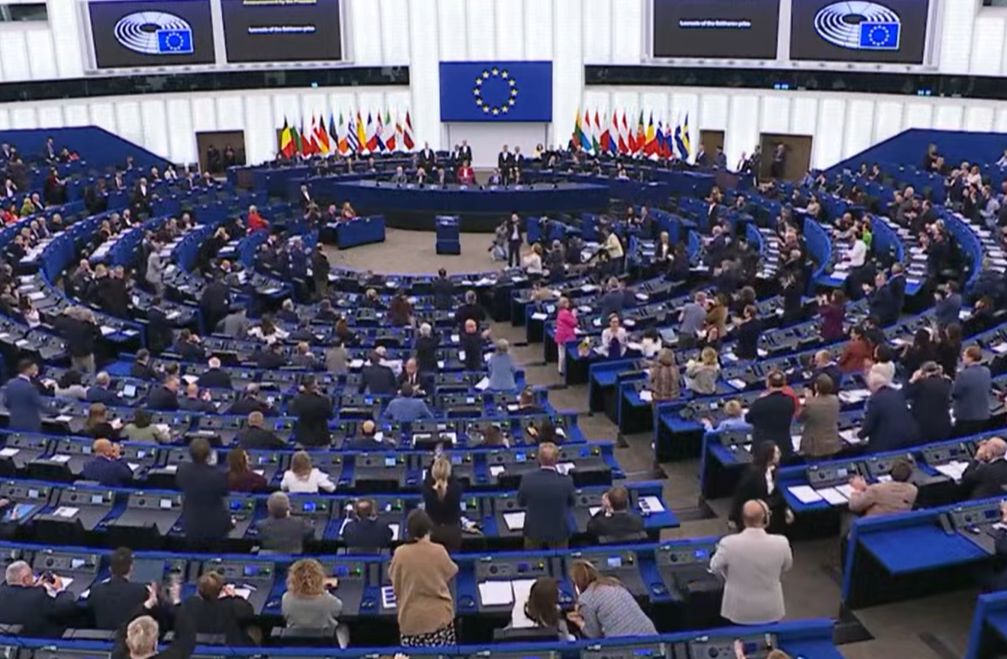

The European Parliament awarded its prestigious Sakharov Prize for Freedom of Thought to the International Criminal Court (ICC) and its officials on October 22, praising the institution for upholding international law and justice. The decision comes amid mounting criticism of the Court regarding judicial overreach, institutional integrity, and lack of impartiality.
Washington imposed sweeping sanctions on the ICC earlier this month following its pursuit of Israeli leaders and past investigations involving American forces. In November 2024, the Court issued arrest warrants for Israeli Prime Minister Benjamin Netanyahu and former Defense Minister Yoav Gallant on allegations of war crimes and crimes against humanity. Both the allegations and the Court’s authority to prosecute Israeli officials have been fiercely rejected.
The ICC’s jurisdiction is limited by the Rome Statute, the treaty that established the Court. Under the treaty, the ICC can prosecute crimes committed on the territory of a member state or by its nationals. It can also prosecute if a nonmember state expressly accepts its authority or if the UN Security Council refers a situation to the Court.
Since neither Israel nor the United States has joined the treaty, the ICC would ordinarily have no jurisdiction over nationals of either country. The ICC therefore attempted to claim authority over Israeli officials based on the UN Secretary-General’s acceptance of the Palestinian leadership’s application to join the Rome Statute in 2015 under the designation “State of Palestine.” Since no sovereign Palestinian state exists, this authority is contested. Moreover, the Oslo Accords signed by Israel and the Palestinians expressly deny the Palestinian Authority criminal jurisdiction over Israelis, leaving it no such authority to transfer to the ICC.
And even if the ICC had jurisdiction over Israeli officials, its handling of the case raises further legal objections. Legal scholars have argued that the Court failed to give Israel a fair opportunity to investigate the alleged crimes itself before seeking arrest warrants against its leaders.
Questions about the institution’s credibility intensified in July, when its member states removed chief prosecutor Karim Khan, who had sought the Israeli arrest warrants, after finding that he committed serious misconduct and a serious breach of duty. Khan denied wrongdoing. The Court has also faced longstanding criticism of selective justice, particularly its early concentration on African defendants, and accusations that some of its judicial interpretations stretch the boundaries of established international law.
The European Jewish Congress condemned the prize, describing itself as “appalled” and warning that the ICC’s handling of proceedings against Israel raised serious concerns about impartiality and due process. It argued that honoring an institution whose conduct remains the subject of substantial legal controversy risks undermining the credibility of the Sakharov Prize itself.
The decision follows the October 9 Nobel Peace Prize awarded to Navi Pillay, a former ICC judge who chaired the UN Commission of Inquiry that accused Israel of genocide in Gaza. Together, the two awards raise a troubling question about the use of prestigious international honors to confer legitimacy on institutions and officials whose handling of Israel remains deeply flawed.