
An overtly antisemitic campaign to drive Jewish-owned restaurants out of Philadelphia, scheduled for November 8, the eve of the anniversary of Kristallnacht, backfired spectacularly as Jews and supporters turned out in force, filling the targeted eateries with customers, creating hours-long lines and buying out every restaurant’s inventory.
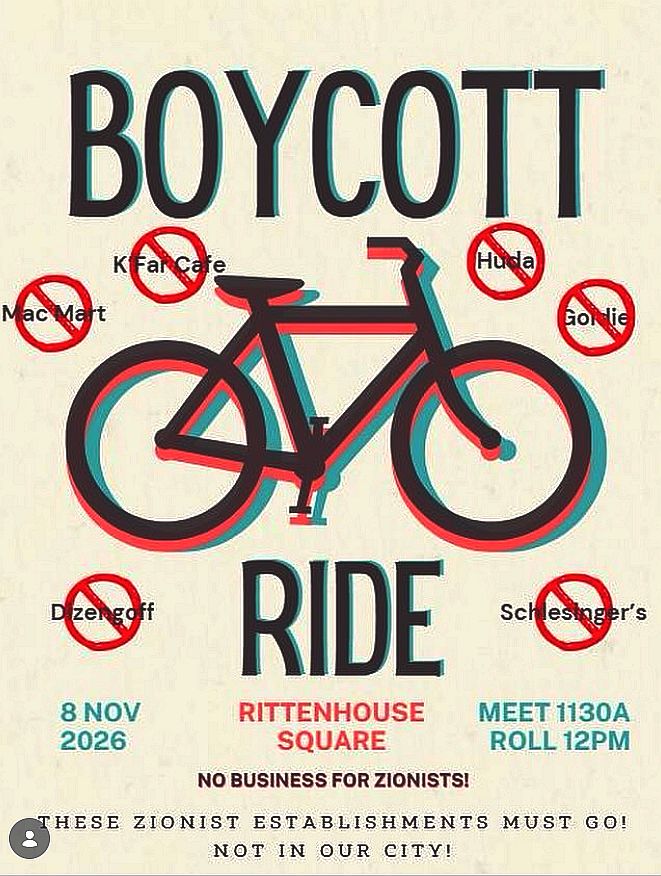
The campaign, organized by the pro-Palestinian cycling group Philly Bike On Your Left, called for a “Boycott Ride” targeting six Jewish-owned businesses in Philadelphia’s Rittenhouse Square neighborhood. Its promotional flyer declared, “No business for Zionists! These Zionist establishments must go! Not in our city!” The organizers described the targeted Jews as “disgusting humans.” The businesses included K’Far Café, Dizengoff and Goldie, owned by Israeli-born chef Michael Solomonov’s restaurant group, along with Huda, Schlesinger’s Delicatessen and Mac Mart, a macaroni-and-cheese shop.
The Kristallnacht boycott of Jewish-owned businesses was unconvincingly couched as anti-Zionist activism in solidarity with Palestinians. The Jewish business owners were singled out for collective punishment because they were presumed to support Israel. The cited offenses included raising humanitarian funds for United Hatzalah, an Israeli emergency medical service, and assistance for children injured or traumatized in the October 7 Hamas attacks on Israeli civilians. And the demand that these businesses “must go” clearly revealed the campaign’s goal was to exclude Jewish business owners from the city’s commercial life. That the boycott took place on the eve of the 88th anniversary of Kristallnacht, the 1938 Nazi pogrom in which Jewish businesses, homes and synagogues were systematically attacked and destroyed across Germany and Austria just drove home the fact that the same antisemitism has resurfaced, this time under the guise of Palestinian advocacy. That the organizers believed it sufficient to label their targets “Zionist establishments” and package it under the banner of Palestinian solidarity revealed their hubris in assuming Americans are ignorant of the history of antisemitism. And while they subsequently claimed to be “grossly misrepresented” and “to stand firmly against racism and oppression of all forms,” they convinced no one of the purity of their motives.
The condemnations came from across the political spectrum, religious communities and civic organizations. Philadelphia Mayor Cherelle Parker declared that singling out businesses because their owners are Jewish was unacceptable and had no place in the city. City Council President Kenyatta Johnson condemned the antisemitism and warned against ignoring the historical significance of the Kristallnacht anniversary. State Representative Amen Brown was even more forceful. “Targeting Jewish businesses because of who owns them is antisemitism. It is Jew-hatred,” he declared. Brown, who invoked his own experience as a Black man from West Philadelphia, insisted that Jewish businesses belonged in the city and would not be intimidated into leaving.
The denunciations crossed party lines. Republican Attorney General Dave Sunday condemned the boycott as discrimination drawing on some of history’s oldest antisemitic tactics. Republican Senator Dave McCormick called it “pure, unadulterated antisemitism,” while Democratic Senator John Fetterman denounced the campaign as a demonstration of Jew-hatred. Governor Josh Shapiro, Congressman Brendan Boyle and numerous other state and local officials all condemned the targeting of Jewish businesses. Religious and civic leaders joined the outcry. Catholic Bishop Timothy Senior of Harrisburg denounced the discrimination and invoked the Kristallnacht anniversary. The Philadelphia Council of Clergy Global expressed outrage at the hatred directed toward Jewish neighbors, while the NAACP spoke out against antisemitism. The Pennsylvania Restaurant & Lodging Association similarly condemned the harassment and intimidation of restaurant owners.
One notable exception was Democratic Congressman-elect Chris Rabb, a member of the Democratic Socialists of America (DSA), recently elected to represent the very district where the Jewish businesses were targeted. As of November 10, Rabb had remained silent, failing to condemn the boycott or respond to repeated requests for comment while the Philadelphia DSA, which had endorsed and campaigned for Rabb, dismissed the condemnations of the attempted anti-Jewish boycott as politically motivated attempts to conflate antisemitism with anti-Zionism, although it denied organizing or endorsing the demonstration. The Jewish Federation of Greater Philadelphia rebuked Rabb’s silence, declaring that Jewish Philadelphians should not have to wonder whether their incoming congressional representative would stand with them when they were targeted for being Jewish.
Jewish organizations and their supporters mobilized to turn the boycott on its head. The Jewish Federation of Greater Philadelphia urged residents to patronize the targeted businesses, while the nonprofit JewBelong installed 14 billboards across the city encouraging residents to boycott the boycott.
Hundreds of Jews and non-Jewish supporters gathered in Rittenhouse Square and the surrounding streets. Israeli flags waved, demonstrators sang Jewish songs, and signs declared “End Jew-Hatred,” “Curb Your Antisemitism” and “I Am Not a Jew With Trembling Knees.” As the cyclists rode past, they encountered the counterprotesters who jeered and booed them.
But the most striking repudiation of the boycott came from the customers who flocked to the targeted restaurants. Jews and non-Jews alike lined up for hours to patronize the very establishments the organizers had demanded be shunned. Lines stretched around city blocks, with some supporters traveling from New York, Baltimore and Washington, D.C. At Schlesinger’s Delicatessen, customers waited more than an hour and a half for food. Mac Mart, ordinarily closed on Sundays, opened especially for the occasion and was overwhelmed by customers.
Instead of depriving the targeted restaurants of business, the boycott brought them an unprecedented influx of customers. According to Michael Balaban, CEO of the Jewish Federation of Greater Philadelphia, all six businesses sold out their inventory. At Mac Mart, one customer even offered to buy an open box of baking soda after the shop had run out of food. “What was supposed to be a boycott of Jewish businesses turned into a food festival of Jewish businesses,” Balaban observed.
The organizers had demanded “No business for Zionists” and declared that Jewish-owned establishments “must go.” Instead, their effort to ostracize Jewish business owners brought an extraordinary outpouring of public support that transformed an antisemitic boycott on the eve of Kristallnacht into a resounding demonstration of solidarity with the very people it sought to exclude.