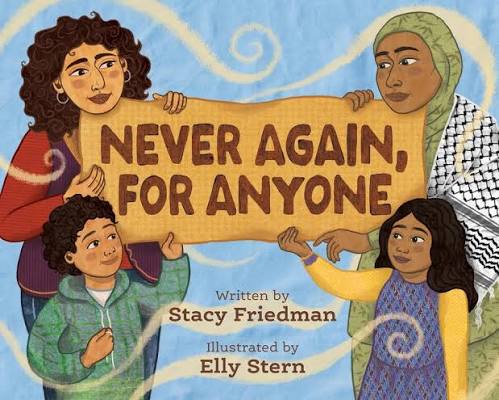

NEVER AGAIN, FOR ANYONE, by Stacy Friedman, illustrated by Elly Stern. Arsenal Pulp Press, Vancouver, 2026
“The first sin is to call bad, good, and good, bad, highlighting how our linguistic gift of description contains a powerful peril.” Rabbi Samson Rafael Hirsch
The anniversary of the October 7 massacre immediately preceded the Torah reading of “Bereisheet.” This biblical story of the Garden of Eden signals a pivotal moment in the moral evolution of humanity, as the serpent employs verbal cunning to convince Eve to defy God’s injunction against eating from the Tree of Knowledge of Good and Evil: “You shall not surely die,” says the serpent, “for God knows that on the day you eat of it, then your eyes shall be opened, and you shall be as gods, knowing good and evil.” (Genesis 3:4)
According to Rabbi Meir Soloveichik, what the serpent was counselling was a moral free-for-all, in which good and evil in the newly-created world would be determined not by God’s moral limits, but by every individual’s perception of what is good and what is evil.
The consequences of this moral relativism have rarely been as clear as in the dystopian world we’ve inhabited since Hamas’s sadistic orgy of death of October 7. Women were raped and mutilated, families were burnt alive, people were tortured to death and decapitated – yet young people on campuses and in the streets of major cities in Europe, the Americas and Australia rejoiced, their professors describing feelings of exhilaration, as massive marches exuded both rage at Israel and jubilation over Israeli deaths. Israel was accused of “genocide” even before it began to defend itself against these brutal attacks. Hamas’s crimes were quickly denied or explained away (UN Women, for example, whose mantra had been “believe survivors,” took two months to release a tone-deaf statement).
Perhaps most shocking to me, as a children’s author and teacher, has been to encounter this moral inversion even in literature for the youngest readers, the preschoolers who enjoy picture books.
The “G” Word
The Jewish author-illustrator team of Stacy Friedman and Elly Stern has just released a preschool polemic, NEVER AGAIN, FOR ANYONE. I mention their Jewish identity because they wear it proudly; it’s the Jewish fig leaf that masks their antizionist propaganda.
The title’s message is clear enough: If Jews say “Never Again” for the Holocaust, then they are forbidden to visit a second Holocaust on the Palestinians. Whether naively or cynically, this author-illustrator team applies a thick veneer of Jewish rituals and religious precepts to an anti-Israel polemic in order to sever Judaism from the land of Israel. Thus, the book opens with an epigraph invoking a lofty Jewish principle: “That which is hateful to you, do not do to your fellow – Hillel the Elder” – perverting Jewish ethics by turning the victims of October 7into the offenders.
Since October 7, Israel – alone on the world stage – has been regularly called to the docket to empty its pockets, singled out for the crime of genocide while actual genocide is ignored in Sudan (through murder, rape, and starvation), in Xianjiang, China (through culturally erasing its Uyghur population), and elsewhere. The devious motive for the absurd genocide charge is to efface the Holocaust as a step towards eliminating Israel, and one balks at having to repudiate what is obvously a politicized accusation. Unfortunately, because it is the premise of this dangerous children’s book, the charge must be answered.
In his eloquent essay for The Free Press, in the wake of former UN High Commissioner for Human Rights Navi Pillay’s receipt of the Nobel Peace Prize, Elie Wiesel’s son Elisha answered the accusation succinctly:
Israel dropped leaflets and called civilians to tell them to evacuate before striking. What genocidal country vaccinates its targets against polio? There are victims on both sides of the Gaza border, but just one party sought the bloodshed. Genocide is the intent to destroy a people, and that intent is spelled out in only one place: the charter and conduct of Hamas.
On October 7, 2026, the third anniversary of the Hamas attack, 78 retired American military professionals issued an open letter refuting the genocide accusation. They stated:
[G]enocide is a grave and exceptional violation of international law, defined and prohibited by the Genocide Convention of 1948 and enumerated as a crime in the Statute of the International Criminal Court and in the U.S. federal criminal code. The allegations that Israel committed this crime do not meet the established definition and standards of genocide, are unsupported by established facts, nor do they stand up to common sense scrutiny. . . .
[E]stablished legal precedent makes clear that civilian deaths occurring during combat, however tragic, are insufficient, by themselves, to support a finding of genocidal intent. That is because of the unfortunate realities of war and the laws that govern it, both of which Israel’s accusers appear woefully ignorant. . . Assessments of Israeli combat operations, undertaken by some of the signatories to this letter, describe a military taking an unprecedented combination of precautions to avoid civilian casualties; not one following orders to destroy Palestinians as a group. (emphasis added)
Stacy Friedman doesn’t use the word “genocide” in the children’s text (she does in the Note for Parents), but by insisting on the moral equivalence of Israel’s treatment of Palestinians and the murder of Jews in the Holocaust (the historical event which gave the world the word “genocide”), she makes her belief in that equivalence clear, demonstrating the “woeful ignorance” to which these military experts allude.
The Story
Friedman’s story opens outside a kindergarten at pick-up time. On the left-hand page, little Ameera is in the loving arms of her hijab- and keffiya-clad mother. The faces of mother and child are mournful. Meanwhile, on the right-hand page, Lev is beaming as he and his mother walk home to prepare for Shabbat. While the Palestinian family has something to mourn (the attack on Gaza is implied, at least for the adult reader), Lev and his mom (“Ima”), are portrayed as footloose and fancy free – which is curious, because the events of this story happen in the aftermath of the October 7 massacre, an event that traumatized Jews throughout the world. Could Lev’s mother be unaware that Hamas had just murdered 1200 of her fellow Jews and kidnapped 251 others?
As they braid the challah, Ima shares with Lev the story of his Bubbie. A hidden child during World War II, she suffered miserably. This happened, according to Ima, because “people in power” didn’t like Jews.
As Ima retrieves the fragrant challah from the oven, Lev hears chants of “Free free Palestine” and “The occupation has to go” through the window, and asks his mother what it all means:
Well [she explains], Palestinian people’s homes and land were stolen or destroyed to create a country called Israel. The people outside are marching to demand that Palestinians have the right to return and live safely in their homes. People with power are making life dangerous for Palestinians, making it hard to get food and medicine or go to school. (Emphasis added.)
These factual errors betray the author’s ignorance of both Israeli history and international law. Israel didn’t steal Palestinian land. Well before the War of Independence (starting in the late nineteenth century), Zionists purchased land where since antiquity Jews had lived and ruled and from which they had been periodically exiled. The tracts purchased from Arab owners, many of whom didn’t live in Palestine, were often malarial swamps. The land had been Ottoman until the fall of the Ottoman Empire at the end of World War I, then became territory governed under Britain’s Mandate for Palestine. Never at any time in any era had there been a sovereign state of Palestine.
During the Israeli War of Independence, about 600,000 Palestinians fled, were exhorted to leave by their leaders, or in limited cases were driven out for military and security reasons by the Israeli army.
In the same period, there were other population upheavals of far greater magnitude related to emerging nation states. For comparison, think of the 14,000,000 Indian and Pakistani refugees during India’s war for independence and the creation of Pakistan, or the 12,000,000 ethnic Germans who fled west from central and eastern Europe at the end of World War II. In all these cases, the refugees resumed lives in new circumstances.
Under international law, there is no right of return for refugees. If Friedman and Stern don’t believe this, they should read Adi Schwartz and Einat Wilf’s exhaustive study of refugee law, The War of Return.
Interestingly, NEVER AGAIN, FOR ANYONE doesn’t even mention that approximately 160,000 Arabs remained in Israel or returned after the war and are today full citizens of the country. The authors also omit entirely a similarly-sized wave of refugees – the 800,000 Jews driven out of Arab lands before and after Israel’s War of Independence. About 600,000 of these came to Israel, but unlike the Palestinian refugees, they were settled and absorbed into their new country.
In some Arab nations to which Palestinians fled, the refugees were denied full integration into the host population. Only Jordan recognized Palestinian Arabs as citizens; King Abdullah considered Jordanians and Arabs from Palestine to be one people. In Lebanon, however, Palestinian refugees continue to be denied basic rights, including the right to own real estate or property. They are also denied admission into more than 20 professions, including medicine, law, engineering, pharmacy, and journalism, and have difficulty securing work permits. They rely on UNRWA for social services, including medical care.
Friedman and Stern use Bubbie’s story to drive home a humanitarian message: we should channel our suffering into empathy for other people. So Bubbie visited new immigrants in her neighbourhood, and marched against the war in Iraq. Her motto wasn’t just “Never Again.” It became “NEVER AGAIN, FOR ANYONE.”
But Bubbie’s empathy was not exceptional; many Holocaust survivors – like Elie Wiesel (author of the haunting Night) and Victor Frankl, psychologist-author of Man’s Search for Meaning – took on humanitarian missions. The great German neurosurgeon Dr. Ludovic Goodman (Ludwig Guttmann), whose pioneering work with paraplegics led him to found the Parallel Olympics (later the Paralympics), is another example. Rabbi Jonathan Sacks explains his thinking:
[H]e was a man the Germans regarded as subhuman, vermin, lice, and he knew he wasn’t subhuman. He looked at these paraplegics and realised they weren’t subhuman either. That was his taking his pain to cure the pain of others and give them new hope and new life.
Jewish Privilege, Palestinian Victimhood
In the discussion questions that follow the story, Friedman addresses the child on the adult reader’s lap with questions like, “What do you know about the injustices that Palestinian people face?” Given that this is a picture book, it’s doubtful that its young audience will grasp terms like “injustice” or know what “Palestinians” are. When preschoolers think of injustices, they’re more concerned with the friend who grabbed their truck, or butted ahead of them in line.
Nor does it occur to the author to follow this loaded question with the other side of the equation: “What do you know about the injustices the Israeli people face?” But those injustices were on full display on October 7, and have been extensively documented since that date. British historian Sir Andrew Roberts compiled the 172-page 7 October Parliamentary Commission Report, documenting Hamas’s atrocities for the British Parliament. A more accessible source is Israeli spokesperson and TV anchor Alon Penzel’s Testimonies without Boundaries: Israel: October 7th, 2023, which meticulously chronicles the atrocities.
ZAKA, Israel’s Disaster Victim Identification organization, recovers the remains of victims of accidents and terrorist attacks. Simcha Greinman was one of the ZAKA volunteers who went to Kibbutz Be’eri in the wake of the pogrom – even while Hamas terrorists were still roaming the kibbutz. He was accompanied by Penzel, who was determined to compile a detailed record of Hamas’s crimes.
Here, in Greinman’s own words, and for Stacy Friedman’s enlightenment, is what he found in the kindergarten:
We continued to the second room in that kindergarten, where we found a very small three or four-year-old child. We witnessed a very, very shocking scene. He had a knife stuck in his head, inside the skull. On the floor was a hammer whose handle was completely burned, and on the hammer itself were pieces of the toddler’s skull. (pp. 17-18)
On its surface, the title NEVER AGAIN, FOR ANYONE, appeals for equity in justice. But if you don’t believe that driving a knife into the skull of a Jewish three-year-old bears mention in the aftermath of the October 7 attack, if you erase the burning of living Jews, the desecration of bodies, the sadistic rape and sexual torture of Israeli men and women and the taking of 251 hostages, you can’t pretend to care about justice. If, in order to prove that you’re a good person, you close your eyes to Jewish suffering, then you don’t care about justice. You just care about flaunting your progressive credentials.
Research, or Cherry-picking?
Did Friedman and Stern not even bother to seek out any accounts of the October 7 atrocities? Was Arsenal Pulp, whose publisher Brian Lam signed the November 3, 2023 Publishers for Palestine Statement of Solidarity accusing Israel of genocide and entirely omitting Hamas’s assault on Israeli civilians, intentionally blind to Israeli suffering – or caught in an information bubble that excluded the Jewish and Israeli perspective? Or did they decide that Friedman and Stern’s Jewish identity gives them a free pass to make up facts rather than undertaking careful research? Maybe author, illustrator and publisher just knew that Israel attacked Gaza simply for the fun of attacking Gaza, even at the cost of the lives of 915 soldiers and the disruption to thousands of Israeli reservists’ education, family life, mental health and livelihoods.
Whatever is the case, you won’t find any of the following facts in the book’s Note for Parents:
- That the 1988 Hamas charter, citing the Prophet Mohammed, calls for the slaughter of every Jew on the planet: “The Day of Judgement will not come about until Muslims fight the Jews (killing the Jews), when the Jew will hide behind stones and trees. The stones and trees will say O Muslims, O Abdulla, there is a Jew behind me, come and kill him. Only the Gharkad tree, would not do that because it is one of the trees of the Jews.”
- That Gaza had not been occupied by Israel since 2005, when Israel uprooted every Israeli home, business, farm, and synagogue.
- That Gaza’s schools, operated by UNRWA principals and teachers (many affiliated with Hamas) teach Gazan children that it is virtuous to kill Jews.
- That, from the moment Hamas won an election in Gaza in 2006, they initiated a civil war to wipe out their Fatah opposition, pushing some off rooptops to their death.
- That, in the current conflict, Hamas concealed themselves deep in 350 – 450 miles of tunnels that could easily have sheltered Gazan civilians,who were forbidden to shelter within them, since they were more valuable to Hamas as corpses in the propaganda war..
- That, in the current conflict, Hamas confiscated food, including baby formula. As Honest Reporting explained, “substantial food entered Gaza, but Hamas seized much of it, diverted large quantities to fighters, and sold the remainder on the black market at prices ordinary Gazans could not afford.” Friedman states that “people in power” are “making it hard to get food” there. To which “people in power” is she referring?
- That, unlike Israel, which is officially tolerant of homosexuals, including within the IDF, Hamas tortures gays. A UN Watch report from 2022, “Torturing Palestinians,” cites this testimony from a gay man from Gaza: “They arrested me, hanged me from the ceiling, beat me up and interrogated me for five days.” So why does one of the protestors in NEVER AGAIN, FOR ANYONE carry a pro-gay poster that reads, “Stop Pinkwashing”? Is it “pinkwashing” to tell the truth about Hamas’s persecution of gays, a fact that should make some of Hamas’s gay supporters think twice about their support for this bigoted organization.
Who’s the Audience?
Picture books have two audiences – the child who is read to, and the adult who reads. Much of NEVER AGAIN, FOR ANYONE seems to be directed at the latter. The child on the parent’s knee can’t read the posters held up in the protests depicted. What is a child to make of a placard that reads, “U.S. OUT OF IRAQ. WAR IS NOT THE ANSWER”? Where is Iraq, and why would a child be interested in a war that happened there? What about QUEERS AGAINST PINKWASHING? Of what interest is that to a preschooler?
I’ve shared a wealth of picture books with my own children and grandchildren – none of them political. They cover a range of genres: classic fairy tales like Cinderella, folk tales like Jack and the Beanstalk, alphabet books, counting books, hilarious books like The Paper Bag Princess (a send-up of the classic dragon-and-princess fairy tale), and magical books like Maurice Sendak’s Where the Wild Things Are. Force-feeding vulnerable young children with political propaganda is what totalitarian cultures like China, Russia, and North Korea do. Free societies share picture books to encourage a love of rhyme and rhythm, to satisfy children’s curiosity about bugs, birds, and beasts, and to transport them, in Maurice Sendak’s words, “through night and day and in and out of weeks and almost over a year to where the wild things are.”
But force-feeding is what NEVER AGAIN, FOR ANYONE is up to, most overtly in the Note for Parents, which lists seven organizations in the US, Canada, and the UK the parent can contact to put their pro-Palestinian impulses into action.
Among these NGOs are Jewish Voice for Peace (JVP), a radical organization that supports terrorists. In 2017, they supported convicted terrorist and PFLP operative Rasmeah Odeh in her deportation proceedings from the US. The PFLP is designated as a terrorist organization by the US, EU, Canada and Israel.
As this is a Canadian book, the author also includes Independent Jewish Voices, a small Canadian anti-Israel group, hardly representative of Canadian Jewish opinion, which is overwhelmingly pro-Israel. IJV opposes the IHRA definition of antisemitism, supports BDS, and has partnered with Samidoun, designated a terrorist entity in Canada over its ties to the terrorist group the Popular Front for the Liberation of Palestine (PFLP).
Anti-Israel Judaism?
In the Note for Parents, Friedman blames “powerful voices” for presenting “a view of Judaism that conflates the Jewish religion with the Zionist state.” But the most powerful voice that does that is the Hebrew Bible – specifically the chapter of Genesis read this year on the Sabbath after the third anniversary of the October 7 pogrom. God commands Abram (soon to be renamed Abraham), as follows:
Go forth from your native land and from your father’s house to the land that I will show you.
I will make of you a great nation,
And I will bless you;
I will make your name great,
And you shall be a blessing.
I will bless those who bless you
And curse the one who curses you;
And all the families of the earth
Shall bless themselves by you.
You can’t sever Judaism from its biblical roots and from the land in which the Jewish faith and nation were born thousands of years ago, and where Jews established a temple and capital in Jerusalem. Jewish belief that God promised the land to Abraham and his descendants in an enduring covenant is central to the religion. Whatever faith Friedman and Stern have confected to camouflage their political agenda – whatever mix of Shabbat candles, challah, and Bubbie stories – it’s not Judaism.
Conclusion
If little children who hear this story come away with anything, it is likely to be the impression that big, bad Israel stole a country away from pure, innocent people called Palestinians. The uninformed adults who read this book will walk away with the impression that Israel is an interloper in a land to which Israelis have no connection – that Israel is the aggressor, not the victim. Characterizing tyrannical Hamas as good and democratic Israel as bad is spreading a Big Lie, to borrow a term from the Nazis. It’s the lie this book promotes. It’s the lie that worked in the 1930s and 40s. Unfortunately, it’s the lie that is working all too well in some quarters today.
Marjorie Gann is a children’s author, essayist, and book reviewer. Her book Five Thousand Years of Slavery (Tundra, 2011) was named a 2012 Notable Book for a Global Society by the International Reading Association. A subsequent title, Speak a Word for Freedom: Women Against Slavery (Tundra, 2015), covers the history of women’s contribution to abolitionism. A retired teacher, she contributed an essay on teaching the history of world slavery to The 1867 Project: Why Canada Should be Cherished, Not Cancelled, published by Canada’s Aristotle Foundation, where she is a Senior Fellow. Her essay “Empty Shelves: The Noxious Politics Behind a Canadian School Board’s Massive Book Purge,” was published by C2C Journal in December, 2023. A Senior Fellow of the Foundation for Truth About Israel (FTI), she writes on children’s literature and reviews children’s and young adult books.