
The UN Commission of Inquiry’s finding that Israel committed genocide in Gaza has given powerful ammunition to those who promote the biased allegation as established fact. Amnesty International hailed the commission’s September 2025 report as “further confirmation” of genocide, while Human Rights Watch called the report “rigorous” and cited it as evidence of a growing consensus. But the commission’s report is far from authoritative.
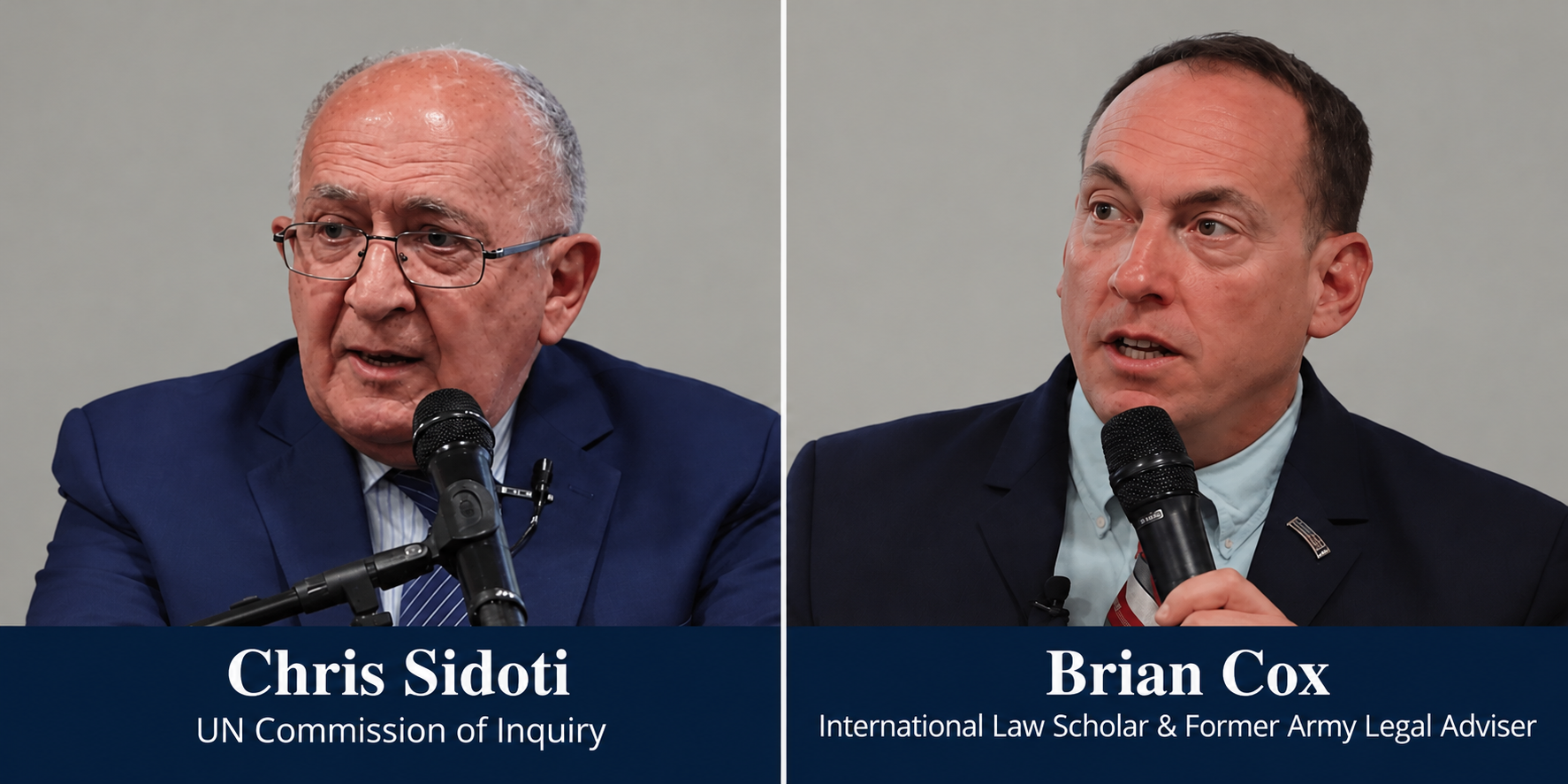
Its flawed reasoning and gaps in evidence had already been challenged in a detailed rebuttal following its release. Those shortcomings came into even sharper focus during an October 8, 2026, public debate at Caulfield Hebrew Congregation in Melbourne, Australia, where Chris Sidoti, one of the three UN commissioners responsible for the report, was repeatedly challenged to defend its evidence and conclusions.
Opposing him was Dr. Brian L. Cox, an international law scholar, former adjunct professor at Cornell Law School and senior fellow at the Macdonald-Laurier Institute. A retired U.S. Army officer with 22 years of service, Cox spent seven years as a military lawyer, including serving as Chief of International and Operational Law for Regional Command-East in Afghanistan. Cox challenged the commission’s interpretation of international law, its treatment of Israeli military operations and its evidence of genocidal intent. Audience members confronted Sidoti with conflicting accounts in the commission’s own reports.
Throughout the exchanges, Sidoti continued to defend the commission’s conclusions, even as he acknowledged uncertainty about important facts and struggled to explain discrepancies in the evidence.
To support its genocide finding, the commission cited widespread destruction and civilian deaths in Gaza, alleged deliberate attacks on children and medical facilities, the destruction of a fertility clinic, and statements by Israeli leaders interpreted as evidence of genocidal intent. Taken together, the commission concluded, these demonstrated an Israeli intention to destroy Palestinians in Gaza as a group.
But under international law, when genocidal intent is inferred from conduct, it must be the only reasonable inference supported by the evidence. The commission was thus required to demonstrate why competing explanations could be ruled out. Yet when Cox presented such alternatives, Sidoti repeatedly defended the commission’s interpretations without adequately explaining why those competing explanations were unreasonable.
The debate took place just one day before the Norwegian Nobel Committee announced that Navi Pillay, who chaired the commission, had won the 2026 Nobel Peace Prize, despite longstanding criticism of her anti-Israel record and the commission’s methodology, examined in our earlier report.
The Melbourne debate exposed another fundamental problem with the genocide accusation. Organizations and commentators have reinforced one another’s conclusions by repeating similar allegations, quotations and interpretations, creating an impression of mounting independent evidence even where the underlying arguments remain disputed.
The Legal Standard the Commission Claimed To, But Did Not, Meet
Under Article II of the 1948 Genocide Convention, genocide requires dolus specialis, the specific intent to destroy, in whole or in part, a national, ethnic, racial or religious group as such. That intent can be established directly or inferred from conduct. But the International Court of Justice ruled in Croatia v. Serbia (paragraphs 143–148), that genocidal intent inferred from a pattern of conduct must be the only reasonable inference supported by the acts in question.
The Convention’s 1947 Secretariat commentary (UN Doc. E/447, page 23) expressly distinguished genocide from civilian losses sustained during military operations, even on a large scale. Such losses do not ordinarily constitute genocide but fall under the laws governing warfare. Without the requirement of specific intent, virtually any war fought in densely populated civilian areas, with extensive casualties and destruction, could be characterized as genocidal.
Although the commission acknowledged this legal standard and cited evidence that could support alternative explanations, it declared genocidal intent to be the “only reasonable inference” without demonstrating why it had rejected those alternatives as unreasonable (paragraph 254).
That gap between the standard the commission cited and the reasoning it offered lay at the heart of the challenges raised in Melbourne.
Using the Same Arguments, Omitting the Same Context
The commission’s treatment of statements by Israeli leaders illustrates its failure to reconcile evidence supporting competing interpretations with its finding of genocidal intent.
Yoav Gallant — “Human Animals” Reference
The commission cited Defense Minister Yoav Gallant’s October 9, 2023, description of the enemy as “human animals” as evidence of an intention to destroy Palestinians in Gaza. Yet Gallant repeated virtually the same remarks to soldiers in the field the following day, explicitly identifying whom he meant. “We are fighting against human animals. This is the ISIS of Gaza,” he declared, adding, “There will be no Hamas.”
While the commission actually acknowledged (paragraph 230) that Gallant’s October 10 statement referred to Hamas fighters, it insisted that his use of the same expression a day earlier referred to Gaza’s entire population because it accompanied his announcement of a siege. The commission thus used the siege’s impact on Gaza’s civilians to justify interpreting Gallant’s description of the enemy as a reference to all Palestinians, despite his explicit identification of Hamas specifically as that enemy.
PM Benjamin Netanyahu — Amalek Reference
The commission similarly interpreted Prime Minister Benjamin Netanyahu’s invocation of Amalek, an ancient biblical enemy of the Israelites, as evidence of genocidal intent. Speaking three weeks after Hamas’s October 7 massacre, Netanyahu quoted Deuteronomy 25:17, “Remember what Amalek did to you,” a reference to the Amalekites’ attack on the Israelites following their exodus from Egypt.
The commission’s report, however, interpreted his words through an entirely different biblical passage, 1 Samuel 15:3, which commands the killing of Amalekite men, women and children, although Netanyahu had never invoked that passage. The commission thus attached the meaning of a command to annihilate an entire people to a quotation calling for remembrance of an ancient attack.
Its interpretation also disregarded an important principle of Jewish law. Since no contemporary nation can be identified as Amalek, references to Amalek have long been understood as moral or symbolic allusions to enemies seeking the destruction of the Jewish people, rather than as directives to annihilate a contemporary population. This distinction is recognized in traditional Jewish legal commentary and explained by the late Rabbi Jonathan Sacks in an essay.
Even more tellingly, Netanyahu’s October 28 speech explicitly identified the enemy as the murderers responsible for the atrocities of October 7, specified Israel’s objectives as destroying Hamas’s military and governing capabilities and recovering the hostages, and urged Gaza’s civilian population to evacuate south. Nevertheless, the commission interpreted his biblical reference as evidence of an intention to destroy Palestinians as a people, without demonstrating why it had rejected the interpretation supported by his actual words and stated objectives.
The same conflation of biblical passages had appeared in a November 2023 essay by genocide scholar Omer Bartov and in South Africa’s subsequent application to the International Court of Justice, before appearing in the commission’s June 2024 and September 2025 reports. The repeated interpretation gained authority without establishing why a biblical command Netanyahu never invoked should override the passage he actually quoted and the objectives he expressly stated.
Military Destruction and the Missing Context
The commission’s treatment of Israel’s military operations revealed a related problem. Its genocide analysis relied heavily on the scale of destruction caused by Israeli forces without adequately accounting for the military circumstances of the war Hamas initiated with its October 7, 2023, massacre and hostage-taking. These included Hamas’s extensive tunnel network, its fighters and weapons embedded within densely populated civilian areas, its use of civilian infrastructure for military purposes and its continuing attacks against Israel.
Sidoti similarly pointed to evidence of “total destruction”—damaged homes, schools and hospitals—to support the commission’s conclusion. Yet the visible aftermath of an attack does not establish its military objective or the intentions of those responsible. A building destroyed during an operation against an underground tunnel or Hamas position may exhibit the same damage as one deliberately destroyed to devastate a civilian neighborhood.
The commission nevertheless treated the extent of destruction as evidence of genocidal intent without demonstrating why Israel’s military operations against Hamas could not reasonably explain it. Once again, it declared genocidal intent the “only reasonable inference” without proving why competing explanations were unreasonable.
Sidoti’s Defense
The failure to rule out reasonable military explanations became especially significant during the Melbourne debate. When Cox challenged the commission’s finding of genocidal intent, Sidoti stated that it had considered Netanyahu’s qualifying statements but found them unpersuasive in light of Israel’s military actions. Yet he failed to explain how those actions established an intention to destroy Palestinians as a people rather than to defeat Hamas.
The commission had acknowledged competing explanations and the legal requirement that genocidal intent be the “only reasonable inference” from the evidence. Yet it treated its assertion that those explanations had been considered and rejected as sufficient to meet that requirement. Sidoti employed the same approach in Melbourne, declaring competing explanations unpersuasive without demonstrating why they were so.
Sidoti further argued that Israel’s stated objective of defeating Hamas did not rule out genocidal intent. The two could coexist, he suggested, with genocide serving as the “strategy” for achieving that military objective. But the fact that genocide could theoretically be used to defeat Hamas does not establish that Israel actually adopted such a strategy. Sidoti offered no explanation of why defeating Hamas through military operations was an unreasonable alternative to the commission’s finding of genocidal intent.
His response raises a fundamental question: Was the commission determined to find Israel guilty of genocide regardless of what the evidence showed?
When Inference Becomes Evidence
The commission relied on an unverified civilian death rate and attributed genocidal intent to the destruction of a fertility clinic without establishing what those responsible knew or intended.
The 83 Percent Civilian Figure
In its September 2025 report, the commission cited a civilian death rate of 83 percent, derived from a media investigation of an Israeli intelligence database. The database reportedly identified approximately 8,900 Hamas and Palestinian Islamic Jihad militants as dead or probably dead among roughly 53,000 Palestinian fatalities.
An audience member asked Sidoti whether the commission had independently established that the remaining approximately 44,000 fatalities were civilians. He acknowledged, “No, we didn’t because we don’t have that information.” Nor had the commission independently verified the figures for combatant deaths. “So we literally do not know,” Sidoti conceded.
Yet the commission had cited a civilian death rate of 83 percent based on a calculation that effectively classified everyone absent from a list of identified militants as a civilian. Even an accurately established civilian death toll would require further evidence before it could support conclusions about deliberate targeting or genocidal intent.
The Al-Basma Fertility Clinic
Another point brought up at the debate was the supposed evidence for genocidal intent regarding Gaza’s Al-Basma fertility clinic. The commission had claimed that the destruction of the clinic demonstrated Israel’s intention to prevent Palestinian births, one of the acts prohibited under the Genocide Convention when accompanied by genocidal intent.
Audience member Mark Kuperholz confronted Sidoti with conflicting accounts in the commission’s own reports. Its September 2024 report attributed the destruction of approximately 3,000 embryos to airstrikes. By March 2025, a revised account identified an Israeli tank shell as the probable cause and increased the reported losses to 4,000 embryos and another 1,000 reproductive specimens.
Kuperholz questioned the forensic evidence identifying a tank shell and raised alternative explanations for the embryos’ destruction, including failure of the liquid nitrogen system needed to preserve them. Sidoti insisted that a tank shell was responsible but was unable to reconcile the conflicting reports.
“I’m stumbling and I know that I shouldn’t be stumbling in front of this particular audience,” he conceded, acknowledging that he needed to review the evidence.
Cox challenged the commission’s inference of genocidal intent. Even if an Israeli tank shell had struck the clinic, he argued, the evidence failed to establish that those responsible knew the building housed reproductive material or that preventing Palestinian births was the purpose of the attack.
The commission had thus attributed a specific genocidal purpose to an incident whose basic circumstances remained disputed, without adequately establishing the knowledge or intentions of those responsible.
An Earlier Debate Exposed the Same Problem
The commission’s tendency to infer deliberate intent from incomplete evidence had already been raised during an August 2026 debate between Sidoti and Cox concerning its previous, June 2026 report, which accused Israeli forces of deliberately targeting Palestinian children.
Rather than answer a legal critique challenging the commission to substantiate even one case of Israeli soldiers knowingly and deliberately targeting a civilian child, Sidoti dismissed it as “ideological.” He later cited the deaths of two young brothers allegedly shot by an Israeli quadcopter. Sidoti said video evidence indicated that a quadcopter was responsible and attributed the shooting to Israeli forces because, he asserted, Hamas did not possess such drones. He then argued that the quadcopter’s surveillance capabilities would have enabled its operators to recognize the boys as children.
Sidoti thus inferred deliberate targeting from what the operators could have seen, without establishing what they actually saw or whether they knowingly fired on civilian children. The commission’s conclusion depended on an assumption about the operators’ knowledge and intent that the evidence Sidoti presented did not not establish.
When Institutional Agreement Becomes Its Own Evidence
The commission’s conclusion that Israel committed genocide rests on flimsy evidence and disputed assumptions. Yet individuals and organizations have repeatedly cited its findings to spread the genocide libel against Israel. This raises a fundamental question: How much of the supposed consensus rests on independent evidence, and how much on institutions repeating one another’s conclusions?
The commission itself contributed to this process by misrepresenting the International Court of Justice’s January 2024 orders in South Africa v. Israel as finding it plausible that Israel was committing genocide.
This was untrue. Then-ICJ President Joan Donoghue explained in a BBC HARDtalk interview that while the court had recognized the Palestinians’ plausible right to protection from genocide, it had made no finding about the plausibility of the genocide allegation itself.
When Cox challenged Sidoti on this point, Sidoti insisted that the commission’s interpretation was consistent with Donoghue’s explanation. Once again, Sidoti treated the commission’s assertion as sufficient to settle the matter, without explaining how it could be reconciled with the former court president’s explicit clarification. The commission had thus claimed the authority of the world’s highest court for a conclusion the court had never reached.
The process also worked in reverse. The endorsements by Human Rights Watch and Amnesty International cited at the beginning of this article expose a disturbing pattern of circular reasoning masquerading as independent corroboration. Organizations and politicians intent on promoting the genocide accusation cite the commission’s findings as confirmation of their own allegations, while their endorsements, in turn, appear to validate the commission’s conclusions. This echo chamber creates the illusion of mounting proof, as the same disputed claims are repeated and amplified without new evidence or any resolution of the flaws in the original evidence and reasoning.
If not actively countered, the danger is that the falsehoods that are echoed again and again by powerful institutions, politicians and commentators can ultimately be written into history as established fact.