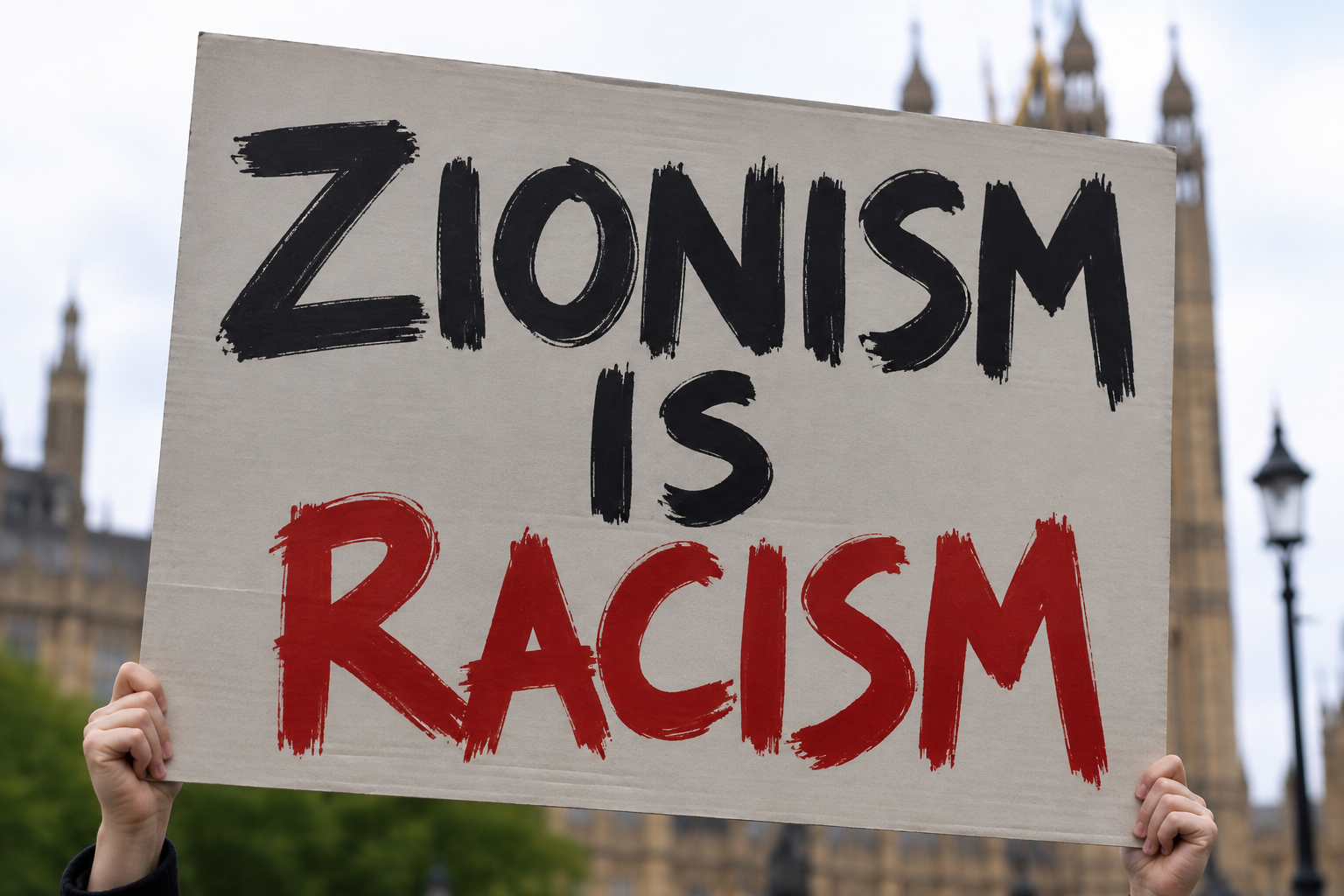

Britain’s Green Party, a hard-left, radical progressive party led by Zack Polanski, a self-declared anti-Zionist Jew, recently revived a charge formally repudiated by the United Nations more than three decades ago when it adopted a resolution equating Zionism with racism.
The principal author and organizer of the resolution was British-Palestinian activist Lubna Speitan, a leading member of Greens for Palestine, an activist group that encouraged supporters to join the Green Party specifically to advance the measure. Speitan, who rejected efforts to moderate the resolution’s language, had previously called for Zionists to be “hunted in the same way as the Nazi oppressors were” and advocated confronting synagogues that support Israel. She had also submitted a character reference for a friend subsequently convicted of supporting al-Qaeda. Green Party delegates adopted the resolution by a vote of 1,022 to 813 on October 4, formally declaring the Greens an anti-Zionist party and defining Zionism as a form of racism. The resolution endorsed replacing the Jewish state with a single democratic state throughout historic Palestine.
The vote provoked an immediate backlash from Jewish organizations and exposed deep divisions even within the progressive Green Party. Vivien Lichtenstein, chair of the Jewish Greens, called for Polanski’s resignation over the resolution and his handling of the controversy. Former Green Party leader Caroline Lucas condemned the motion as dangerous and divisive, while the European Greens warned that it conflicted with their policies. Israel’s Foreign Ministry denounced the resolution as antisemitic and barred Polanski from entering Israel. The controversy spread into British politics when more than a dozen Labour MPs referred the Green Party to the country’s equality watchdog. Labour subsequently threatened to terminate local power-sharing arrangements with Green councillors who refused to repudiate the resolution, arguing that cooperation could not continue with politicians endorsing a policy it regarded as antisemitic.
But despite the backlash, Polanski has dug in his heels and refused to overturn the resolution, defending its premise and dismissing disagreements over its terminology as a debate about semantics. In an October 18 BBC interview, he insisted that the claim that Zionism is racist in its practical application was not controversial. Polanski refused to affirm Israel’s right to exist as a Jewish state and defended his contention that Zionism is racist. Dismissing the two-state solution as unrealistic, he refused to overturn his party’s resolution calling for Israel to be replaced by a single Palestinian state.
The resolution revives the anti-Zionist libel of the UN’s 1975 “Zionism is Racism” resolution (UN Resolution 3379) that was adopted with Soviet and Arab bloc support. After years of international opposition, the UN General Assembly finally revoked that resolution in 1991. Thirty-five years later, the accusation has resurfaced as the official policy of a British political party, defended by its Jewish leader despite objections from Jewish organizations, members of his own party, and European political allies.