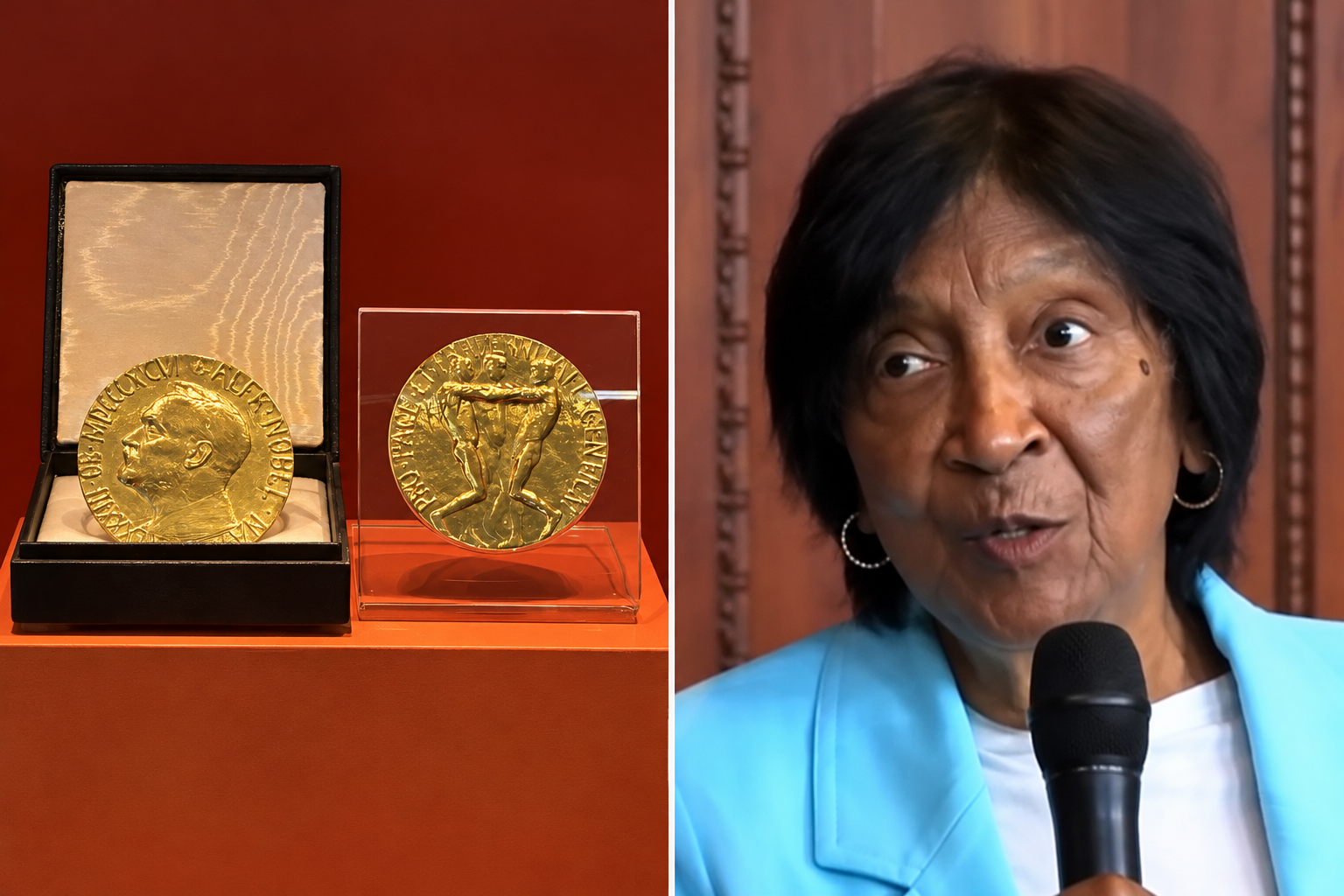

The Norwegian Nobel Committee’s decision to award the 2026 Nobel Peace Prize to Navi Pillay, the former UN human rights chief long condemned for anti-Israel advocacy and defending and supporting antisemitic rhetoric, raises concerns about those entrusted with one of the world’s most prestigious honors. Announced on October 9, the prize went to a woman who chaired a biased UN Commission of Inquiry that concluded Israel had committed genocide, relying on flimsy evidence and flawed legal reasoning to support what appeared to be a predetermined verdict.
Pillay’s record dates back to the beginning of her tenure as UN High Commissioner for Human Rights in 2008, when she defended the 2001 Durban anti-racism conference, which had been condemned for antisemitism and anti-Israel rhetoric. As international human rights lawyer, scholar, and activist Anne Bayefsky documented, Pillay actively promoted the subsequent Durban conferences, and continued to endorse the Durban Declaration that singled out Israel as the only UN member state accused of racism. At the 2009 Durban Review Conference, she remained seated during Iranian President Mahmoud Ahmadinejad’s Holocaust-denying speech while Western delegates walked out, although she had received the speech in advance. She subsequently thanked the Islamic bloc whose representatives had applauded his antisemitism. Pillay also initiated the inquiry that produced the Goldstone Report, and refused to withdraw her support of its allegations that Israel deliberately targeted civilians, even after Goldstone retracted that central finding. She has a long history of singling out the Jewish state for opprobrium. A 2009 report issued under Pillay’s authority praised Hamas for publicly professing its commitment to respecting international human rights and humanitarian law. At a 2010 Security Council session addressing threats to civilians worldwide, Pillay condemned Israel alone, directing both of her appeals exclusively against the Jewish state. In 2011, she accused Israel of institutional discrimination, overlooking Arab representation in Israel’s parliament, diplomatic service and the Supreme Court.
Pillay subsequently signed a 2020 petition demanding that governments “Sanction Apartheid Israel!” and accused Israel of treating international law “with perpetual disdain.” When she was appointed to lead the UN Human Rights Council’s Commission of Inquiry, UN Watch demanded her recusal, arguing that she had already prejudged the issues she was charged with investigating.
The commission’s antisemitism controversies were equally serious. After fellow commissioner Miloon Kothari claimed that social media was controlled largely by “the Jewish lobby” and questioned Israel’s membership in the United Nations—remarks that were widely condemned as antisemitic—Pillay defended his remarks, insisting they were taken out of context. He subsequently apologized. As for the report issued by the compromised commission headed by Pillay, it was challenged on multiple fronts, foremost for failing to establish the specific intent to destroy a protected group required under international law. While acknowledging Israel’s stated objectives of defeating Hamas and recovering the hostages, it did not rigorously investigate whether civilian casualties resulted from Hamas’s military operations within densely populated areas rather than an intent to destroy Palestinians as a people. Its focus instead was on Israeli military operations while largely excluding Hamas’s October 7 massacre, hostage-taking, rocket attacks, and tunnel network from substantive consideration. And it calculated that 83 percent of Palestinian fatalities were civilians by subtracting 8,900 identified Hamas and Islamic Jihad fighters from approximately 53,000 deaths, effectively treating every combatant not identified on that list as a civilian. Allegations that Israeli forces deliberately targeted children relied on unnamed physicians without presenting eyewitness testimony identifying the shooters. In other words, its conclusion that Israel committed genocide seemed to have been made independent of any thorough investigation. UN Watch analyst Salo Aizenberg argued that the commission’s selective evidence and failure to exclude reasonable alternative explanations left the necessary genocidal intent unproven. Pillay’s commission nevertheless presented genocide as its definitive conclusion.
The Nobel Committee praised Pillay’s courage, integrity, and contributions to international law, expressly recognizing her commission work. The award was condemned by UN Watch, the Simon Wiesenthal Center, B’nai B’rith International, Hadassah and others.
Pillay’s record of anti-Israel campaigning, defense of antisemitic rhetoric, and leadership of a genocide investigation whose credibility had been challenged were established long before the Nobel announcement. Honoring her for integrity and impartial justice raises a pointed question about the standards and priorities behind the prize itself.