
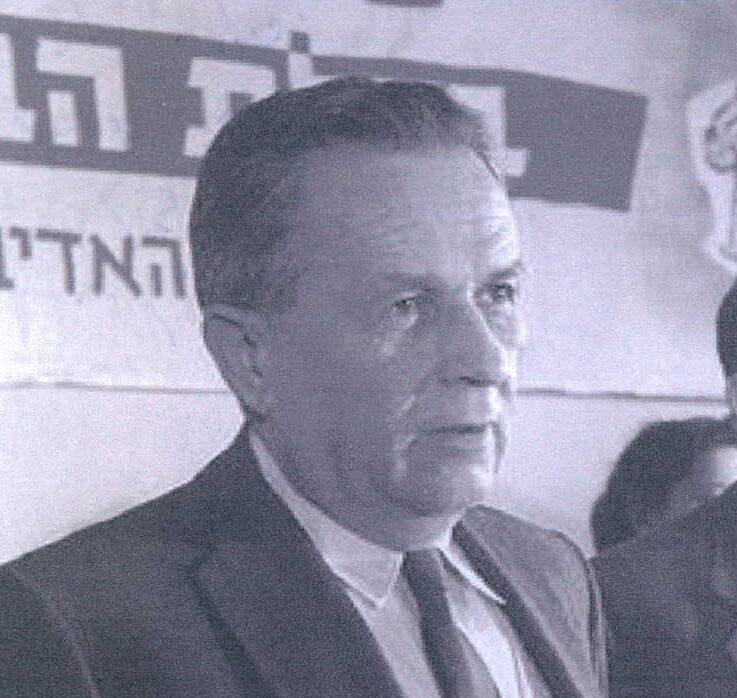

Senior Fellow Hanan Amiur’s The Six-Lie War is a handbook for understanding and refuting key lies weaponized against the Jewish state. It was published in Israel in 2025 where it was a best seller and released in English in 2026. It is excerpted here. The photo above is Abba Hushi, a labor leader in Haifa in 1948 who, along with Shabtai Levi, pleaded with the Arabs of the city not to flee.
Chapter Two
“The Jews Brought the Nakba Upon Us in 1948 and Turned Us into Refugees”
Ask the average Palestinian, and they’ll tell you that the establishment of the State of Israel in 1948 involved ethnic cleansing and the expulsion of Arabs from the country. The catastrophe, which they call the “Nakba,” was the result of Jewish aggression—a deliberate campaign to seize Palestinian land, destroy their villages, and cleanse the country of Arabs. Hundreds of thousands of Arab refugees—who over the years became millions—have since awaited their return to homes in Jaffa, Haifa, Lod, and other cities and villages across the land.
Indeed, there is no dispute that the decisive war over the land in 1948 ended in a crushing defeat for the Palestinians. Many of them were killed in battle; many others fled or were expelled; and Jewish communities were established on parts of their former lands.
The central question this chapter will explore is who caused the Palestinian catastrophe—and who bears responsibility for it.
Where to begin? Some might say the story starts 1,400 years ago, in the early days of Islam, with the bloody battle at the Khaybar oasis in the Arabian Peninsula between Muhammad and his Muslim followers and the Jewish tribes living there. Many view that battle—which ended in a brutal massacre of the Jews—as the root of ancient Muslim hostility toward Jews. But Khaybar, distant as it is in time, cannot directly explain the modern Jewish–Palestinian conflict or the events of the “Nakba.”
Organized Arab violence against Jews in the Land of Israel began much later—1,300 years after Khaybar—in 1886, with a deadly mass attack on the young Jewish agricultural settlement of Petah Tikva. But even that date is too early for understanding the Nakba, since the institutions of the Jewish Yishuv and its military organizations had not yet come into being.
It seems, then, that the murderous escalation of the Arab struggle—the one that led them directly to their great disaster—can be traced to the year 1920 and the events that followed. That is where our journey begins: to understand the Jewish people’s right of blood to the land, and to refute the lie of the Nakba.
In that bloody year, Arabs attacked Jews across the Land of Israel at different times, in various locations. The main assault took place near Jerusalem on the Jewish holiday of Passover, during the Muslim celebration of Nabi Musa—a traditional pilgrimage that often served as a pretext for incitement against the Jews. Arab mobs, incited against the Jews by their leader Haj Amin al-Husseini, murdered dozens of Jews, while hundreds more were wounded, robbed, and raped. Al-Husseini was just beginning his rise at the time—a young cleric with a soft face that concealed a violent, hateful, Nazi soul. In the years to come, he would become Grand Mufti and the militant leader of the Arabs of the land. We will return to the man who led his flock into a tragic chain of mistakes, schisms, defeats, humiliations, and failures—all of which laid the groundwork for the “Nakba,” the great disaster of the Arabs of the land.
About a year after those events, in 1921, Winston Churchill—then Britain’s Colonial Secretary—visited the country. A delegation of local Arab leaders met with him and demanded that the Balfour Declaration be annulled and that the Arabs of the land be allowed to unite with “Greater Syria.” Churchill responded by telling them they would do well to abandon their plans of becoming Syrians, for Britain was committed to its promise to the Jewish people to establish their national home in the Land of Israel, in accordance with the Balfour Declaration and its international ratification at the San Remo Conference of the victorious powers of the First World War.
In his book The Churchill Factor: How One Man Made History (2014), former British Prime Minister Boris Johnson quotes Churchill’s direct remarks during his visit:
“A great historical tradition binds the Jews to this land. You cannot treat it as a matter of no account. They were here many centuries ago and have always striven to return. This is their sacred land, to which they have always aspired to return… It is manifestly right that the Jews, who are scattered all over the world, should have a national center and a National Home where some of them may be reunited. And where else could that be but in this land of Palestine, with which for more than three thousand years they have been profoundly and intimately associated?”
But the refusal of the Arabs of the land to acknowledge the Jewish people’s historical right to the Land of Israel despite countless archaeological discoveries was, and remains, absolute. It stems from a fundamental religious conflict: the belief that it is inconceivable for the Jews—infidels who, according to Islamic tradition, are meant to live in a subjugated status as dhimmis (protected but inferior subjects)—to regain power in defiance of Islamic prophecy.
As if that weren’t enough, not only were the Jews not humiliated, but they also had the audacity to settle in the very heart of Dar al-Islam—the region that had been under Muslim rule for centuries. To this impossible theological stew, one must add another potent ingredient: the doctrine of Din Muhammad bi’sayf—“the religion of Allah is through the sword”. According to this tenet of Islam, infidels face only two choices: conversion to Islam, or total war.
And so, the Arabs of the land received Churchill’s words with fury—expressed, as would become their hallmark, through violence. Just weeks later, they instigated the Riots of 1921, during which they attacked Jews and Jewish communities over six consecutive days of bloodshed. Armed with rifles, axes, and knives, they fell upon the Jews and murdered dozens.
During those terrifying years, a distinct pattern of Palestinian violence emerged—one that has not changed since: beating to death any Jew encountered in the mob’s path, the rape and murder of women and girls, and the looting of homes and property. Faced with these brutal assaults, the Jews found themselves in urgent need of self-defense. Thus began the race to establish military preparedness ahead of the great confrontation to come.
The Race for Military Organization
For nearly twenty-five years—up to the early 1930s—the Arab approach to military organization remained stagnant and largely undeveloped. Arab forces fought in a manner that could only be described as primitive, relying on sheer numerical superiority, the intimidation of violent mobs, and the sporadic actions of armed gangs affiliated with local clans or villages. Lacking effective leadership or military training, this remained their default mode of combat.
On the Jewish side, following the violent outbreaks of the early 1920s, a slow but growing realization began to take hold: more effective military organization was urgently needed. The Jewish defense group Hashomer had operated in the previous decade, and the Haganah was established in the early 1920s in response to these attacks—but it wasn’t until eight years later, in the aftermath of the 1929 riots (referred to in British records as “The Disturbances of August 1929”), that the realization hit with full force. From that point on, the Zionist leadership understood that a major leap forward in military preparedness was essential.
That moment marked the beginning of a widening gap in military preparedness—one that has only grown with time.
The 1929 riots erupted across the country that summer. The Arabs, increasingly frustrated by the growing Jewish presence in the Land of Israel, reached a boiling point. Spurred on by Muslim religious leaders, who whipped the crowds into a frenzy and urged them to “fight the Jews to the last drop of blood,” Arab mobs once again flooded the streets in search of defenseless Jews.
As in the riots ten years earlier, they shouted the same slogans: “Palestine is ours and the Jews are our dogs,” “We will drink the blood of the Jews,” and the ever-recycled battle cry “Al-Aqsa is in danger!”—a false claim that Jews were plotting to destroy the mosque on the Temple Mount in Jerusalem.
This baseless fear—that the Zionists were planning to desecrate Islamic holy sites—was deliberately instilled in the hearts of local Arabs by Haj Amin al-Husseini, the Grand Mufti, who repeated it tirelessly and systematically. His goal was to recast the conflict with the Zionists—whom he labeled “infidels”—as a religious war, a jihad. Al-Husseini’s campaign succeeded beyond all expectations. Even a century later, the mosque still stands, and the slogan “Al-Aqsa is in danger” continues to incite Arab mobs and serves as a coded license for the mass murder of innocent civilians.
The Mufti’s propaganda success is all the more astonishing given that Al-Aqsa’s role as a symbol of Palestinian identity has no real historical basis. Jerusalem never held major importance in Islam. Unlike Mecca and Medina—which are mentioned repeatedly in the Quran—Jerusalem is not mentioned at all. Unsurprisingly, during all the centuries of Muslim rule over the city, no Muslim regime ever made it their capital. Jerusalem’s peripheral status in Islam remained unchanged even during the height of the modern conflict. For example, between 1948 and 1967—when the city was under Jordanian control—not a single foreign Arab leader came to pray at Al-Aqsa.
In any case, the week-long wave of Arab pogroms against Jewish communities in 1929 left hundreds of Jews dead or wounded. Many towns were abandoned, looted, and destroyed. The worst tragedy took place in Hebron, where Jews and Arabs had lived side by side for centuries. Incited by rumors that “Jews are killing Arabs in Jerusalem,” Arab mobs stormed the Jewish quarter. A Jewish pharmacist—whose attackers had once been his customers—was forced to watch as his wife’s hands were hacked off while she bled to death, and his daughter was gang-raped. His daughter was then murdered, and the pharmacist himself was tortured to death in horrific fashion. Many other Jews in Hebron suffered a similar fate on that terrible day, caught in a grotesque carnival of slaughter. Dozens were tortured to death. Teenage boys were castrated. Women and girls were raped, then killed—often in front of their helpless families. The frenzied mob gouged out eyes, scalped heads, or held victims over burning stoves. Blood flowed for hours. Even infants and small children were not spared. Similar horrors unfolded in Safed and in other towns and cities across the land.
The entire Jewish Yishuv was stunned by the savagery of the attacks—the sheer scale of the losses, the helplessness of the victims, and the total failure of the British police to respond. Survivors of the Hebron massacre later recalled how some Jews were stabbed to death at the very feet of the city’s British police commander, who watched from horseback without intervening.
The trauma of 1929 shook the Yishuv to its core. It shattered any remaining illusions and triggered an urgent push for military buildup—after nearly a decade of stagnation, and less than twenty years before the decisive confrontation to come.
Jewish efforts focused on the Haganah, which had until then operated modestly. In response to the riots, it was restructured into a broad civilian defense force, with the aim of recruiting every man and woman over the age of seventeen. At first, the organization numbered only a few hundred fighters, under a new national command appointed by Yishuv leadership. Over the course of the 1930s, it expanded to thousands. By the eve of war in 1948, the Haganah boasted tens of thousands of soldiers, organized into specialized units, trained in both defense and attack, and equipped with a wide range of military skills. Yet throughout these years, the Haganah suffered from a chronic shortage of weapons.
The Arab side also attempted to build a more organized and capable military force. But lacking experience, leadership, talent, and internal unity, their efforts remained fragmented and local.
There were indeed terrorist cells like the Black Hand—better known as “Izz ad-Din al-Qassam”—founded by the radical cleric al-Qassam. But even at their height, such groups amounted to little more than scattered cells with limited capabilities.
A more ambitious effort was led by Abdul Qadir al-Husayni, nephew of the Mufti. He established the “Army of the Holy Jihad”—an organization intended, like the Haganah, to coordinate military operations across the country. Initially composed of a few dozen fighters, by the mid-1930s his “army” had grown to several hundred men, trained in basic combat and armed with rifles and pistols funded by donations. The rest of the Arab fighting force, however, still relied on traditional local militias. Without a unified command structure, they operated independently in narrow sectors—organized by village or clan—and lacked the coordination and strategy that might have enhanced their strength on the battlefield.
From the very outset, then, the race to organize militarily was marked by a steadily widening gap in favor of the Jews—a gap that steadily eroded the Arabs’ overwhelming numerical advantage. At the start of the conflict, the Arabs outnumbered the Jews in the country by a ratio of 9 to 1, with some 50 million additional Muslim supporters in the broader region surrounding the Land of Israel.
Compromise or Combat?
In the realm of internal politics as well, processes unfolded during these years that proved fateful in retrospect. Throughout the 1920s, 1930s, and 1940s, two opposing political camps gradually emerged within each people, competing for public opinion and for the soul of their still-forming nations: a hardline, militant camp, and a more moderate, compromise-oriented one.
On the Jewish side, the Revisionists and the “dissidents” represented the hardline, militant faction, while the Labor movement stood on the practical side, which was more open to compromise. On the Arab side, the uncompromising camp was led by the al-Husseini clan, which sought to establish an Arab state throughout the entire land. Opposing them was the somewhat more moderate camp led by the Nashashibi clan, backed by the Hashemite Kingdom of Jordan. Despite their deep hatred of Jews, the leaders of this camp conducted themselves with a little more restraint.
In the wake of the Great Arab Revolt of 1936–1939—led by al-Husseini’s hardline faction—the more violent camp won the struggle for dominance over Palestinian public opinion. The path to victory in the internal Palestinian arena was also marked by bloodshed and brutality, and in hindsight, this was a victory that amounted to total defeat.
The situation among the Jews unfolded as a near-exact reversal. The Revisionist camp, which demanded sovereignty even over Transjordan—as had been promised at the San Remo Conference—remained in the minority. The moderate, compromise-oriented camp prevailed and earned broad public support, and by virtue of that support, came to shape the Yishuv’s policies.
And once again, the rule that has held true throughout the hundred-year conflict remained unbroken: even at this early stage, though the Jews had already begun to pull ahead in the race for military organization, they consistently remained open to compromise at every critical juncture—while the Arabs categorically rejected any and all compromise.
The Great Revolt and the Arab Collapse
In 1936 the Arabs launched what they called “the Great Arab Revolt.” The anti-British Axis alliance of Nazi Germany and Fascist Italy was on the rise, and many Arabs viewed these global developments as an opportunity to rebel against British rule. As in previous uprisings, the revolt was fueled by deep frustration at the growing strength of the Jewish Yishuv—its expanding hold on the land, economy, and military capacity, and the unmistakable signs of a Jewish state-in-the-making.
Jewish land purchases from Arab owners were reaching new heights. Increasing portions of the local economy were either seized or built by Jewish hands, and the large waves of immigration had swelled the Jewish share of the population to 30 percent. The Arabs, in turn, chose to revolt.
What began as an economic offensive against the British and the Jews—a six month-long general commercial strike declared with the aim of pressuring Britain to establish an Arab government in the land—quickly turned into a storm of violence and destruction whose primary victims were Arabs murdered by other Arabs. In short order, the organized revolt plunged Arab society into violent chaos, delivering a death blow to the social, political, economic, and cultural foundations of what was meant to become Palestinian society. In retrospect, considering the revolt’s consequences, it is entirely plausible that the true Nakba befell the Arabs during those three savage years—after which their defeat in the war a decade later became all but inevitable.
Early in the revolt, the supreme leader, Haj Amin al-Husseini, ordered his armed gangs to target the rival Nashashibi faction, known as al-muʿārada—“the opposition.” A bloody campaign of inter-clan warfare erupted, devolving into indiscriminate violence and score-settling by knife and rifle alike—over family rivalries, financial disputes, criminal feuds, and more.
The essay collection Tzva ha-Medinah ba-Derekh: Prakim be-Toledot Ko’ach ha-Haganah ha-Ivri (“The Army of the Emerging State: Chapters in the History of the Jewish Defense Forces”), published by Israel’s Ministry of Defense and Yad Tabenkin, describes the collapse of Palestinian Arab society on every level during these years. The collapse was driven by the way the armed gangs filled the anarchic vacuum in the Arab towns and cities. These gangs began looting, raping, robbing, and murdering indiscriminately, devastating local Arab communities and driving out anyone who could afford to flee.
“We entered Ramallah,” recalled one gang leader quoted in the book. “We took all the weapons from the police depot. Then we went to a clothing store, took all the clothes, and marched through the city in a parade.” Similar testimonies come from Hebron, where the gangs also abused the local population. They would demand diribat dam aw diribat al-mal—“give us the money tax, or we’ll take the blood tax.” The practice of al-kaf al-aswad—“the black hand”—also became widespread during this period: a gang member would dip his hand in tar and stamp it on a piece of paper bearing a threat—“By this hour, you must pay this amount to the revolt’s fund.” These threats were affixed by gang members to the doors of Arab homes and businesses. Those who delayed payment often paid with their lives. In many cases, the victims’ bodies were left in the street, since anyone who dared to bury them risked being murdered as well. In the end, it was often the British police who came to collect and bury the corpses.
Although the violence was largely directed inward, its declared targets remained the Jews and the British. In September 1937, Arabs—acting under the Mufti’s inspiration—assassinated the British District Commissioner of the Galilee, Lewis Andrews. The British were stunned by the boldness and arrogance of the attack, and responded with force. Hundreds of leaders from Palestinian Arab society were arrested or fled the country, including members of the Arab Higher Committee, who were exiled to the remote Seychelles Islands. The Mufti fled to Al-Aqsa Mosque, knowing the British would not enter for fear of desecrating the site. Two weeks later, he escaped in disguise to the Jaffa port, boarded a boat, and fled to Beirut. The Palestinian Arabs were left leaderless.
The book Yeme Homah u-Migdal (“Days of Tower and Stockade”), edited by Mordechai Naor, describes a desperate emergency conference of Palestinian intellectuals, held in Haifa amid the violent anarchy tearing Arab society apart. The desperate participants resolved to send an emissary to the Mufti—now in Damascus—pleading with him to put an end to the bloodshed. The emissary, Dr. Omar al-Halal, begged the Mufti to issue a statement declaring that “the killing of an Arab by another Arab will not be forgiven.” But the Mufti, cold-hearted and unrepentant, refused to call for an end to the murders and sent the emissary back to Haifa empty-handed.
All that remained for the leaders of the Nashashibi clan was to count their dead and mourn. Eventually, their own gangs regrouped and launched a campaign of revenge killings against the al-Husseini faction—further fueling the cycle of Arab-on-Arab bloodshed. During the revolt, between 5,000 and 8,000 Arabs were killed at the Mufti’s direction—most of them his political opponents, or simply members of families linked to rival factions. In contrast, the Jewish death toll over those years stood at around 400.
From a historical perspective, the defeat of the moderate Nashashibi camp at the hands of the fundamentalist al-Husseini faction is hardly surprising. The history of Islam is filled with such defeats, in which reformist and conciliatory elements were vanquished by radical and violent ones. That same tide of rising extremism is evident today across the Muslim world—from Afghanistan to Turkey, from Iran to the Hamas-supporting Palestinian street.
Amid this storm of bloodshed, the Jewish Yishuv maintained a policy of self-defense and restraint. The Nobel Prize–winning author S. Y. Agnon gave powerful voice to both the Arab violence and the contrasting Jewish restraint in his novel Shira (1971), describing the mood of the time:
Many things are happening. Every day Jews are killed in secret as well as in public, and every day there are black borders in the newspaper. At first, when we saw a black band in the paper and read that a Jew had been murdered, we left our meal unfinished. Now that there is so much misfortune, one sits at the table eating bread with butter and honey, reading, and remarking, “A Jew was killed again, another man, woman, child.” We sit with folded hands, yielding to murder, proclaiming, “Restraint, restraint!” They murder, kill, incinerate, while we exercise restraint.
Agnon’s words, of course, were a lament—both for the violence inflicted on the Jews and for their restraint in response. But as noted, the vast majority of the violence was in fact directed inward, into Arab society itself. And the consequences were not long in coming: a mass exodus of the upper and middle classes, and the destruction of the Palestinian Arab elite. Historian Prof. Benny Morris estimates that some 40,000 Arabs fled the country during the revolt. One indicator of the scale of the exodus was the spike in real estate prices in Beirut, the capital of Lebanon, where home prices rose by around 70 percent in the summer of 1938 due to the surge in demand from fleeing refugees.
The Jews Turn Crisis into Opportunity
The social collapse on the Arab side during the years of the revolt, as well as the absence of military order and organization, was seized by the Jews as an opportunity to innovate a new model of settlement: Tower and Stockade. A convoy of trucks, loaded with people and all necessary supplies, would set out from an existing community toward a chosen site. Within hours, the participants would pitch tents, assemble prefabricated buildings, surround them with a defensive wall, erect a central watchtower, and establish a new settlement, staking an irrevocable claim on the land.
Fifty-two new Jewish settlements were founded in this fashion during the three years of the Great Arab Revolt.
Meanwhile, the Arab side experienced the opposite reality. While Jewish settlement expanded through the Tower and Stockade initiative, thousands of Arab homes—sometimes entire neighborhoods—were demolished by the British police in their efforts to suppress the violent anarchy. Economic sectors previously dominated by Arabs, such as quarry workers or suppliers of raw materials for construction and roadwork, lost their primacy to Jewish labor due to the general strike imposed by the gangs. Arab agriculture, too, suffered a heavy blow. Until the revolt, the Yishuv had relied on Arab produce; but during the uprising, that dependence shifted first to imported goods, and then to the development of a rival Jewish agricultural sector.
The Arab economic shutdown—intended to collapse the Jewish economy—ultimately backfired, weakening the Arabs even further. When the Arab port of Jaffa was shut down and the flow of goods was blocked, the Jewish response was swift: Jewish immigrants from the Greek port city of Salonika—trained as dockworkers and laborers—joined forces with young men from Tel Aviv to build a new Hebrew port in the city. They pitched tent camps near the site and began construction with round-the-clock shifts in a spirit of celebration and pioneering fervor. Songs were composed for the occasion, and the port builders were known to dance in circles during their work, sometimes knee- and waist-deep in the sea. Within just a few days of breaking ground, the first Yugoslavian ship docked at the new port and unloaded a shipment of cement. The Arab port of Jaffa—which had enjoyed a monopoly until that point—was reduced to economic ruin.
“And what is my blessing to Tel Aviv on its day of celebration, and my blessing to this new port?” asked Zionist leader Menachem Ussishkin in a speech marking the port’s construction, and answered: “That with each passing year, imports of foreign goods decrease, and with each passing year, exports of local products grow. Thus, the land will grow and expand and prosper, until it becomes a self-sufficient and healthy economic creation.” His blessing is continuously being realized.
The gamble taken by the Arabs of the land—the result of mistaken decisions and their choice of violent struggle—failed. Their effort to build up military strength was also severely and unexpectedly damaged. The British, finding themselves unable to contain the geographically dispersed Arab aggression, were forced to establish a Jewish auxiliary force—the Notrim—to help defend Jewish communities. In training and arming these Notrim, the British were effectively laying the groundwork for the future Jewish army. The underground Haganah organization took full advantage of the opportunity, collaborating with the Notrim to build a covert network of training, patrols, and offensive operations.
Funding for Jewish military growth came from a broad mobilization, both within the Yishuv and among Jewish communities the world over. On November 1, 1938, for example, a festive national donation day was held, calling on the Jewish public to donate jewelry to the Kofer ha-Yishuv (“Settlement Tax”)—a fundraising campaign that served as a code name for financing the transformation of the Haganah into the army of the future.
As in the biblical story of the Tabernacle offering, the flood of donations was so great that banks remained open late into the night to accept the incoming gold and silver.
On the Arab side, the process moved in reverse. The Palestinian economy—paralyzed by the strike—had nowhere to return to once the six-month shutdown ended, as many traditional trades had been taken over by Jews. Militarily, more than one hundred gang members were executed by hanging at the hands of the British, thousands more were killed in battles with Mandate police and rival factions, nearly 15,000 were arrested, and many thousands fled the country as fugitives. Arab military competence, already low, declined even further in the absence of any mechanism for debriefing and operational assessment or the transmission of combat knowledge.
Thus, while the Jews used the years of the revolt to build a large, strong, and organized defense force, the Arabs—by their own hands—destroyed their ability to establish a meaningful military presence in preparation for the decisive struggle over the land.
The so-called “Great Arab Revolt,” intended to crush the Jews, ended up crushing the Arabs. True, the revolt did yield a significant political achievement: the British White Paper of 1939, a policy document that prohibited the sale of Arab land to Jews and severely restricted Jewish immigration to the land. But despite its impact on the Yishuv, the Jews had already managed to establish a decisive advantage over their rivals. When the revolt subsided in 1939, the Arabs found themselves facing ruin, while the Jews were hard at work—strengthening their military, economic, communal, and political foundations.
The First Steps of Jewish Military Intelligence
The growing military strength of the Jewish community and its preparations for the coming war were reflected across multiple fronts. In the realm of intelligence, for example, the gap in favor of the Jews became particularly pronounced. The Arab community, weakened, fractured, and reeling in the years following the failed revolt, was in no position to build or operate an effective intelligence apparatus—something that required resources, planning, funding, and the recruitment of skilled field personnel.
By contrast, during the decade between the Arab Revolt and the War of Independence, the Jews established an organization known as SHAI—short for Sherut Yediot (“Information Service”), the intelligence arm of the Haganah, which laid the foundation for a professional intelligence network. SHAI deployed networks of Arab agents (modi’im) throughout the country, operated by Arabic-speaking Jews who gathered intelligence from within the Arab population.
By 1943, once it became clear that relying solely on Arab informants was insufficient, the Palmach—the elite strike force of the Haganah underground army—established its “Arab Section,” effectively the first unit of mista’arvim (undercover Israeli operatives assimilated into Arab society). This unit brought greater operational and intelligence depth to the existing network. Its members conducted foot patrols deep into Arab territories, producing “village files” that compiled military intelligence on locations from which attacks on Jewish communities and supply routes were launched. These intelligence files would serve Jewish forces throughout the war.
The SHAI—many of whose members were local Jews who had enlisted in the British army during World War II and gained experience in intelligence work, especially in field operations—also established a wiretapping network that steadily grew more sophisticated. At first, covert apartments in major cities served as miniature listening posts, where English-speaking Haganah operatives monitored the wireless communications used by the British. Later, in 1948, when the Arab Liberation Army invaded, Arabic-speaking operatives joined the effort and set up interception units targeting Arab leadership and military command.
Dozens of selected telephone lines—including those of the offices of the Arab Higher Committee—were secretly rerouted from the central post office to the basement of the Jewish Agency building. There, they were monitored around the clock, yielding high-quality intelligence and enabling psychological warfare operations, including the planting of disinformation. The Arabs had no idea that their plans were known to the Zionist side—and, in some cases, that what they thought were their own ideas had in fact been fed to them by Jewish operatives through planted phone calls.
The intelligence campaign extended to every relevant arena—even the United Nations. In 1947, when the UN Special Committee on Palestine visited the country to prepare its recommendations—later forming the basis for the Partition Plan—a listening device was installed in the chimney of the Jerusalem conference room where the committee held its confidential meetings. The telephone lines used by committee members were also tapped by the Haganah. As a result, the Zionist representatives—who were fully aware of all that transpired—were able to come prepared to committee sessions, fending off or advancing proposals according to the needs of the Yishuv.
The Jews Arm Themselves
Another critical arena in which the Zionist side gained a decisive advantage over the Arabs on the eve of war was in weaponry and armaments. The Arabs of the land, acutely aware of the growing gap in military preparedness in favor of the Jews, implored the Arab states to supply them with weapons. But their pleas mostly went unheeded. By the time war broke out, the amount of weaponry that Palestinian Arabs had received from their brethren in neighboring countries was meager and almost negligible.
Through great effort, the Arabs of the land managed to obtain small quantities of arms. In the vast desert between Egypt and Libya—once a battlefield between British and German forces during World War II—massive caches of abandoned weapons and ammunition remained, which Bedouin tribes in the region collected and sold to the highest bidder. Haj Amin al-Husseini seized the opportunity and dispatched a truck to the North African arms market. It was loaded with weapons and ammunition, cleared in Cairo, and then transported via Sinai, Rafah, and Khan Younis to storage facilities in Jerusalem. There were a few other initiatives of this kind, but in the overall arms race leading up to the coming conflict, these were few and far between—and ultimately marginal.
The Jews, by contrast, succeeded in building a clandestine domestic arms industry that operated in underground factories and produced millions of rifle bullets, around 150,000 hand grenades, 16,000 submachine guns, and more. But this was only one part of the Jewish arms effort. In the years leading up to the war, Zionist emissaries stationed across European capitals forged secret deals that resulted in large weapons acquisitions—procurements that would give Jewish forces a clear advantage on the battlefield and compensate for their demographic inferiority.
As we have seen, at this point the local Arab society was a patchwork of shattered, feuding communities trapped in endless cycles of blood feuds, lacking elite leadership or a coherent command structure. Its ability to procure heavy weaponry, establish a central command, or develop an intelligence infrastructure was hampered by the economic and social disintegration it had brought upon itself. Archival records show that most of the weapons supplied to volunteers in the Arab Liberation Army were outdated rifles of European, Turkish, and occasional American origin—resulting in widespread confusion due to the lack of standardization in both maintenance and ammunition.
Fueling the Jewish arms drive was the horror of the Holocaust—the memory of millions of Jews murdered by the Nazis—and a deep fear that a similar fate might await them in the Land of Israel. This fear was reinforced by memories of the 1929 massacres and the Arab leadership’s proclamations that “the land will run red with Jewish blood.” While local Arab delegations traveled to Arab capitals pleading for weapons and were turned away empty-handed, a Jewish operative dispatched by David Ben-Gurion was in Czechoslovakia—then a major arms producer—finalizing, in just a few short days, the details of a large-scale secret deal that would decisively impact one of the war’s main fronts.
A massive American transport plane, leased by the Jews and piloted by an American, was loaded with Czech weapons and flown under cover of darkness to an abandoned British emergency airstrip near the town of Be’er Tuvia, where Jewish forces were waiting. As the drone of engines approached, the secured landing strip—located dangerously close to a hostile Arab village—was lit up with torches. The plane landed safely, was unloaded, inspected by technicians, refueled, and took off again, all in just eighty minutes. That very night, the weapons were delivered to units preparing for Operation Nachshon, the mission to break the siege of Jerusalem.
Following that first flight, additional planes landed in Israel in similar fashion, laden with arms. They were joined by ten cargo ships that secretly unloaded weapons at various coastal points—right under the noses of the British. One of these ships was the Nora.
As the Nora approached the coast of Tel Aviv, British port inspectors were lured away to a raucous party filled with wine and women—kept far from the docks and oblivious to the covert unloading operation taking place. “Lovely Jewish girls kept them entertained while the weapons were swiftly offloaded and rushed to the front,” recalled Israel Galili, head of the Haganah’s national command, with a wry smile in an interview for the Israeli documentary series Pillar of Fire. “The guys unloading the weapons literally kissed the grease on the guns,” he added, his voice thick with emotion, describing the desperate need for arms at that critical stage of the war.
The fear that Arab armies would launch a simultaneous invasion from all directions instilled a deep sense of humility in the Jewish leadership. While they pressed ahead with tireless preparations for the looming conflict, they also remained consistently open to compromise—willing to accept any proposal from the international community that might avert war.
That humility was met with Arab arrogance. The Arab leadership scornfully rejected every compromise proposal and filled the air with boasts about the impending realization of their genocidal vision for the Jews of the land.
***
And so, the two nations approached the brink of war.
On the social and political front, the Arabs failed to establish a unified and stable state structure capable of rising above tribal loyalties rooted in clan and village. Instead, over the course of the three years of revolt, they inflicted upon themselves an internal collapse from which they never recovered—allowing the militant political camp to defeat the more moderate one in the struggle to lead Palestinian society.
During the revolt, the Palestinian elite fled the country, leaving behind the weak and impoverished. Every attempt to heal and unify fractured Palestinian society in the aftermath of the revolt, in preparation for the great trial that lay ahead, was violently thwarted by agents of the Mufti, then based in Damascus. The Mufti, who saw himself as the sole legitimate leader of the Arabs of the land, refused to allow them to recover without him. As a result, attempts to establish political parties, women’s associations, action committees, a national fund, and youth movements were all crushed in their infancy. Palestinian society remained deliberately crippled. The ongoing cycle of blood feuds between the al-Husayni and Nashashibi clans further undermined Palestinian cohesion and prevented any unified front from forming in the run-up to war.
The Jews, by contrast, absorbed hundreds of thousands of immigrants, established national institutions and a system of self-governance, founded national enterprises, and operated networks for education, culture, taxation, health care, and democratic politics built on a party system. They too struggled with intense internal tensions—tensions that in rare cases erupted into bloodshed—but unlike the Arabs, they knew when to stop and preserve internal unity in the face of a common goal. This ethos was embodied in the famous declaration by Menachem Begin, leader of the political minority: “Anything but civil war” (made during the Altalena affair, when a weapons ship belonging to the Irgun—an underground Zionist paramilitary group that had split from the Haganah—was shelled by forces loyal to David Ben-Gurion, killing several of its crew members).
On the diplomatic front, the Arabs rejected every compromise proposal put forward by the international community, responded with indiscriminate terror against civilians as well as British officials and soldiers, and steadily lost ground in the diplomatic arena. The Jews accepted every compromise that was placed on the table—even those that represented dramatic retreats from the promises made to them in the Balfour Declaration and at the San Remo Conference—and thereby won the sympathy of the world ahead of the coming conflict.
On the military front, the local Arabs failed, over decades, to build an effective, organized national fighting force. Instead, they remained at a primitive stage, relying on loosely organized, locally based armed gangs whose horizons extended no further than their own village, its fields, and the nearest Jewish settlement. Their primary method of operation was the fazʿa—or “panic”—which the Middle East scholar Danny Rubinstein, in his 2017 book Ze Anachnu O Hem (“It’s Us or Them”), describes as a doctrine of warfare—if one can call it that—based on “a rumor about an incident spreading quickly by word of mouth through the rural area, prompting masses of villagers to grab hidden weapons from their homes and rush to the scene of the incident—the battlefield.”
The various armed bands lacked any form of national chain of command, and thus almost no coordination existed between them—coordination that would surely have magnified their military power. Quite the opposite occurred: deep animosity between the Arabs’ two central military commanders—Fawzi al-Qawuqji in the north and Abdul Qadir al-Husayni around Jerusalem—not only prevented collaboration, but was in fact manipulated by Israeli intelligence into a dramatic episode of intra-Arab betrayal that may have changed the entire course of the war at its most critical hour. We will return to that moment in the pages ahead. The Arabs also had no significant weaponry, due to both the refusal of Arab states to arm them and their own failure to establish a domestic arms industry.
The Jews, by contrast, had learned the lessons of the 1929 riots and spent the next two decades steadily and deliberately building a trained and organized national army under a centralized command composed of veteran officers with combat experience in modern armies. They built a domestic weapons industry, acquired some of the finest arms in the world, and developed and operated effective systems for aviation, intelligence, espionage, reconnaissance, and psychological warfare.
On the eve of war, the mental gap between the average Jew and the average Arab in the Land of Israel was stark. It reflected deep disparities in education, governance, culture, and economic infrastructure—all of which the Jews had succeeded in building. The Zionist movement’s earlier successes instilled in the Jews of the land a quiet confidence, which translated into determination rather than despair. They were backed against a wall, fully aware that defeat would mean the worst imaginable fate—and they were prepared to fight for their state to the last drop of blood. The Arabs, by contrast, were weighed down by bitter internal conflict and economic and social decay, which translated into despair, mass flight, and low morale—mixed with a deep hatred of the Jews and a growing fear of them.
The Outbreak of War
Given the process of Arab self-destruction over the decade preceding the war, one might assume the Jews felt confident in their strength. But this was far from the case. Despite their internal cohesion and relative military preparedness, the months leading up to the war were filled with terror and dread of an upcoming disaster. The Jews knew they would be facing not only local armed gangs, but also a coordinated invasion by several standing Arab armies. Just three years after the Holocaust, the declarations of enemy leaders left no room for doubt about the fate that would await the Jews if they lost the coming war. The Arab intent was clear and openly stated: to finish what the Nazis had started.
In his book Industry of Lies: Media, Academia, and the Israeli-Arab Conflict (2017) Israeli journalist Ben-Dror Yemini quotes, among numerous statements by Arab leaders, a declaration made by the Palestinians’ supreme leader, the Mufti Haj Amin al-Husseini, following his meeting with Hitler in Germany:
Our fundamental condition for cooperation with Germany was a free hand to eradicate every last Jew in Palestine and the Arab world. I asked Hitler for an explicit commitment that he would permit us to solve the Jewish problem in a manner suited to our national and racial aspirations, and in accordance with the scientific methods Germany had devised for dealing with its Jews. The answer I received was: “They are your Jews.”
There is no doubt that it wasn’t only the Mufti—or his rival, the Palestinian military commander Fawzi al-Qawuqji—who aligned themselves with the Nazis and considered them allies. Admiration for Nazism was widespread among the Arabs of the land. In his 2021 book Tik Sagur: Taalumat HaMufti VeHaShoah (“Closed File: The Mystery of the Mufti and the Holocaust”), author Yoni Reini cites a 1941 survey by the American Consulate in Mandatory Palestine showing that 88 percent of local Arabs supported the Nazis and hoped for their victory, while only 8 percent supported the British.
As a souvenir from his visit to SS headquarters in October 1943, the Mufti received a photograph from Reichsführer Heinrich Himmler—head of the SS and Gestapo—with a warm personal inscription:
“Our shared understanding of the Jewish enemy and our common struggle against him form the solid foundation for the natural alliance between Germany and the Muslims.” Himmler concluded the dedication by wishing al-Husseini “successful execution of your struggle until final victory.” The Mufti beamed with pride.
Many years have passed since then, but identification with Nazism remains alive and festering in the Arab world, including within Arab society in Israel. To this day, the Nazi salute is performed by some units of the Palestinian security forces and among students at Palestinian universities. Even within Hezbollah, the Islamist terror group in Lebanon, certain units are known to use the Nazi salute. Admiration for Nazism is also widespread in Gaza. After the barbaric massacre carried out by Hamas terrorists in Israeli border communities during the events of October 7, 2023, IDF soldiers uncovered a staggering amount of Nazi propaganda in the homes of Gaza residents. Photographic evidence shows countless Arabic translations of Hitler’s Mein Kampf prominently displayed on bookshelves in many homes.
Many Arab leaders competed to outdo the mufti and each other with declarations of their intent to annihilate Israel—statements that struck like leaden stones in the hearts of the Jews of the land. The Palestinian representative to the United Nations, Jamal al-Husseini, did not hesitate to promise “a bloodbath” from the UN podium. In an interview with an Egyptian newspaper, the secretary-general of the Arab League, Abdul Rahman Hassan Azzam, warned: “This will be a war of extermination. It will go down in history as a massacre of enormous scale, remembered like the massacres of the Mongols and the Crusades.” In a secret meeting in London with Israeli diplomat Abba Eban—who had come to request acceptance of the partition plan—Azzam replied bluntly: “You are far too logical. But this is not a matter of logic but a matter of pride. We will not give up the war. We will attempt to annihilate you.” The general commander of the Arab forces in Palestine, General Ismail Safwat, expressed the goals of the coming war in a telegram to the Arab League secretariat: “To liquidate the Jews of Palestine and cleanse the land of them entirely.”
The mass extermination was not to be carried out solely by local Arabs and the invading Arab armies. It was also meant to be joined by the “millions of volunteers” promised by Hassan al-Banna, the founding imam and leader of the global Muslim Brotherhood movement—who declared they were “kneeling in prayer to Allah to merit dying as martyrs.”
The Muslim Brotherhood was soon joined by the Council of Islamic Jurisprudence at Al-Azhar—the highest authority in Sunni Islam—which issued a fatwa declaring a “global jihad for Palestine.” The aim of this proclamation was to rally and inflame volunteers from across the Muslim world, and it succeeded: many other religious leaders followed suit, issuing similar calls and promising Muslim volunteers martyrdom and divine reward in paradise for taking part in the war for Palestine.
It was only natural, then, that even if the Jewish high command believed it could defeat the local Arab forces when war broke out, there remained a grave concern over the broader Arab plan: to supplement the local fight with a simultaneous invasion by five standing armies—alongside massive reserves of Muslim volunteers “from India, from Pakistan, and from China,” as promised by the Arab League’s Secretary-General.
This fear for the fate of the Yishuv only deepened when word spread of British intelligence assessments suggesting the Arabs were likely to win. It was this looming threat that lay behind the Jewish side’s willingness to accept any compromise offered by the international community—so long as war might be averted.
But as is well known, the leadership of the Arabs in the land was determined to reject any proposal that might prevent the genocide they envisioned—an idea that gripped their imagination, inflamed their spirit, and stoked their thirst for Jewish blood. Their eagerness to launch total war and back it with an immediate offensive, fueled by a belief in certain Arab victory, was all-consuming. It was this very fervor that steered them down the fateful path that would end in the “Nakba”.
On November 29, 1947, the United Nations passed the resolution calling for the partition of the land into two states, as discussed in the previous chapter. “For 2,000 years we feared and hoped for this moment, and now it has arrived. It is so great and so wondrous that it lies beyond the power of words,” declared Zionist leader Golda Meir (Myerson) to the jubilant crowd that gathered outside the Jewish National Institutions building in Jerusalem upon hearing of the UN decision.
The Jewish acceptance of the partition plan was neither rational nor inevitable. According to the plan, the Jewish state—most of it desert and wasteland—was to include a sizable Arab population: roughly 407,000 Arabs alongside 498,000 Jews. The proposed Arab state, in contrast, was to include fertile and developed lands and house a vast Arab majority: 725,000 Arabs compared to just 10,000 Jews.
Nevertheless, the Jews said yes, and the Arabs said no.
“Much suffering and sorrow can still be averted by seeking a way back to the highway of the Partition Plan,” pleaded Abba Eban, Israel’s representative to the UN, addressing the Arab delegates. But on the other side, ablaze with zeal to wage war against the Jews of Palestine and slaughter them to the last, there was no one willing to listen.
After the war, when Israel was accepted as a member of the United Nations, Eban was asked whether the country might in the future agree to the Partition Plan. He replied that once the UN had failed to implement its own decision, and Israel had been forced to fight a war of independence, the Partition Plan was null and void.
Despite this declaration, Israel was admitted to the UN.
The first stage of the war broke out the very next day, with a general Arab strike lasting three days, accompanied by terror attacks against Jewish civilians on the roads and in towns.
The act of aggression that marked the start of the war occurred when a civilian bus run by the Egged transport company was ambushed by Arab assailants in central Israel, and five of its passengers were murdered. The Arab response to the UN’s partition decision sent shockwaves across the Middle East. In his book, Yemini quotes a draft law approved by the Arab League Council in the days preceding the UN vote, which declared: “All Jews who are citizens of Arab states will be considered part of the (Jewish) minority in Palestine.” Their bank accounts would be frozen, their funds used to finance the war, and Jews suspected of Zionist activity would be treated as political prisoners, with their assets subject to confiscation.
The incitement quickly bore fruit. As news of the partition resolution spread, mobs in Arab capitals murdered hundreds of local Jews, while countless apartments, shops, and synagogues were looted and burned.
The British Pull Out
Alongside the violence that erupted following the UN Partition Plan, the British began reducing their presence in Palestine in December 1947. The process took about six months, culminating in their full withdrawal and the declaration of the State of Israel.
On the whole, the British presence hindered the Jews, who were eager to shake off the Mandate and activate the national institutions for independent Jewish governance that they had built over the years. The Arabs, by contrast, were dependent on the British, lacking any alternative governmental infrastructure. As the British began to depart, everything that could go wrong on the Arab side did go wrong. Food distribution collapsed, followed by the breakdown of public transportation, personal security, law, and order.
British hostility toward the Jews was second only to that of the Arabs. The British strictly and rigorously enforced the ban on Jewish immigration, preventing Holocaust survivors in Europe from entering Palestine, while at the same time turning a blind eye to the infiltration of an entire Arab army—Fawzi al-Qawuqji’s Arab Liberation Army. That force, consisting of thousands of Arab volunteers and mercenaries from across the Arab world who had answered the call for holy war over Palestine, slipped into the country with artillery and armored vehicles in tow.
“It’s us or them,” said Abdul Qadir al-Husayni to his men fighting fiercely in the hills around Jerusalem. “Victory will belong to whoever controls the roads,” declared al-Qawuqji to his forces, who concentrated their efforts on attacking the transportation arteries. Both were correct. The battle was decided in the Jerusalem hills, and across the land, the Jews were forced to move supplies to isolated communities in armed convoys—an effort that became one of the defining features of the war.
Arabs Against Arabs
Although Jewish civilians were the primary victims of the militias under al-Qawuqji and al-Husayni—and of the Arab armies that would later join the invasion—the fighters and volunteers who came to “save” the Arabs of Palestine did not exactly distinguish themselves by pan-Arab solidarity. Intelligence reports cited in the comprehensive research of historian Benny Morris in The Birth of the Palestinian Refugee Problem-1947-1949 (1988) point to seething hatred among the Arabs of Nablus toward the Iraqi soldiers who had “come to their aid.” One of the reasons: Iraqi troops would abduct their young children at night and return them in the morning, traumatized, shattered, and scarred for life after nights of rape and sexual abuse.
Morris describes how a delegation of Arab leaders from Haifa traveled to the Mufti, Haj Amin al-Husayni—who was then in Egypt—to plead with him to remove the irregular fighters of the Arab Liberation Army from Arab Haifa. Rather than protect the local Arab residents from the Jews, these fighters were looting their shops and homes, harassing women, and spreading chaos and terror through the community.
“The people fear their supposed saviors more than they fear their Jewish enemies,” wrote Nimr al-Khatib, leader of Arab Haifa, in his wartime memoirs. He described the soldiers of the Arab Liberation Army as looters, rapists, and murderers: “They acted as if the city were theirs, plundering the people and robbing their homes. Human life was abandoned, and the honor of women was desecrated.”
The Flight
In its meeting with the Mufti, the delegation laid out its desire to restore calm in Haifa and to halt the exodus of the Palestinian elite from the country. But just as during the Arab Revolt a decade earlier—when the Arabs of Haifa had sent a special envoy to the Mufti begging him to stop the internal killings—al-Husseini once again refused. Instead, he ordered that women and children be evacuated from “danger zones” to reduce casualties, a decision that naturally accelerated the broader wave of flight.
Attempts to stem the flight from Haifa, as in other Arab cities, encountered an embarrassing obstacle: 11 of the 15 members of the city’s Arab National Committee had already fled the city. Even had the committee called on residents to stay, such a message would have carried no moral weight. As a result, municipal leaders—many of whom were themselves among the escapees, along with their family members —avoided confronting the phenomenon.
In Jaffa as well, Arab volunteers abused the local population. In a letter to Moshe Sharett, David Ben-Gurion recounted a conversation reported to him between the mayor of Jaffa, who wanted to sign a truce with Tel Aviv, and the commander of the irregular forces in the city, who forbade it. “Without an agreement,” the mayor warned, “Jaffa will be completely destroyed.” “I don’t care if Jaffa is destroyed,” replied the militia leader, “so long as we get to destroy Tel Aviv.”
The outcome is well known. Jewish Tel Aviv was not destroyed. Arab Jaffa was.
The stoking of Arab fears by their own leaders made mass flight inevitable. As early as September 1947—months before the war—the Arab League’s Political Committee predicted a wave of women, elderly, and children fleeing Mandatory Palestine for Arab countries, and even pledged to ensure their absorption. In March 1948, just before the Arab invasion, the Arab Higher Committee circulated a directive to local national committees urging them to evacuate women, elderly, and children from combat zones or areas likely to see fighting.
While Arabs claim that an entire people were expelled by the Zionists, the Palestinians themselves described their decision to flee—entirely of their own volition—with striking clarity. Little needs to be added or subtracted from their own accounts:
“The residents of the large village of Sheikh Munis, and of many other Arab villages around Tel Aviv,” wrote the Palestinian newspaper al-Sarih in March 1948,
Have brought shame upon us all by abandoning their villages, livestock, and children. It is impossible not to compare this disgraceful flight with the steadfast defense of the Jewish settlements in Arab areas by the Haganah. But what good is comparison, when we all know that the Haganah rushes to battle with courage, while we flee from the fight?
“The first group of the fifth column,” wrote the Palestinian newspaper al-Shaab in June 1948, months later,
Are those who abandon their homes and businesses to live elsewhere. Many of them had lived in great comfort and luxury. At the first sign of trouble, they fled to avoid any part in the struggle—directly or indirectly. The neighboring countries did us a disservice by taking in those fleeing the battlefield. These are the worst types in our fifth column and deserve the harshest punishment.
In his 1953 book Facts about the Palestinian Matter, published five years after the war, the Mufti absolved himself of all responsibility for the mass flight. According to him, the fault lay not with him but with the Arab states, whose decision to issue travel documents to the refugees encouraged and ultimately caused the exodus. The Mufti may have forgotten his obstinate refusal to stop the bloodshed or alleviate the suffering of the Palestinian Arabs—but the history books remember.
In that same book, the Mufti also blamed the Arab states for the failure to supply arms to the Palestinians. Had they done so, he claimed, the Arabs would have defeated the Jews. According to Anwar Nusseibeh, head of the Arab Jerusalem National Committee during the war, the Mufti feared that if his rivals from competing clans received weapons, they would use the opportunity to exact revenge for the violence of the revolt years earlier. For that reason, he actively sabotaged efforts to arm them—even in the midst of war against the Jews.
In any case, the intra-Arab discussions held in real time leave little doubt as to who was viewed as responsible for the “Nakba.” The blame fell on the escapees themselves, on those who encouraged and ordered them to flee, and on those who decided not to equip them with weapons.
Embarrassingly, this list did not include the Jews.
“There was a general sense of collapse and breakdown,” writes Professor Benny Morris of the Arab mood during the early months of the war. “In many places, a mere spark was enough to get people packing and fleeing for their lives. The residents of Arab cities would flee, dragging with them the entire rural hinterland, whose villagers joined in the flight.”
Thus, due to fear, flight orders, lack of leadership, and the collapse of law and order—and despite the fact that the Jews maintained an exclusively defensive posture—hundreds of thousands of Arabs fled the country in the early months of the war, entirely on their own initiative.
A correspondent for the Economist reporting from Palestine summed up the situation succinctly in October 1948:
The most powerful factor [in the Arab decision to flee] was the broadcasts from the Arab Higher Committee, which called on all Arabs to leave Haifa. They were told that after the British completed their evacuation, the armies of the Arab states would invade Palestine and throw the Jews into the sea.
Roughly two years later, the Lebanese editor Habib Issa offered a bitter admission about the circumstances of the flight and defeat:
Immediately after the British publicly announced their abandonment of the Mandate and their exit from Palestine, the Arab League began convening meetings and conferences. Its Secretary-General, Abdul Rahman Azzam Pasha, issued declarations, documents, and countless statements promising the Arab peoples—and everyone else—that the conquest of Palestine and Tel Aviv [the de facto Jewish capital] would be as easy for the Arab armies as a military parade. His declarations stated that the armies were already at the borders, and that all the millions the Jews had spent on land purchases and economic development would surely be easy spoils for the Arabs—because throwing the Jews into the depths of the Mediterranean would be a simple matter.
Issa continued, “the Arabs of Palestine had no choice but to obey the ‘advice’ of the League and believe what Azzam Pasha and other ‘responsible’ figures in the League told them—that abandoning their lands and homes was only temporary and would end within days, with the successful completion of the Arab ‘punishment campaign’ against Israel.”
Flight Fever
Contrary to later Palestinian claims of a “pre-planned mass expulsion,” and despite the fact that the flight of Palestine’s Arabs was largely the result of collapsing morale and social disintegration, it was never part of the Zionist leadership’s plan. On the contrary, Zionist leaders made repeated efforts to persuade the Arab population to stay and not flee.
In retrospect, this position came to be seen as a historic missed opportunity—a peak moment of naïveté and folly. But at the time, the mass flight caught the Jewish leadership by surprise and was met with deep suspicion. Haganah commanders worried that the exodus would make it easier for the invading Arab armies to advance. “Something just beneath the level of consciousness,” wrote the Zionist leader Yosef Weitz in his diary, “frightens us about this flight.”
Already in the first week of the war, David Ben-Gurion convened a series of meetings of the Security Committee—a proto-security cabinet of the time—where it was decided to adopt a firm policy of restraint and defense in the face of Arab aggression. The reasoning was clear: “We are not interested, through our conduct, in helping the Arab Higher Committee and the Mufti draw broader segments of the Arab population into the circle of hostilities or expand the scope of violence.”
And yet, despite the Jews’ passivity, a pattern of flight emerged across the country—a “fever,” as historian Benny Morris termed it.
Residents of one neighborhood or village who fled to another would infect their hosts with fear and a tendency to flee, and soon enough they would all flee together, leaving the host village empty as well. Those at the bottom of the economic ladder, whether townspeople or peasants, eventually followed, once the departure of the elites caused schools, clinics, businesses, and municipal services to shut down. All this occurred while the British themselves were preparing to depart. No one wished to be left at the mercy of the Zionist enemy, fearing revenge for the barbaric atrocities they themselves had perpetrated against Jews over the past thirty years, since 1917.
“As for the Arabs,” said Yosef Weitz, then chairman of the Negev Committee, “a line has been set: our hand is extended in peace. Any Bedouin who comes in peace will be answered in kind. But anyone who dares to act otherwise will meet a bitter end.” The Arabs did not believe him, and continued to flee.
The Arab flight is all the more surprising given the Haganah’s policy of restraint and defense. Throughout the first month of the war, the Haganah operated in a purely defensive mode, and the Jewish community endured a continual and demoralizing barrage of attacks across the country. With no counterattack forthcoming, the Arabs interpreted Jewish policy as weakness and escalated their offensives.
When the situation became unbearable at the end of the first month of war, the decision was made to carry out retaliatory actions—to strike Arab villages that had attacked Jewish settlements or roads. Even then, strict adherence to a defensive principle remained in place: attacks would be launched only in response to aggression, and only against those who had taken part in it. Arab territories that had not attacked Jews were not attacked in turn, and in several parts of the country, Jews approached their Arab neighbors with local peace initiatives aimed at securing good relations between neighboring communities. All such overtures were summarily rejected and banned by the Arab Higher Committee and the Mufti, who feared that such agreements would constitute implicit recognition of the Jewish presence.
For four full months—between December 1947 and March 1948—the Jews maintained a strictly defensive and reactive posture, hoping to limit the scope of conflict and stem the tide of Arab flight.
The First to Run
Everything changed in March 1948. For the Jews, the months of March and April were marked by one blow after another. On the battlefield, large supply convoys were repeatedly beset by Arab ambushes, which were often accompanied by brutal war crimes. In March alone, two major convoys were destroyed on the same day: the Haganah’s Nabi Daniel convoy, which had departed Jerusalem carrying 120 tons of weapons and supplies for the besieged Etzion Bloc, and the Carmeli Brigade’s Yehiam convoy, transporting similar cargo from Nahariya to the besieged Kibbutz Yehiam in the Western Galilee.
Just days later came a new and ominous precedent: the first failed attempt to break through to Jerusalem. The Palmach’s Hulda convoy, which had tried to reach the besieged city from Kibbutz Hulda, got mired in muddy roads and was attacked by hundreds of Arab fighters. The convoy was forced to retreat, leaving behind large quantities of supplies—just as the Nabi Daniel convoy had before it. Only days later, the Hadassah convoy was attacked on its way to Mount Scopus, carrying doctors, hospital workers, patients, university staff, and Jewish defenders. This convoy too failed to reach its destination. Once again, the outcome was a massacre—Arab forces slaughtered dozens of civilians and medics.
These repeated losses underscored a grim reality: Jewish convoys were no longer in control of the roads, and Jewish settlements were effectively under siege. Meanwhile, in the south, Arab saboteurs repeatedly damaged the pipelines supplying water to the Negev, while Arab armies were beginning to mass on the borders in preparation for an invasion. As if this weren’t enough, the Jewish community was dealt a heavy blow on the diplomatic front as well, as detailed in the previous chapter: the United States suddenly reversed its earlier support for the establishment of a Jewish state under the UN Partition Plan, instead backing a temporary international trusteeship to take effect after the British Mandate ended on May 15.
Palestinian confidence soared. Momentum was on their side. Palestinian newspapers ran headlines rejecting any ceasefire and promising that calm would return to Palestine only once an Arab government was established, Jewish immigration ended, and the Partition Plan was scrapped.
The Jewish community, which had been preparing to declare a state in accordance with the UN decision, now found itself with its back to the wall. Military failures inside the country, which had effectively handed control of large internal areas to enemy forces, posed a real threat to the Jews’ ability to move troops and defend against a full-scale Arab invasion from beyond the land’s borders.
To survive the escalating strategic crisis—which was quickly turning into an existential threat—the Jewish leadership decided in April to shift from defense to offense and put into action what became known as “Plan D.”
The operational logic behind Plan D rested on two main pillars: transforming the Haganah from a semi-underground militia into an organized and open army, and establishing control over the territory allocated to the Jewish state in the UN Partition Plan. This included seizing Arab villages located near major roads to create territorial continuity between Jewish communities—especially those that had been left outside the partition borders—and to prevent them from being cut off.
The orders were accompanied by a clear proviso: Arab towns, villages, or cities that served as enemy bases and chose to fight would be cleared and their residents expelled to nearby Arab communities or across the border. Arab communities that refrained from fighting would be disarmed, a Jewish garrison would be stationed there, and residents would be allowed to remain in their homes and continue their daily lives.
Despite this clearly defined policy—which distinguished between those who chose war and risked their homes and those who abstained and retained the right to remain—the “flight fever” continued to spread relentlessly, even at this late stage, six months into the war.
In Tiberias, for example, Arab flight came as an unwelcome surprise to the Haganah’s commanders. The commander of the Jewish sector asked the British military governor to convene the city’s Arab notables in an attempt to persuade them to stay. The response: “There are no notables. They’ve all fled. There is only a population devoid of leadership.” Instead, the British provided the fleeing Arabs with ships, trucks, and buses.
The same occurred in Haifa. During the city’s surrender negotiations, the Arabs surprised both the Jews and the British by announcing that the entire Arab population would evacuate. Labor leader Abba Hushi along with Hafai mayor Shabtai Levi fervently implored the Arabs not to leave: “For hundreds of years, we have lived together in peace and brotherhood, and your ancestors are buried here.” The British commander also warnd them, “Don’t make this grave mistake. Don’t destroy your lives needlessly.” But the Arabs were adamant — they were leaving.
In hindsight, it became clear that the decision wasn’t entirely theirs. The Arab Higher Committee and the Mufti had forbidden them from accepting the surrender terms, promising instead that the Arab armies would soon invade and reclaim the land. The Arabs of Haifa understood all too well what happened to those who defied the Mufti, and opted for an organized flight.
“The Jews want the Arabs to calm down and return to normal life,” reported a Times correspondent in Haifa, “but the evacuation continues. Most Arabs feel there is no longer any reason to stay.”
Morris also cites a British Army intelligence assessment on the flight from Haifa: “The hasty flight of Haifa’s Arab military commander, Amin Az al-Din, his deputy, and their civilian counterpart, Ahmad Khalil of the Arab Higher Committee, was likely the most decisive factor [in breaking the morale of the city’s Arabs and prompting their flight]. The morale of Haifa’s Arabs collapsed completely in the face of their leaders’ desertion and repeated acts of cowardice at the highest levels.” The U.S. vice-consul summed it up more bluntly: “The typical Arab in Haifa is a coward and shows no willingness to fight for his country.”
During the city’s surrender, one Arab community leader told the British commander: “We lost this round of the battle—but there will be more rounds.” He was right. In the decades that followed, there were indeed many more rounds. In every one of them, the Arabs were defeated.
What happened in Tiberias and Haifa was repeated in Jaffa. The city’s Arab leadership fled at the very start of the fighting, and riots broke out at the port as masses tried to escape by boat. Nearly two weeks before the battle began, the mayor announced he was going on “a four-day vacation”, and his flock waited in vain for his return. He wasn’t the only one to flee: about half the members of the city’s national committee also abandoned the residents and escaped. “It is pathetic to see how the Arabs of Jaffa were deserted by their leaders,” wrote Sir Henry Gurney, the Chief Secretary of the Mandate government.
It wasn’t just the flight of leaders that drove the residents to flee, but also their suffering under the grip of Arab gangs. The hatred between the civilians and the irregular fighters, and the misery inflicted by the latter on the former, were major drivers of the panicked rush to the port. In Safed and Jerusalem, as well as in other cities, the wealthy chose to flee from both the militias and the war.
Akko (Acre) was one of the few exceptions. There, unlike in most cities, the Arabs accepted the surrender terms. As the Jews had promised, those who stayed remained unharmed—and the war passed them by. Many descendants of Akko’s Arab population still live peacefully in the city today, with full possession of their property. The same was true in two other large Arab towns, Nazareth and Shefa-Amr, and in dozens of Arab villages across the country—such as Daburiyya and Iksal in the Galilee, or Abu Ghosh near Jerusalem—whose residents chose not to participate in the fighting and continue to live peacefully in communities which continue to thrive to this day.
The mass Palestinian flight even before full-scale war broke out angered many in the broader Arab world. A U.S. consulate report from Port Said, cited by Morris, described the bitter reception accorded to the first waves of Palestinian refugees—many of whom were of fighting age and fit for combat. The prevailing sentiment in Port Said was clear: If the Palestinian fighters are fleeing the battlefield and coming to us, why should we volunteer to fight on their behalf?
A similar resentment arose in Jordan, where many wealthy Palestinian families had sought refuge. “Why should we go fight for them,” Morris records Jordanians as saying, “when they are depositing in our banks the money they made from selling lands to the Jews?”
Palestinian Arabs, for their part, blamed the British, claiming that it was only due to British inaction that they were forced to flee. The British High Commissioner, Sir Alan Cunningham, and the War Office both firmly rejected this narrative:
After their defeat, and in an effort to justify their own incompetence, Arab leaders accused us of helping the Jews and obstructing the Arabs. In reality, however, the collapse resulted from the cowardly and inefficient conduct of Arab commanders, and from their refusal to heed our advice to show restraint.
In short, while the Arab side continues to claim that a premeditated Zionist transfer plan was responsible, no such plan was ever discussed—let alone adopted—by Zionist institutions. The expulsions that did occur were ad hoc responses to battlefield conditions and driven by immediate need for survival.
Ironically, it was the British Royal Commission of Inquiry—known as the Peel Commission—that first raised the idea of transfer, recommending that 250,000 Arabs be removed from the future Jewish state, with British assistance and, if necessary, by force.
The Deir Yassin Incident
A singular event that intensified Arab panic and helped fuel the growing “fever” was a rare incident involving significant civilian deaths during the battle for the Arab village of Deir Yassin. The village had been used as a base for armed gangs who repeatedly attacked Jerusalem’s Jewish neighborhoods, and it was captured by forces from the Irgun and Lehi, two underground paramilitary groups outside the Haganah’s command.
During the operation, Irgun and Lehi fighters killed what appears to have been over 100 villagers—though opinions remain divided as to whether they were combatants or not. In a leaflet published by the Irgun following news of the battle’s outcome, the organization flatly rejected the accusations of war crimes:
Our soldiers were fired upon with rifles and machine guns from nearly every home. Evidence of this lies in the high number of our casualties—more than several dozen—the large cache of weapons we captured, and the number of Iraqi and Syrian dead, members of the regular army encamped in the village. Our soldiers, who embarked on a difficult and dangerous operation against fortified enemy positions, acted unlike any fighting army: they gave up the element of surprise. Before the actual combat began, they used loudspeakers to warn the villagers, calling on women and children to evacuate immediately and take shelter on the hillside. Indeed, most women and children were saved thanks to this warning and reached safety. However, some of those who remained, having ignored the call, were struck during fighting inside the homes. Around 150 women and children were detained and, that same day, were transferred by us to the security zone.
Despite the chaos and complexity of the battle, the incident has remained a stain on the moral history of Israeli warfare. It was harshly and unequivocally condemned by every institution of the Yishuv: the Chief Rabbinate, the Haganah, the Jewish Agency. David Ben-Gurion himself telegrammed his unequivocal disavowal to the King of Jordan.
Yet for all the shock and condemnation among Jews, the battle of Deir Yassin cast a hypnotic spell over the Arab public. When survivors fled to East Jerusalem and gave their accounts—amid the mass funeral for Arab military commander Abdul Qadir al-Husayni—they did not stop at the already grim facts. They inflated them into legend, weaving a tale of horror and atrocity that only deepened the Arab world’s superstitious dread of the Jews.
By early May 1948, after five months of war, the Arab states began to grasp the scale of the deepening crisis and made efforts to stem the flow of refugees and return them to their homes. But even threats to blow up homes and confiscate land, roadblocks manned by the Arab Liberation Army, and other efforts failed to halt the tide. A strange and desperate mix of fear of the Jews and lack of faith in the Arab armies poised to save them created an unstoppable human flood.
Within just a week of Haifa’s evacuation, Jewish attitudes began to shift. The absence of Arabs in major cities dramatically reduced the burden of defense and security, freeing forces to prepare for the expected invasion. The opportunity proved tempting for the Yishuv’s leaders, who began to consider a reversal of policy on Arab flight. “It seems to me,” wrote Yosef Weitz, who was then in Haifa, witnessing events firsthand, “that we must take advantage of this mood of panic and defeatism among the Arabs and pursue those who have not yet surrendered, so that they too will flee. We must establish our state.”
Ben-Gurion’s takeaway from Haifa’s evacuation was just as clear. In a speech to the People’s Council, he declared:
Entire cities have been abandoned by the Arabs, even though there was no real danger of destruction or massacre. It has become strikingly clear which nation is deeply bound to this land.
After the war, the UN Security Council convened a reconciliation conference in Lausanne, Switzerland, in an attempt to achieve an Arab-Israeli peace agreement. The chair of the conciliation committee, Claude Bréart de Boisanger, summed up the refugees’ testimony at the time: “No Arab who appeared before the committee claimed to have been expelled. They all said they had fled in fear, because of developments leading up to the war—just as thousands fled France in 1940.”
The Betrayal
The disunity of the Arabs of the land, which had hindered them throughout the struggle and prevented them from establishing a strong and organized military force, reached its peak in the betrayal by northern front commander Fawzi al-Qawuqji of Jerusalem front commander Abdul Qadir al-Husayni, on the eve of Operation Nachshon, at one of the most critical junctures of the war.
Two central problems stood in Abdul Qadir al-Husayni’s way. The first was the bitter memory the Arabs of the land retained of the murderous tyranny his uncle, the Mufti, had inflicted upon them. These lingering resentments from the time of the Great Arab Revolt had motivated them not to cooperate with his nephew’s war effort. The Mufti had become a toxic brand in their eyes, and al-Husayni had to expend enormous energy in exhausting attempts to settle disputes, bury grievances, and build trust.
But that was not his most urgent problem. In those fateful April days, Abdul Qadir traveled to Damascus to beg the Arab League leadership to send weapons for his forces in the Jerusalem area and for his ally Sheikh Hassan Salameh, who commanded in Jaffa and the coastal plain. Instead of meeting his request, the Arab leadership rejected him outright and even humiliated him for his supposed incompetence. “If we send Abdul Qadir artillery,” said Taha al-Hashimi, head of the Arab League’s Military Committee, to his colleagues, with al-Husayni sitting in the room, “the Jews will overpower the mujahideen and take the artillery from them.”
Even al-Qawuqji did not hold back his public contempt. He described al-Husayni’s fighters as unreliable, “easily agitated, undisciplined, and incapable of engaging in organized warfare.” Al-Qawuqji was referring to the faz‘a style of warfare which he deeply disdained.
Abdul Qadir seethed. “History will judge you. You are criminals and traitors. You have abandoned the land,” he told the members of the Arab League’s Military Committee in Damascus. The humiliation peaked when the committee delivered its final decision: a shipment of just 50 rifles.
Offended, despairing, and furious, al-Husayni returned to Jerusalem with the meager 50 rifles he had been given. “I am going back to recapture the Castel,” he said of the strategic hilltop village that was, at that very moment, the site of a drawn-out, bloody battle between Jews and Arabs. “If I am killed, my blood is on the heads of the Military Committee leaders, who are leading us like sheep to the slaughter.”
What al-Husayni did not know was that the internal tension between him and al-Qawuqji had not escaped the attention of Haganah intelligence officers, who decided to exploit it to the fullest by trying to recruit al-Qawuqji to assist the Jews against the Mufti and his forces. A successful effort on this front would mean a rift within the Arab war effort.
And so, on the eve of Operation Nachshon, while al-Husayni was still in Damascus begging for arms and being humiliated, al-Qawuqji met secretly with Yehoshua Palmon, head of the Arab Affairs Department of the Jewish Agency and a member of the Haganah.
During the meeting—later recounted by Palmon in the documentary series Pillar of Fire—he showed al-Qawuqji a document the Mufti had sent to the Germans a few years earlier. In it, the Mufti had denounced al-Qawuqji—who himself was a known admirer of the Nazis—as a “British agent” and “a spy for the Jews.” The claims were baseless, of course, but they had led to al-Qawuqji’s humiliating arrest and harsh interrogations by the Germans. The document had been obtained by Haganah intelligence through obscure means. Interestingly, the Mufti had also slandered al-Qawuqji to then–President of Syria Shukri al-Quwatli: “The Palestinians will never accept al-Qawuqji,” he said. “He will sell himself to the British. He cannot be trusted.”
The purpose of the meeting between Palmon and al-Qawuqji was achieved. The conflict between the two main Palestinian forces was now being fueled by the revelation of real intelligence. At the end of the meeting, an enraged al-Qawuqji promised his Jewish adversary that his forces would not come to the aid of the Mufti’s troops in Jerusalem—who were fighting for their lives in Operation Nachshon—or to the forces of Hassan Salameh in Jaffa, who were likewise engaged in fierce fighting for the city. “They are not soldiers,” al-Qawuqji told Palmon. “Strike them. Kill them. I do not care, and I will not interfere.” Indeed, he did not.
“I swear by God, I am sick of life,” al-Husayni told a Syrian officer he encountered on the road from Damascus, heading directly into the battle for the Castel. “The members of the Military Committee enjoy their money and weapons, while we are condemned to die.” Three days later, exhausted from sleepless nights, enraged, betrayed, frustrated, and disillusioned, Commander Abdul Qadir al-Husayni was killed in the Castel. His death shattered Palestinian morale and shifted the balance of the war.
Within days, al-Qawuqji, too, would suffer strategic defeat—in his loss at the Battle of Mishmar HaEmek.
The Destruction of Villages
By April 1948, nearly six months into the war, two decisive battles were unfolding in different parts of the country. At Sha’ar HaGai (Bab al-Wad), fighting raged against al-Husayni’s forces over control of the Castel, which commanded the road to Jerusalem. In the Ramot Menashe area, near the Jezreel Valley, al-Qawuqji sought to cut off a major route connecting Haifa to the Tel Aviv region (Wadi Milik), and to open the road between Jenin and Haifa by capturing the kibbutz of Mishmar HaEmek, which sat close to the main artery.
Both battles stretched over several days of bitter, bloody combat. For more than ten days, the Arab villages near Mishmar HaEmek served as staging grounds and operational bases for al-Qawuqji’s forces, who bombarded the kibbutz and attempted to capture it. Meanwhile, at the entrance to Jerusalem, the village of Castel changed hands repeatedly, contested by both sides.
In his 2020 book Ze Mah SheHayah (“That’s How It Was”), Amos Horev, who served as a platoon commander in the Palmach battalion under Yitzhak Rabin, recounts the dramatic decision to destroy the Arab villages that posed a threat to the war effort. His unit’s mission was to open the road to besieged Jerusalem. Due to the repeated Arab ambushes on convoys which led to the implementation of Plan D, the Palmach decided to go on the offensive. The village of Castel—then a stronghold blocking the road to Jerusalem—was recaptured following a costly battle. This time, however, in order to tip the balance in a campaign that had already claimed nearly 2,000 Jewish lives, Horev decided not only to expel the villagers, but to demolish every house so they would have nothing to return to.
“There was no specific order to blow up the village,” he wrote in his book, “but I did it—driven by all the bitterness and fury and the sense that what had happened there must never happen again. From then on, we blew up every village so the residents wouldn’t return, and we wouldn’t be forced to fight, again and again, to keep the supply route to Jerusalem open.”
The same conclusion was reached by the forces defending Mishmar HaEmek: to win the battle, they would have to demolish the nearby villages that had served as bases for the attacking forces, ensuring that the enemy would have no place to return to. Thus, out of military necessity, and in accordance with a legitimate and effective military doctrine of destroying infrastructure that might serve the enemy in offensive operations, the decision was made to demolish hostile villages that had been used as staging grounds for armed attacks.
The Whispering Campaign
In light of the mass flight of Arabs from villages and cities—and as part of the new policy of no longer trying to prevent the enemy’s panic—an additional objective was added to Plan D: to encourage continued Arab flight through nonviolent means, using psychological warfare then known as a “whispering campaign.”
Israel’s psychological warfare against its enemies during the War of Independence relied on two main tactics:
The first was spreading reports about the fall of major Arab cities, laced with rumors that the Jews were approaching and intended to destroy any villages in their path—along with their inhabitants.
The second was conducting minor but noisy mortar attacks using “Davidka” cannons, developed by the Israeli military industry. While Davidka shells were barely lethal, their tremendous noise and fiery explosions made them seem like atomic bombs to the Arabs. This served the Jewish forces’ goal of “spreading general panic and breaking the enemy’s morale,” as stated in the operational orders.
The success of this psychological warfare exceeded expectations. Sefer HaPalmach (“The Palmach Book”) recounts how Palmach commander Yigal Allon employed a whisper campaign during Operation Yiftach to capture the Galilee, in preparation for an expected invasion from Syria and Lebanon.
“I gathered the Jewish village headmen who had connections with Arabs in the various villages,” Allon recalled, as he searched for ways to overcome the shortage of manpower and weapons available to him. “I asked them to whisper in their ears that massive Jewish reinforcements were arriving in the Galilee and planned to wipe out all the villages in the Hula Valley—and to advise them, as friends, to flee while there was still time. The rumor spread across the Hula Valley that it was time to run. Tens of thousands fled. The tactic achieved its goal completely, and we were able to prepare for the invaders without having to worry about our rear.”
In a similar fashion, IDF forces exploited what al-Qawuqji mockingly referred to as the Arab tendency to “get agitated easily,” and turned it to their advantage—causing the Arabs of the land to abandon many other places of their own accord. As May 15—the end of the British Mandate and the expected Arab invasion—drew near, the military necessity of clearing the territory allocated for the Jewish state became urgent. The goal was to eliminate pockets of internal resistance that could block supply routes, ambush convoys, or sabotage the war effort from behind the lines. With the spread of rumors, panic took its toll. Most of the villages weren’t conquered at all—they were simply abandoned, long before a single shot was fired.
The Decisive Stage
The end of the first week of April can be marked as the Palestinians’ breaking point in the war. Within just a few days, the Arabs of the land suffered three heavy blows. First, the death of their most prominent military leader, Abdul Qadir al-Husayni, at the Castel near Jerusalem. Second, to the west of the city, the village of Deir Yassin was conquered and subdued in a battle that included an unusually large-scale killing of civilians. The survivors were loaded onto trucks and transported to the edge of East Jerusalem, where they were marched into the city on foot in a public display of humiliation. As fate would have it, they arrived at the same time as the mass funeral procession for al-Husayni, and together they ignited a frenzy of panic and mass flight. Third, in Mishmar HaEmek in the northern front, the Jews repelled a bold attempt to conquer the kibbutz by the northern front commander of the Arab forces, the Lebanese officer Fawzi al-Qawuqji. As part of the battle, the nearby villages that had served as staging grounds for the attacking forces were destroyed.
The combination of these defeats broke the Palestinians’ morale and left them demoralized by mid-May—just as they were about to face the British withdrawal and the declaration of a Jewish state.
Despite the Palestinians’ despair, Israel’s declaration of independence was immediately followed by the invasion of Arab armies from multiple fronts, marking the start of the second and decisive stage of the war. From the north, a massive force entered the country, including half of the Syrian army and units from the Lebanese army. From the east, large concentrations of the Jordanian Legion—the most formidable army in the region—massed across the Jordan River, with the goal of capturing Jerusalem. Through Hashemite territory came a large Iraqi column and a contingent from Saudi Arabia. From the south, the Egyptian army invaded.
The invading forces were buoyant. “This won’t be a war—it will be a parade,” boasted Egypt’s defense minister to King Farouk. “Within two weeks we’ll be in Tel Aviv.” “I suggest you surrender in advance and live as a protected minority under Jordanian sovereignty,” King Abdullah of Jordan benevolently offered Golda Meir (Meyerson), head of the Jewish Agency’s political department, who had traveled to meet him in disguise as an Arab woman on a last-ditch mission to dissuade him from joining the invasion. Golda, the envoy of just 600,000 Jews surrounded by some 50 million hostile Arabs in and around the land, rejected his arrogant offer out of hand—but offered one of her own: “Let’s meet again after the war.”
The war’s decisive phase lasted about three and a half weeks. During this time, the IDF focused primarily on halting the invasion, and the phase ended with the first truce going into effect on June 11. The Jewish Quarter of Jerusalem’s Old City, under siege for six months, was conquered by Arab irregulars and the Jordanian Legion. Its synagogues were destroyed, the defenders taken prisoner, and the civilians expelled to the western part of the city under Israeli control. In Gush Etzion—established on land purchased by the Jewish National Fund between Bethlehem and Hebron—the fate of the defenders was even more tragic. In the final desperate battle against local Arab militias and the Arab Legion, the village of Kfar Etzion was overrun on the eve of the state’s declaration. Nearly all its defenders were killed, and their bodies mutilated in the same sickening ways Hamas used against Israeli soldiers and civilians in the October 7, 2023 attack described in the book’s introduction.
By the end of the first truce, the situation had become clear: in the territories captured by the Jews, hundreds of thousands of Arabs remained—today they constitute about one-fifth of Israel’s citizenry. In contrast, the areas conquered by the Arabs were ethnically cleansed of Jews through expulsion or massacre, leaving not a single Jew alive.
The first truce lasted nearly a month and was used by both sides to regroup and rearm. Afterward, fighting resumed for another ten days, during which the IDF shifted from defense to offense—attacking, pushing back the armies of Jordan, Egypt, and the Arab Liberation Army, and capturing large swaths that had been designated for the Arab state. This military campaign triggered another wave of refugees. But this time, an explicit order was issued not to encourage expulsions or destroy villages, since the existential threat had passed and the sword of annihilation was no longer at the nation’s throat. Still, some field commanders continued encouraging Arabs to flee, knowing from experience that even small nudges could spark massive flight. Yet residents of villages and cities that did not show hostility were allowed to remain. This is why, to this day, the Galilee—one of the most beautiful and fertile regions of Israel—remains majority Arab.
Despite the general Israeli policy of leaving Arab residents in place, some exceptional events during the second phase of the war forced the IDF to deviate from the norm. One such case was the Ramla–Lod episode.
In an effort to secure the road between Jerusalem and Tel Aviv and eliminate the Jordanian threat to Israel’s center, the IDF decided to capture the cities of Ramla and Lod, which were held by the Arab Legion and served as bases for attacks on surrounding settlements and transport routes.
On the eve of the battle, Ben-Gurion instructed the army: “Except in the heat of combat, it is forbidden to burn, destroy, or demolish Arab villages, to expel Arab residents from villages, neighborhoods, or cities, or to displace Arabs from their homes without explicit permission or direct instruction from the Minister of Defense in every case.”
The battle ended in success with the capture of both cities, and aside from a few pockets of remaining Legion forces, they were under Israeli control. At this point, a few hundred Palmach fighters found themselves occupying a city of some 40,000 Arab civilians, many of whom still had large stores of weapons in their homes.
In his book Genesis 1948 (1970), historian Dan Kurzman describes the actions of Moshe Kelman, the Palmach battalion commander who led the conquest of Lod. According to Kurzman, Kelman summoned the Muslim and Christian community leaders to discuss the terms of surrender. “If the residents of this city wish to live with us in peace,” Kelman told them unexpectedly, “we would be very happy. They can reopen their shops and return to normal life. Can you arrange the surrender?” He continued: “Gentlemen, the city has been captured, and we want your cooperation. We suggest you identify the citizens who run public services so that your people can receive water and electricity without delay. But first, you must accept our terms for peace: the surrender of all combatants and all weapons within 24 hours. If these conditions are not met, we will have to act.”
“We agree,” one of the Arab leaders replied. “Can the residents stay here if they wish?” “Yes, they can,” Kelman answered, “if they live here peacefully.”
But cascading miscommunications soon led to tragic and unexpected consequences. As life slowly began returning to normal, an armored unit of the Arab Legion suddenly entered the city and opened fire on IDF forces.
In the ensuing firefight, Israeli troops suffered casualties. Arab residents of Lod, believing the Legion had returned to liberate their city, broke their leaders’ promise, rushed to aid the Legion, and began brutalizing any Israeli fighters who fell into their hands. Snipers opened fire from windows, and the bodies of Israeli soldiers captured by the mob were mutilated.
The behavior of Lod’s Arabs prompted return fire from Israeli troops at houses used as sniper nests, and fire on anyone who broke the curfew and entered the streets. Around 250 Arabs were killed, many of them detainees who tried to escape during the chaos. The incident shook the Israeli leadership’s faith in the sincerity of Arab surrenders and raised fears of a widespread uprising by Arab civilians behind the lines. When Ben-Gurion arrived at the scene following the events, commanders asked what to do with Lod’s Arab population. Ben-Gurion gestured sharply eastward—as if to say, “Expel them.” That, at least, is how the commanders interpreted his response. And that is what they did. The Arabs of Lod departed in convoys—into exile.
“We did not want War”
By the end of the war’s second truce, the IDF was an entirely different army from the one that had fought at the war’s outset. It was now equipped with bombers and fighter planes, operated field artillery batteries, and had deployed its first armored force, which quickly broke through the Egyptian army’s defensive lines in the southern front. The primary military effort was focused on taking control of the Negev desert and the Arava—an area south of the Dead Sea basin which forms part of the border between Israel and Jordan—and stabilizing the future armistice lines that would mark the war’s end.
In terms of demographics and displacement, the war concluded with some 700,000 refugees and internally displaced persons located within and around Israel’s borders. These were Arabs who had been forced to flee their homes in villages that had taken part in the fighting and moved to villages that had not.
Despite mounting international pressure on the Israeli government to allow the return of the refugees—including direct American threats of sanctions—the young government convened and resolved to reject these demands.
“If the war resumes,” David Ben-Gurion told his colleagues during the first truce,
“It will be a war of life and death for us—not for them. If we win, we will not annihilate the Egyptian or Syrian peoples. But if we fail and fall—they will annihilate us… War is war; we did not want it. Tel Aviv did not make war on Jaffa. Jaffa made war on Tel Aviv. This must not be allowed to happen again. The return of the Arabs to Jaffa is not just unjustified—it is sheer folly. Those who made war against us must bear responsibility for its consequences… If the Arabs return now to Abu Kabir and to Jaffa, and the war resumes, our chances of ending the war as we desire will diminish.”
Refugees Around the World
The Arab and international demand that Israel take back the refugees stood in stark contrast to norms elsewhere in the world at the time.
In the years leading up to Israel’s War of Independence, tens of millions of refugees were persecuted, expelled, displaced, resettled, and forced to build new lives across the globe as a result of regional and global conflicts. In his book The Industry of Lies, Ben-Dror Yemini recounts the fate of numerous peoples during those war-torn years: 14 million Germans were expelled from Central Europe; 18 million Indians and Pakistanis were transferred in a cross-border population exchange to separate the warring national groups; about 1.5 million Poles and Ukrainians were relocated for similar reasons; four million Greeks and Armenians were expelled by Turkey (three million of whom were murdered during the transfer); and millions more—Sudanese, Georgians, Chechens, Yugoslavs, and others—were expelled from their homelands due to conflicts, resettled, and moved on with their lives.
This massive global population exchange, which occurred around the same time that the Arabs of Palestine fled the land, was not only met with understanding but was often encouraged by world powers and regarded as a legitimate and appropriate solution to ethnic, national, or territorial disputes that had ignited regional wars and world wars.
“The departure of the Arabs is a direct result of the foolish aggression organized by the Arab states,” explained Moshe Sharett, the Foreign Minister of the newly established Israeli government, in a policy paper sent to Israel’s UN delegation in response to the questions they were facing. Sharett added a key principle that would shape Israel’s position: “Any decision regarding the return of the Arabs can only be made as part of a comprehensive peace agreement with the Arab states, during which the matter of the confiscated property of Jews from neighboring countries and their future will also be raised.”
Indeed, a peace conference convened in Lausanne, Switzerland, after the war at the initiative of the UN Security Council in an effort to reach an Israeli-Arab agreement. During the negotiations, the major powers came to recognize a set of basic realities: Israel would not permit mass return of the refugees, and the refugees themselves were not willing to live under Israeli rule, due to the Mufti’s absolute prohibition on doing so. The only remaining solution was for the refugees to be absorbed by the Arab countries in which they were already residing.
To this day, this conclusion remains logical and necessary—as clearly expressed at the time by William Burdett, the U.S. Consul General in Jerusalem:
Given that the United States supported the establishment of a Jewish state, it must act to ensure that it becomes a homogeneous state with the best prospects for stability. The return of the refugees would create a permanent minority problem and pose an ongoing temptation for both internal rebellion and external intervention by neighboring Arab states.
Nevertheless, Ben-Gurion found himself under intense international pressure. At one point, President Truman explicitly warned that “Israel’s refusal to allow the return of refugees is inconsistent with the principles upon which American support for Israel is based.” Under this pressure, and after Egypt rejected an Israeli proposal to transfer the Gaza Strip—with all its refugees—to Israeli sovereignty, Ben-Gurion offered his halfhearted and tentative agreement to a peace deal that would include the return of 100,000 refugees.
That was enough for Truman: “I am more than satisfied and believe that this proposal can break the deadlock.” Jordan and Syria responded positively, informing the UN commission that they would be willing to absorb “those remaining refugees who cannot return to their homes.” Egypt and Lebanon likewise agreed to absorb “a certain number” of refugees. But the Palestinians rejected the proposal outright, thus inaugurating an endless era of refusal to accept any compromise. “This is a Jewish propaganda ploy,” their representatives said in Lausanne. “The proposal has no value—not even symbolic.”
Gradually, the Israeli and American position—that the refugees must be resettled in Arab states—won broader support among top American and British officials. Yet the hostility shown by Arab states toward the Palestinians before and during the war continued even after it was over. Efforts in the Arab host countries to raise funds for the refugees—who now lived in the tens of thousands under open skies, destitute and starving—largely failed, with only meager sums collected. The approximately 700,000 Palestinian refugees were abandoned and neglected by the Arab countries whose invading armies had returned from the battlefield defeated. This cruel neglect had a purpose: to perpetuate the problem and absolve themselves of responsibility for solving it.
UNRWA’s Unique Model
The dire condition of the Palestinian refugees led the United Nations to establish UNRWA—the United Nations Relief and Works Agency—which relieved Arab governments and armies of the responsibility to care for their fate. Since Israel refused to take back the hundreds of thousands of Arabs who remained committed to its destruction, and the Arab states in turn refused to absorb the refugees they were using as a political weapon against Israel, the refugees were consigned to a life of prolonged displacement.
Despite its lofty promises, UNRWA has failed entirely to achieve the purpose for which it was created. Rather than help the Palestinian refugees or assist in their resettlement, UNRWA entrenched their impoverished condition. For years, its aid funds sustained a corrupt and bloated bureaucracy that did everything except help the Palestinians. Over time, UNRWA became a direct enabler of the monstrous terrorism of Hamas and the Islamic jihadist organizations. Its schools served as weapons factories, arms depots, and launch sites for rockets aimed at Israeli cities, and as cover for an extensive network of underground terror tunnels. Graduates of its schools took part in the October 7 massacre—and so did some of its employees. Some of them even held Israeli civilians hostage in their homes after they were abducted during the mass slaughter on that cursed morning.
The original sin of UNRWA lies in its unique structure. As noted above, the 20th century saw dozens of massive forced population movements, displacing tens of millions around the world. All of them resettled in the territories to which they were expelled, rebuilt their lives, and started anew. The children and grandchildren of those refugees were absorbed into their new homelands and did not inherit perpetual refugee status from their parents and grandparents. The United Nations created no special relief agency for any of them.
Not so for UNRWA. Only the Palestinians displaced in 1948 have continued to be recognized as refugees for decades—and their refugee status is passed down to their children and grandchildren. To this day, the great-grandchildren of those long-deceased refugees wave large, rusted keys—purportedly to the homes from which they were expelled during the war—symbols of their demand to return to the land and reclaim their property.
UNRWA does not aim to resettle them, but rather to preserve their ancient grievance. It is no accident that the Trump administration accused UNRWA of perpetuating refugee status and froze its funding in 2018, and again when Trump returned to office in 2025.
In contrast to the Arab states’ failure to absorb the Palestinian refugees, the Jewish refugees expelled at the same time from Arab countries were successfully absorbed in Israel. The numbers are nearly identical: around 700,000 Palestinian refugees from Israel, and roughly 800,000 Jewish refugees from Arab lands. The Jewish refugees who arrived in Israel came with nothing, having left behind enormous property and wealth worth hundreds of billions of dollars and some 65,000 square miles of land—nearly four times the size of the entire State of Israel. Yet that did not stop them from successfully integrating into their once and future homeland.
***
In 2016, Dr. Avi Shilon was teaching a course titled Israel Studies at a university in China. When the unit on the “Nakba” concluded, the Chinese students wondered aloud how it was that the Palestinians were not ashamed of their crushing defeat, and instead continued to repeat their grievances over and over. “Perhaps that’s what’s keeping them from moving on?” they asked Shilon.
A very good question.