
The vote-buying scandal in Israel’s Arab sector is shaping up to be a major issue with potentially serious consequences, though much of the Israeli media and many in the political class are denying it.
On Sunday, November 1, five days after Israel’s elections, a bipartisan trio of senior Israeli officials including chairman of the Central Elections Committee Justice Noam Sohlberg, Attorney General Gali Baharav-Miara and Shin Bet chief David Zini, issued an official statement concerning “suspected foreign interference in the elections.”
Speaking on behalf of all three, Sohlberg announced an investigation into what they described as “serious suspicions requiring examination, involving funding from foreign sources intended to influence the election campaign, which may also have national security implications.”
In plain English, there was substantial suspicion of a massive vote-buying operation in Israel’s Arab sector, financed with foreign money, potentially from Qatar or Turkey or the Palestinian Authority, and distributed to voters in exchange for supporting Arab parties and documenting their votes on video. The alleged payments took the form of envelopes stuffed with cash and prepaid fuel cards.
The following day, writing in Yedioth Ahronoth, journalist Nahum Barnea dismissed the entire affair outright. Here is how he described it:
“The story was fake, somewhere between a complete lie and utter nonsense. Nevertheless, Netanyahu delivered an inflammatory speech online, followed by a massive, preplanned campaign: The Arabs are stealing the election.”
Barnea was hardly alone. Haaretz reporters Josh Breiner (“bullshit”) and Raviv Drucker (“Benjamin Netanyahu’s fabricated theory”), New York Times and Yedioth Ahronoth journalist Ronen Bergman (“nothing more than propaganda hype”), and many others joined the chorus.
Numerous politicians made similar claims. They included Balad chairman Sami Abu Shehadeh, who called the affair “a racist blood libel”; Talal al-Krenawi, mayor of Rahat, Israel’s largest Bedouin city, who dismissed it as “lies and falsehoods, a smear against the Bedouins”; Mansour Abbas, chairman of the Islamist Ra’am party, who declared, “There will be nothing, because there is nothing”; and Gadi Eisenkot, chairman of the Yashar party, who described the affair as “an improper influence operation by Netanyahu.”
Really? “Lies and falsehoods”? “Nonsense”? “A racist blood libel”? “An improper influence operation”? “Bullshit”? “A fabricated theory”? “Propaganda hype”?
No.
There is an enormous gulf between these hysterical, dismissive characterizations and the facts on the ground. Here is what is known so far about the scandal that the media and the Israeli left are so determined to minimize.
At present, we have three distinct layers of evidence:
A genuine police investigation into suspected electoral bribery on behalf of Ra’am;
An independent civilian investigation supported by testimony and evidence describing an organized vote-buying operation;
And a separate Shin Bet investigation into suspected foreign financial interference in the elections.
The Police Investigation: Where Things Stand
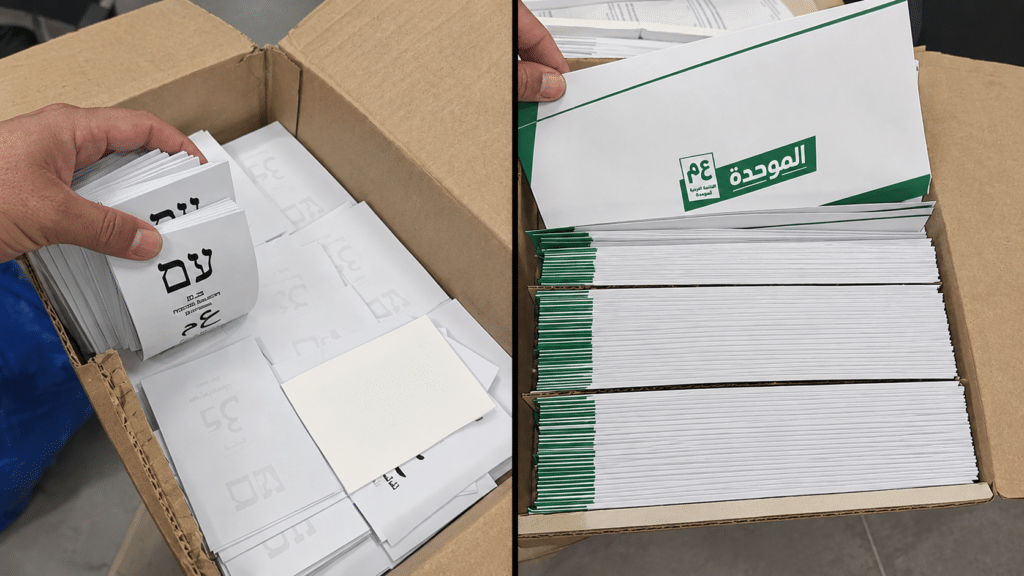
On the night before the elections and in the days that followed, seven suspects were arrested in the Negev. They included activists connected to Ra’am, among them Bedouin school principals. Searches uncovered envelopes containing tens of thousands of shekels in cash, alongside Ra’am ballot slips. Some envelopes reportedly bore inscriptions such as “A Gift from the Islamic Movement.”
The investigation is being conducted by Lahav 433, the Israeli police’s elite national investigative unit, and the Southern District’s Central Investigations Unit. Some suspects have been released to house arrest or released outright, while others have remained in custody.
The conclusion at this stage: The police have uncovered evidence of suspected violations of election law.
The Independent Investigation: Where Things Stand
Numerous publicly identified witnesses from the Arab community have already come forward, describing the widespread distribution of large amounts of cash and prepaid fuel cards to voters in exchange for their votes.
The conclusion at this stage: The testimonies and findings are so extensive that there can be no serious doubt that Arab votes were purchased on a large scale.
The Shin Bet Investigation: Where Things Stand
There is no disagreement within the Shin Bet over the seriousness of the affair or the need for a national security investigation. As noted, both the chairman of the Central Elections Committee and the attorney general have also been persuaded that the matter warrants investigation as a national security case.
The disagreement at the top of the Shin Bet, between its director and other senior officials, concerns the level of urgency and severity. Should this be treated as a national security emergency of the highest order, comparable to a “ticking bomb” investigation, which would permit the use of “special interrogation measures,” as the Shin Bet director reportedly believes? Or should the agency, at least for now, conduct a standard national security investigation, as it would in other security-related cases?
In other words, all the indications suggest that the Israeli police and the Shin Bet are making progress in investigating a serious affair, one with national security implications, involving hostile foreign interference in the very heart of Israeli democracy: the integrity of free elections.
Which brings us back to the response of prominent journalists on the matter. What could be their motive in declaring before any inquiry that concerns about potentially profound interference in Israeli elections were: “Lies and falsehoods”, “Nonsense”, “A racist blood libel”, “An improper influence operation”, “Bullshit”, “A fabricated theory”, and “Propaganda hype”?
Politicians who dismiss and downplay the election affair have their own interests and one can at least understand their behavior. But what excuse do so many journalists in the Israeli media have? Are they not professionally obligated to report the facts to the public fairly, accurately, and impartially?
Everyone knows the answer.
Israel’s mainstream media is largely a propaganda machine, not an impartial conveyer of facts.