
American universities have reported more than $76 billion in foreign gifts and contracts since 1986, yet the identities of many of those providing the money remain concealed. A federal judge has now blocked the Education Department from making those names public for universities covered by the ruling, raising questions about transparency and foreign influence on American campuses.
The ruling followed a lawsuit by the Association of American Universities, representing the nation’s leading research institutions, which argued that disclosure would violate promises of confidentiality, expose donors to possible harassment and discourage future contributions. Universities are already required to report substantial foreign funding to the federal government, but many of the funders’ identities remain unavailable to the public.
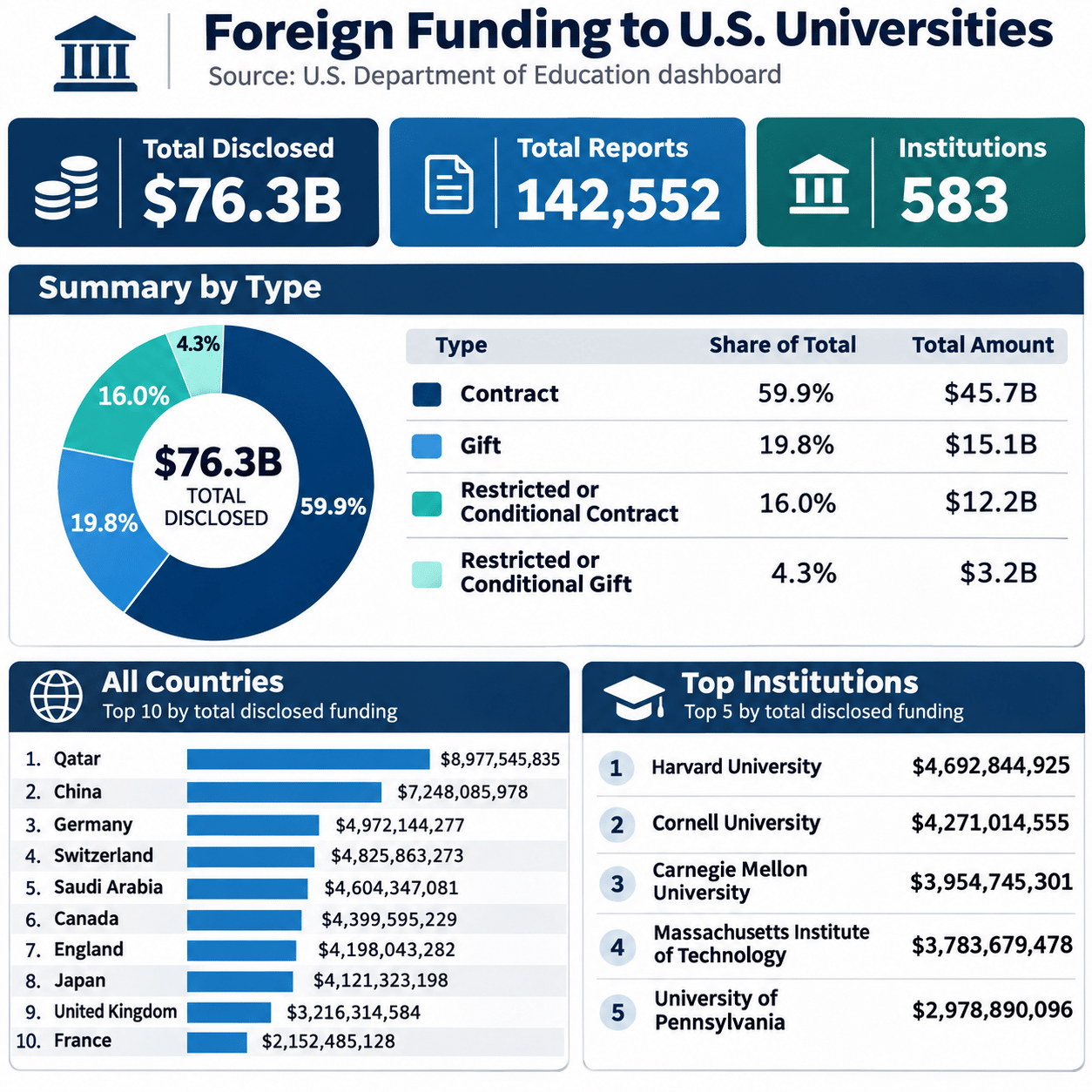
The financial stakes are considerable. The Education Department’s dashboard shows that 583 American universities have disclosed $76.3 billion in foreign gifts and contracts. Harvard, Cornell, Carnegie Mellon and MIT are among the largest recipients. Qatar is the largest reported source, accounting for nearly $9 billion, followed by China with $7.25 billion.
According to the Brandeis Center, 66 American universities have reported funding from Qatar, but the specific sources behind more than $4 billion of that money have not been publicly identified. The Brandeis Center has filed suit to force disclosure, arguing that the public has a right to know whether foreign governments and organizations are using financial relationships to influence university research, academic programs, campus policies and the treatment of Jewish students. Its chairman, Kenneth Marcus, a former assistant secretary of education, has raised particular concerns about foreign interference and rising antisemitism on American campuses.
The court’s decision leaves many foreign funders’ identities shielded from public scrutiny. With billions flowing into American institutions from countries whose political interests may conflict with those of the United States, the inability to identify the sources of much of that funding raises serious questions about accountability and the potential influence of foreign interests on American higher education.