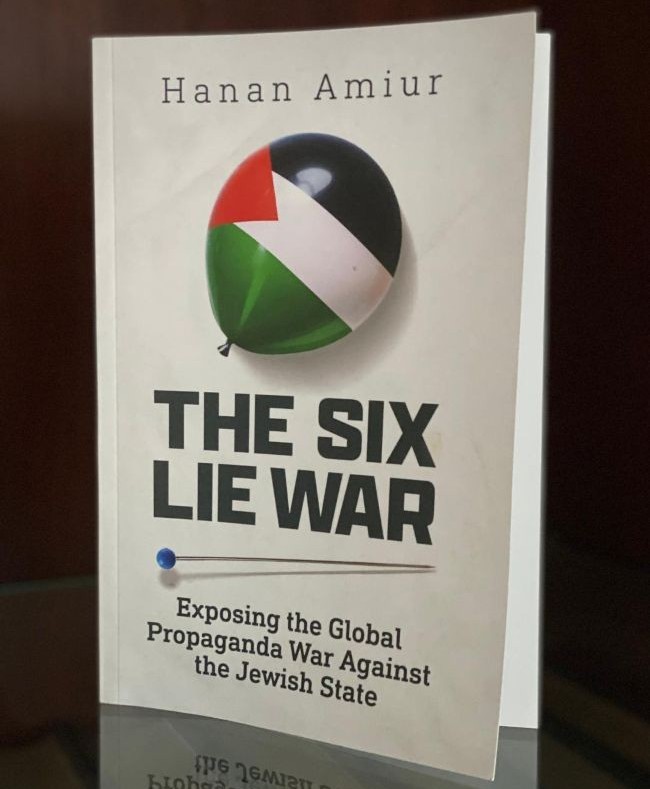

Senior Fellow Hanan Amiur’s The Six-Lie War is a handbook for understanding and refuting key lies weaponized against the Jewish state. It was published in Israel in 2025 where it was a best seller and released in English in 2026.
Chapter Four: “Israel Is An Apartheid State”
Israel’s lawful control of Judea and Samaria, following Jordan’s attack in the Six-Day War, created a complex reality: Israeli rule over Palestinians who had previously been under Jordanian authority. Israel refrained from granting them citizenship, intending to return the territory in exchange for peace. But as terrorism escalated, the situation grew increasingly complicated, forcing Israel to adopt security measures that made daily life more difficult for the Palestinian population. Out of this, the accusation of apartheid was born.
Having already claimed that the land belongs to them and not to the Jews, that Israel carried out a Nakba against them in 1948, and that the 1967 occupation is illegal—the Palestinians now assert that Israel has established an oppressive apartheid regime in the “occupied territories.” According to this claim, Israel illegally seized the land, imposed two separate legal systems—civilian law for settlers and military law for Palestinians—and through these systems, systematically oppresses them: promoting “Jewish supremacy,” denying Palestinians political and national rights, imprisoning them without trial, restricting their freedom of movement, and surveilling them through advanced technologies. Israel, they charge, is an apartheid state guilty of crimes against humanity. This narrative extends not only to Palestinians in Judea and Samaria but also to Arab citizens of Israel. Let us examine this claim.
A Brief Introduction to Apartheid
Any serious discussion of the claim that Israel is an apartheid state must begin with some historical background on how the apartheid regime emerged and developed. Understanding the roots of this unique system—which serves as the primary point of comparison to Israel—is essential to evaluating the accusation. To do so, we must go back four centuries, to the 17th century—the height of the European empires, which were expanding into nearly every corner of the globe. At the time, Portuguese dominance of the maritime trade routes to the East—routes that passed near the coast of South Africa—was beginning to decline, and competition over control of those routes intensified, particularly among the Portuguese, the English, and the Dutch.
In the mid-17th century, a Dutch ship was wrecked near the Cape of Good Hope, a headland on the southern tip of Africa. The surviving sailors took shelter there for about a year, fortifying themselves until they were rescued. Following this incident, the Dutch East India Company—a powerful trading corporation established by the Dutch government to manage its colonial activity in Asia—decided to establish a permanent settlement in the area. Its purpose was to provide merchant ships with a convenient place to stock up on fresh food and give their crews a place to rest. A first delegation was sent from the Netherlands, and several decades later, a group of French Huguenot farmers joined them to expand agricultural production. In this way, the city of Cape Town was founded, and with it the Afrikaner Boer community: white settlers of Dutch descent who spoke Afrikaans, a language that evolved from Dutch and included words from French, English, African, Asian, and other tongues. Over time, this community took root and grew in South Africa.
The Afrikaners’ European origin, technological advantages, and access to economic resources gave them a substantial edge over the local African population, which was far less developed. That gap enabled the white settlers to accumulate land, wealth, and political power. Yet even at the height of their dominance, whites made up only about 9 percent of the South African population, compared to an overwhelming majority—over 90 percent—of native black Africans. The disparity between the prosperity of the white minority and the hardship of the black majority only deepened with time. The natural result was growing unrest and protest against this injustice. In response, the Afrikaners moved to legally entrench the social and political supremacy of the white minority through a sweeping system of laws.
The first law prohibited sexual relations between whites and blacks. After that came a rapid wave of legislation aimed at preserving the discriminatory social order:
- The Mines and Works Act reserved skilled labor positions for white workers and guaranteed them the best-paying jobs, while barring any possibility of a white worker being subordinate to a black manager.
- The Urban Areas Act designated cities as white spaces, requiring non-whites to obtain special permits to enter or live there.
- The Population Registration Act divided the population into four racial categories—white, black, Indian, and “colored” (mixed race)—and banned interracial marriage.
- The Group Areas Act created separate residential zones for each racial group, enforcing complete spatial segregation.
- The Separate Amenities Act mandated total segregation in public spaces, including hospitals, transportation, benches, water fountains, beaches, and restrooms.
Then came the Bantu Education Act, which imposed racially segregated mandatory schooling. The law banned integrated educational institutions and imposed a curriculum on black students designed to prepare them for menial labor and domestic service. These restrictions were later extended to higher education, with the explicit goal of blocking upward mobility for the black population and cementing the existing inequality. Through this process—which began in 1910 with South Africa’s political independence from Britain and continued for roughly fifty years—the apartheid regime was created, institutionalized, and expanded. The term “apartheid” means “separateness” in Afrikaans. It referred to a system characterized by sweeping, almost hermetic, racial segregation between whites and blacks, maintained through dense legal regulations designed to enforce separation, subjugate the black majority, and entrench the absolute supremacy of the white minority.
In the wake of South Africa’s history, apartheid was later codified in the 1998 Rome Statute, the foundational document of the International Criminal Court. According to the Statute, apartheid refers to:
Inhumane acts—such as murder, extermination, enslavement, deportation or forcible transfer of population, unlawful imprisonment, torture, and rape—committed with the intent to maintain a regime of systematic oppression and domination by one racial group over any other racial group.”
In other words, apartheid is a regime that discriminates against a group on the basis of race, denies it fundamental human rights—freedom of movement, freedom to work, dignity—and relies on brutal methods of oppression, including murder, enslavement, torture, and rape. According to those who accuse Israel of apartheid, this is precisely what Israeli law does: it institutionalizes a permanent system in Israel and Judea and Samaria in which Jews discriminate against Arabs because they are Arabs, through measures that constitute crimes against humanity.
And because, in the Palestinian view, Israeli apartheid is racially motivated against Arabs, it does not stop at the borders of Judea and Samaria. It extends to Arab citizens within Israel itself. A host of so-called “human rights” organizations—many of them fronts for anti-Israel activism—embrace and amplify this narrative. Under names like B’Tselem (“In His Image”), Amnesty International, and Human Rights Watch, they engage in a coordinated campaign against the civil and human rights of Jewish Israelis, all while posing as neutral defenders of justice. These organizations routinely publish reports claiming to “prove” that apartheid is entrenched not only in Judea and Samaria but within Israel’s sovereign borders as well. Their claims are cited across major global media outlets.
But do these accusations reflect the reality of how the Israeli government treats Arab citizens within Israel, as well as Palestinians in Judea and Samaria? Let us now examine the evidence, beginning with the case of Arab citizens of Israel.
Israeli Apartheid?
The accusation that Israel practices apartheid against its Arab citizens—as claimed by organizations like Human Rights Watch—relies on a deliberate distortion of the definition of apartheid found in the Rome Statute. The aim is to force that definition onto Israel, even when the situation on the ground does not meet the core criteria of the discriminatory regime as it was originally defined.
At the UN Durban Conference in 2001, anti-Israel organizations adopted a long-running campaign to delegitimize international recognition of the Jewish people’s right to self-determination in their ancestral homeland. There, they introduced a new, unique definition of apartheid—one tailored specifically to Israel. The final declaration of the coalition of antisemitic groups that participated in the conference referred to “Israel’s apartheid brand” and “Israel’s new form of apartheid.”
The claims of apartheid within Israel typically focus on three main areas in which discrimination is allegedly present:
Discrimination in civil rights
Discrimination in immigration policy (specifically, the Law of Return)
Discrimination in land use and building permits
As is often the case with Arab propaganda, these claims are shallow and flimsy, and each one is easily refuted by hard facts and data.
Discrimination in Civil Rights
Anyone who lives in Israel—or has visited and knows it well—understands how absurd the claim of apartheid against Arab citizens truly is. It is detached from reality and utterly unsupported by facts. The lived experience in Israel, accepted as natural by both Jews and Arabs alike, is one of full civil equality among all citizens—Jews, Arabs, and members of the many ethnic and religious communities that make up Israeli society.
A brief aside: while there is full equality of rights, there is not full equality of obligations; and in this respect, it is Arab citizens who benefit from preferential treatment. The vast majority of Jewish youth are required to serve in the military or perform national service for one to three years, whereas Arab citizens are exempt. Nonetheless, some young Arabs choose to enlist and serve their country alongside their Jewish comrades, despite being under no obligation to do so.
In any case, the principle of equal rights in Israel encompasses all individual freedoms and all spheres of life, except one: the demand for national self-determination for Arabs within the State of Israel. Such a move would negate Israel’s identity as a Jewish state and transform it into a multi-ethnic state. But within the bounds of that national framework, Jewish and Arab citizens enjoy the exact same rights. They vote and run for office in democratic elections, move freely throughout the country, leave and return as they wish, pursue professional careers, hold senior public positions, and develop according to their personal talents and ambitions.
Arab citizens vote in Knesset elections and are represented in parliament—often through some of the largest parties. Some have served as ministers in Israeli governments, as senior diplomats abroad, as heads of universities, government ministries, and hospitals. They also represent Israel in international sports competitions and serve on national teams. In addition, affirmative action policies benefit Arab citizens in areas such as admission to elite academic programs and highly sought-after positions in the civil service.
In fact, over the years, Arab Knesset members have been elected not only from Arab parties but also on the slates of Zionist Jewish parties, including right-wing ones. Even outspoken critics of Israel, including those who openly advocate for the country to cease being a Jewish state, sit in the Knesset as representatives of Arab parties. One of the most notable examples is Ahmad Tibi, a former senior advisor to Yasser Arafat, who now serves as a long-standing Knesset member. Arafat, of course, was an extremist Palestinian leader and a convicted terrorist—and Tibi did not advise him on economic policy or livestock management, but on matters directly concerning Israel. In other words, how best to undermine it from within. Yet Tibi not only serves in the Knesset, he has at times served as Deputy Speaker. His fellow Arab MKs make no secret of their nationalist agenda and have even expressed open support for hostile entities. And yet, remarkably, they all enjoy full freedom of speech and prominent roles within Israel’s political system.
Is this apartheid?
Arab citizens and other non-Jews work alongside their Jewish colleagues, stand next to them in supermarket checkout lines, relax with them in the same parks and nature reserves, and live as neighbors in shared communities.
The apartheid is so vicious, in fact, that Arab citizens serve as judges in every level of Israel’s court system, including the Supreme Court. In 2010, former Israeli President Moshe Katsav stood trial on charges of rape and sexual assault against female employees in the President’s Residence. In a case that made headlines across the country, the presiding judge who convicted the Jewish president and sentenced him to a lengthy prison term was an Arab citizen of Israel: Judge George Karra.
Just imagine: an Arab judge finds a Jewish president guilty and sends him to prison. Truly, a brutal apartheid regime.
In a country where apartheid is real, that Arab judge would never have been permitted to study law—let alone be appointed to the bench, let alone preside over a court, let alone sentence Jewish citizens for decades, including the president himself. In a real apartheid regime, that same Arab wouldn’t even reach the courthouse without a permit to enter the city. He wouldn’t be allowed to drink from the public fountain or use the restrooms in the hall of justice.
Discrimination in Immigration Policy (The Law of Return)
There is indeed one area where a distinction exists between Jewish and Arab citizens of Israel: the Law of Return. This, Palestinians claim, is proof of “Jewish supremacy.”
The Law of Return is the cornerstone of Israel’s immigration policy. Enacted in the early days of the state, its purpose was to establish Israel as a national homeland and a refuge for Jews everywhere—whether fleeing antisemitism or seeking to reunite with their people in the Land of Israel as part of the ingathering of exiles. Under this law, any Jewish man or woman anywhere in the world who wishes to settle in Israel has the right to immigrate, receive citizenship, and benefit from a special integration package to ease their transition into life in the Jewish state.
Over the years, the law was expanded on humanitarian grounds to include not only Jews, but also their non-Jewish descendants and relatives by family ties.
Still, the law does create a distinction: a Jewish citizen of Israel can bring relatives from abroad who are eligible for immediate citizenship, while an Arab citizen cannot. Palestinians cite this as evidence of apartheid.
But even if the Law of Return causes frustration among Palestinians—since it highlights the Jewish character of the State of Israel—attacking the law presents a problem: it is a legitimate, just, and entirely reasonable policy.
In fact, international law explicitly permits such legislation. Article 1, Section 3 of the 1965 International Convention on the Elimination of All Forms of Racial Discrimination states that countries may give preferential treatment in granting citizenship to specific groups, so long as the policy does not constitute targeted discrimination against others. Article 1, Section 4 goes further, allowing affirmative action—in other words, it permits states to give preference to certain populations in order to remedy historical injustices.
Anyone familiar with Jewish history understands why such a law is not only justified, but necessary. Consider the 1939 British White Paper, which severely restricted Jewish immigration to Mandatory Palestine. This decision trapped millions of Jews in Europe, denying them the chance to flee the Nazi death machine. The result: the crematoria, the firing squads, the gas chambers. The Law of Return was intended, at least in part, to ensure that such abandonment would never happen again—even if it came too late for many.
The law is therefore not only moral and logical, but also clearly permitted under international law. Nor is it unique to Israel. In Ireland—a country often critical of Israel and quick to invoke the language of apartheid—the Minister for Justice has the authority to grant citizenship to anyone of Irish descent, or to anyone related to an Irish citizen, including the parent or guardian of a child of Irish descent. Sound familiar?
Similar laws exist in numerous democratic nations, particularly those with large diasporas abroad: Mexico, Finland, Greece, Poland, Germany, Italy, Denmark, and many others. Are all of these also apartheid states? Why, then, is this accusation reserved solely for Israel? Perhaps because it isn’t really about facts—but about the unrelenting need to vilify the Jewish state. At bottom, it is just antisemitism in a new form—though some prefer not to say it out loud.
Predictably, Palestinians and Arab citizens of Israel demand the repeal of the Law of Return. That demand will not be met. Repealing the law would mean stripping Jews around the world of their right to seek refuge in Israel when their surroundings grow toxic and dangerous due to rising antisemitism. This is not a hypothetical concern. Violent outbreaks of Jew-hatred—especially in places like France, Britain, and Germany, where large Muslim populations live alongside Jewish communities—have already led many Jews to make aliyah and begin new, safer lives in Israel. This phenomenon has continued for years, but it surged dramatically after the October 7th massacre, which unleashed waves of antisemitic hatred across the globe.
To repeal the Law of Return would be to abandon millions of Jews to whatever fate awaits them abroad. That is why the law is not only justified, but essential—and why it will remain in force.
And above all, we must return to the original point of comparison: the Afrikaners of South Africa were Dutch colonizers who seized control of a land to which they had no historical connection. They deliberately constructed a racist, brutal apartheid regime. The Jews, by contrast, returned to their ancestral homeland—they did not invade it. Unlike the Afrikaners, Zionism never sought racial segregation. In fact, the very idea of racial separation was utterly foreign to it.
Discrimination in Land Allocation and Construction
Palestinians claim that Israel discriminates against its Arab citizens when it comes to land use and housing. According to this narrative, Jewish construction is freely permitted, while Arabs are confined to overcrowded enclaves that they are barred from expanding or developing. One report by the anti-Israel organization B’Tselem even asserted that Israel has not established a single community for its Arab citizens.
B’Tselem is an old hand among civil society organizations—and like many with long memories, it sometimes remembers things that never happened and forgets things that did. In this case, the authors of the report conveniently forgot about a long list of cities and towns built by Israel specifically for its Arab citizens: Rahat, Kuseife, Segev Shalom, Ar’arat an-Naqab, Lakiya, Tel Sheva, Hura, Tirabin al-Sana, Sa’wa (formerly Mulada), Abu Qrenat, Qasr al-Sir, Mak-hul, Umm Batin, and many others.
Moreover, a review of private land ownership in Israel tells a very different story. Out of all privately held land in Israel—about 6 percent of total state land—roughly half is owned by Arab citizens. This, despite the fact that Arabs make up less than 20 percent of the population. Far from being excluded, Arab citizens own private land at a rate more than double their share of the population.
Affirmative Action for Arabs
Contrary to claims of discrimination, Arab citizens of Israel actually benefit from affirmative action when it comes to land allocation—receiving subsidized prices from the state that are significantly lower than those offered to Jews. For example, while this book was being written, land in the Jewish community of Moreshet was being sold for 1.4 million shekels. In the neighboring Arab village of Kaokab? Just 50,000 shekels. The same pattern repeats elsewhere: in Gililon and Kornit, both Jewish communities, land is priced at 1.2 million shekels, while in the nearby Arab town of Sha’ab it costs only 50,000 shekels, and in Shfaram just 74,000. There are thousands of such examples—and not a single case in the opposite direction.
So the Palestinians are right: there is discrimination in land allocation in Israel—but it favors the Arab population.
Illegal Settlement in the Negev
Another form of favorable treatment for Arab citizens of Israel is the government’s policy on illegal Bedouin settlement in the Negev, particularly in its northern region, where these encampments now cover vast swaths of land. For decades, the state has allowed tens of thousands of Bedouin citizens to establish hundreds of illegal settlements—some along the shoulders of highways, others on private Jewish property or on state land earmarked for development, transportation, or military training zones.
Rather than evacuate these encampments or pursue legal action, the state enters into prolonged negotiations, offers generous compensation as if the Bedouin were victims, and allocates free plots in regulated communities to every family that illegally seized land—whether public or private.
No such leniency is extended to Jewish citizens. A Jew who trespasses or builds on land that does not belong to him is subject to swift and uncompromising enforcement. Over the years, hundreds of Jewish-built structures on private land have been demolished and removed without hesitation.
The Myth of Crowding in Arab Communities
One of the central accusations leveled against Israel is that Arab towns are overcrowded while Jewish communities enjoy wide open spaces. But this, too, is a fabrication—not a fact. The data actually shows the opposite: average population density in Jewish communities is twice as high as in Arab ones.
“It is true that Israel has established hundreds of Jewish communities,” wrote researcher Gilad Einni in a study published on the CAMERA website, addressing the apartheid accusation and the claim of discrimination in housing and planning. “But the reason for this is not so malicious. The towns and cities were needed to house millions of immigrants—Holocaust survivors, Middle Eastern Jews who fled oppression in Arab countries, Jews who wanted to live in the Holy Land—who were absorbed by a state established as a refuge for Jews. This is not ‘Jewish supremacy.’ This is a rescue operation.”
***
“You cannot attack Israel again and again with claims as if it is an apartheid state,” said Issawi Frej, an Arab minister in the Israeli government, speaking to foreign correspondents in the spring of 2022. “Israel is not an apartheid state. It is impossible that I am an Arab Muslim minister in the Israeli government, and you say it is an apartheid state. It doesn’t make sense.”
International jurist Richard Goldstone was even more emphatic. Goldstone served as a judge in the Supreme Court of apartheid South Africa, and later in the Constitutional Court of democratic South Africa. According to him:
I know all too well the cruelty of South Africa’s abhorrent apartheid system, under which human beings characterized as black had no rights to vote or hold political office… Blacks critically injured in car accidents were left to bleed to death if there was no “black” ambulance to rush them to a “black” hospital. “White” hospitals were prohibited from saving their lives… [In Israel], Arab patients lie alongside Jewish patients, receiving identical treatment… In Israel, equal rights are the law, the aspiration and the ideal; inequities are often successfully challenged in court… Those who conflate the situations in Israel and the West Bank and liken both to the old South Africa do a disservice to all who hope for justice and peace… Israel, unique among democracies, has been in a state of war with many of its neighbors who refuse to accept its existence… The charge that Israel is an apartheid state is a false and malicious one that precludes, rather than promotes, peace and harmony.
The attentive reader will note that Goldstone rejected the apartheid claim not only with respect to Israel itself, but also to Judea and Samaria (referred to as “the West Bank” in his op-ed). The accusation, he wrote, is “false and malicious.” Following that lead, we now turn to the Palestinian Authority and the situation in Judea and Samaria.
The “Apartheid” in Judea and Samaria
To understand the civil status of Arabs living in Judea and Samaria, one must return to the period before the Six-Day War and Israel’s subsequent control of the area.
Between 1949 and 1967, Judea and Samaria were under Jordanian rule. Arabs living there were granted Jordanian citizenship and participated in Jordanian parliamentary elections in significant numbers. Economically, however, the situation deteriorated rapidly. Research by Professor Talia Einhorn, a member of the International Academy of Comparative Law, shows that the Jordanian regime channeled funding and development resources exclusively to the East Bank, deliberately neglecting Judea and Samaria. Unemployment in the area soared above 50 percent, and chronic water shortages triggered a wave of Palestinian emigration—mainly across the river to the East Bank, i.e., the Kingdom of Jordan.
After 1967, the picture changed dramatically. Within just a few years, roughly 40 percent of the Palestinian workforce was absorbed into the “occupying” Israeli economy. The poverty and scarcity that had characterized life under Jordanian rule gave way to sustained growth. Local agriculture also underwent a revolution: with technical support from the Israeli Ministry of Agriculture, traditional farming—based on manual labor and draft animals—was transformed into modern, mechanized agriculture. Crop yields doubled and even tripled. In time, Palestinian agricultural output surpassed that of neighboring Arab countries. Yet as employment opportunities in Israel expanded, agriculture became a secondary field, mostly worked by women, children, and the elderly.
Within twenty years, the economic condition of Arabs in Judea and Samaria had improved dramatically across every measurable indicator. Under Jordanian rule, only a small fraction of homes had access to electricity and running water. Under Israeli rule, the entire population was connected to modern infrastructure. During this same period—when Israel was supposedly enforcing an “apartheid” regime—Palestinian water consumption increased by 640 percent, compared to just 140 percent on the Israeli side. This transformation was made possible by dozens of Israeli-drilled wells, hundreds of kilometers of new pipelines, and the integration of hundreds of Palestinian villages into Israel’s national water grid.
A World Bank report found that during this period, Palestinians in Judea and Samaria enjoyed stable annual growth of around 5 percent. Incomes rose, private consumption increased, and key health and welfare indicators improved accordingly. After years of stagnation under Jordanian rule, there was a sharp rise in both life expectancy and birth rates. Life expectancy, which had been under 56 years before 1967, now approaches an average of 80.
Clearly, this is a brutal occupation.
It is worth noting that contrary to popular belief, Arab states did not work to support Palestinian prosperity. Quite the opposite. In fact, the Arab world imposed a sweeping economic boycott on Israel, which included the Palestinians living under Israeli rule. They were barred from exporting produce to any Arab country—including Jordan, which had granted them citizenship until 1988. Despite this enforced isolation, Palestinians continued to prosper, thanks to their connection with the dynamic and developed Israeli economy.
Thus, the first two decades of Israeli administration in Judea and Samaria were marked by steady improvements in quality of life, all while Palestinians maintained their political rights through their Jordanian citizenship. But after twenty years, things took a darker turn for everyone involved. In the late 1980s, a violent Palestinian uprising broke out—later known as the First Intifada.
Just months after the uprising began, fearing the violence would spill into his kingdom—where a majority of the population was Palestinian—King Hussein of Jordan announced a complete “disengagement” from the West Bank. Jordan renounced its sovereignty over Judea and Samaria and revoked the Jordanian citizenship of the Arabs living there.
The Outbreak of Terror
The Jordanian disengagement and the outbreak of the First Intifada created two fundamental problems. First, with Jordan’s revocation of citizenship, the Arabs of Judea and Samaria were left without political rights. Second, the escalating wave of terrorism, marked by indiscriminate and murderous attacks on Israeli civilians, forced Israel to take security measures to protect its people. The result was the imposition of restrictions on parts of the Palestinian population, justified by pressing security needs.
From the outbreak of the Intifada in December 1987 to the present day, the relationship between Israel and the Palestinians of Judea, Samaria, and Gaza has been defined by recurring waves of violence and escalating terror. Over time, the attacks have become more deadly and more cruel, forcing Israel to increase its efforts to combat terrorist groups operating from within civilian populations. This is not only Israel’s right—it is its obligation as a sovereign state to protect its citizens. International law fully recognizes this right.
To understand the pressures under which Israel operates in its fight against terrorism, one must revisit the history of the Palestinian Intifada. It began with mass marches and chants of slogans like “With spirit and blood, we will redeem Palestine.” Before long, those marches turned into rock-throwing at Israeli security forces and passing vehicles, causing injuries and even deaths to civilians caught in the chaos, struck by heavy stones.
Next came Molotov cocktails thrown at Israeli vehicles, resulting in horrific burn injuries and death by fire. Soon, the attacks grew more sophisticated and more brutal: lynchings, stabbings, shootings, kidnappings for ransom. Then came car bombs and the rise of suicide bombings. The first suicide attack occurred in the summer of 1989, when a Palestinian terrorist hijacked a civilian bus on its way to Jerusalem, drove it off a cliff, and murdered dozens of passengers.
Israel was facing a relentless wave of terror—one that claimed more and more civilian lives with each passing year. To confront this threat, Israel adopted two parallel responses:
- The Political Response: Opening negotiations with the Palestinians in hopes of achieving a peaceful resolution through compromise. This track will be discussed in the next chapter.
- The Security Response: Taking direct action to thwart terrorism, prevent future attacks, and reduce the risk to civilian life. Israel could not tolerate a reality in which a schoolgirl on her way to class is stabbed to death by a terrorist—as happened in the city of Bat Yam, for example. The ease with which attackers could reach their targets, and the lack of intelligence about when and where the next strike might occur, compelled Israel to adopt tough security measures to regain control.
Apartheid, by definition, is a system of institutionalized racial segregation, codified in law and enforced deliberately and systematically by the state. Israel’s security policy in Judea and Samaria does not arise from a belief in racial superiority or a desire to discriminate. It is a direct response to a prolonged and ongoing campaign of terror. This is a security necessity—not a racist ideology.
The difference between apartheid South Africa and the situation in Judea and Samaria could not be clearer—so much so that the comparison is almost laughable. Black South Africans under apartheid did not carry out suicide bombings in cafés, hurl Molotov cocktails at buses, or slit the throats of civilians in the streets. Palestinians, by contrast, have elevated terrorism into a national ethos—one taught in schools, glorified in the media, and embraced as a mark of pride.
For Palestinian propaganda, facts have never posed much of a problem. And so, despite the obvious and profound differences, the accusation of apartheid was born—a cynical tool of political warfare that bears no resemblance to reality.
Security Needs and Their Impact on Daily Life
Checkpoints and Freedom of Movement
To support their claim that Israel is an apartheid state, Palestinians often point to the presence of checkpoints, accusing Israel of restricting their freedom of movement. But this claim, too, is riddled with distortions and falsehoods.
First, it’s important to remember that not a single checkpoint was established in Judea and Samaria until terrorism began to escalate in Israeli cities. Second, the purpose of checkpoints is not to curtail free movement, but to prevent terror attacks—by intercepting would-be attackers en route to their targets. Innocent civilians, including Jews, may experience brief delays, but the overwhelming majority of travelers pass through without incident. International law not only permits such measures—it obligates Israel to take them, as part of its duty to safeguard its citizens.
Anyone who has spent time in Judea and Samaria knows that being a Palestinian terrorist is no easy task. Most are tracked, intercepted, and neutralized by one of the world’s most effective counterterrorism systems—one that prevents hundreds of attacks every year.
And they also know this: a Palestinian not involved in terrorism can wake up in the morning in Jenin, in the far north, get in their car, and drive all the way to Yatta in the far south, all without encountering any restriction on movement. The claim that Palestinians live in isolated “Bantustans” that break up the geographical and social fabric is pure fiction. The roads of Judea and Samaria are filled, at all hours of the day and every day of the week, with Palestinian vehicles traveling freely—for work, trade, family visits, and every other purpose. These very roads, incidentally, were paved by the State of Israel and funded by mostly Jewish taxpayers.
The Talmud teaches that “a person is not typically brazen in the face of their creditor”, meaning, most people don’t have the audacity to lie outright to someone who knows the truth. But it seems this presumption doesn’t apply to the Palestinians. For despite a reality that is the exact opposite of their claims, they continue to spread the apartheid lie—confident that across the world, there is a willing and antisemitic audience eager to believe any anti-Israel accusation, no matter how baseless.
Violation of Privacy and Security
Another accusation Palestinians level against Israel is that it violates their right to privacy through arrests, night raids, and intelligence surveillance.
This, too, is a baseless claim. Before the rise of terrorism, Israel had no need to carry out arrests in Palestinian homes or operate intelligence systems aimed at preventing attacks. But reality changed—and with it, Israel’s obligations. As international law and plain logic make clear, the state’s primary duty is to protect its citizens from terrorism. That’s how all free societies respond to terror threats around the world. And for any Palestinian who wishes to avoid a night visit from Israeli security forces, the solution is simple: don’t engage in terrorism. Hundreds of thousands of Palestinians live in Judea and Samaria without ever participating in violence, and their rights remain fully intact.
The Political Rights of Palestinians
Another claim frequently made is that Palestinians live as subjects without political rights. This, too, is a lie; one more strand in the web of falsehoods.
Yes, following Jordan’s disengagement in 1988, Palestinians lost their political status as citizens of the Hashemite Kingdom. But since 1994, they have enjoyed extensive political autonomy under Palestinian self-rule—an arrangement made possible, and sustained, with Israel’s support.
The average Palestinian is born under the jurisdiction of the Palestinian Authority, enrolled in a Palestinian health system, educated in Palestinian schools, studies at Palestinian universities, pays taxes to the Palestinian Authority, crosses through border terminals staffed by Palestinian security forces, and lives under a Palestinian system of law, enforcement, and punishment.
In truth, the greatest infringement on Palestinians’ political rights does not come from Israel, but from their own leadership. To avoid ceding power to Hamas—its chief rival—the Palestinian Authority canceled elections nearly twenty years ago. Since then, it has ruled through brutal repression, violently suppressing dissent. The Gaza Strip offers a vivid case study in this political culture. After Israel’s full withdrawal and the achievement of Palestinian independence in Gaza, a terror regime took root—one that crushed opposition and governed through fear. Images of tortured bodies, suspected by Hamas of dissent or disloyalty, regularly appear on Palestinian Telegram channels.
Under Palestinian self-rule, political rights as Westerners understand them—freedom of speech, electoral choice, civil protections—simply do not exist. And conditions are only marginally better in areas controlled by the Palestinian Authority.
Palestinians are free to protest—but only when their protests target Israel. Demonstrations against their own government are typically met with live fire and violent suppression by Palestinian police.
Even the claim that Israeli courts are inaccessible to Palestinians is exaggerated and false. Although Palestinians maintain an independent judicial system, they are still permitted to file lawsuits against Israel and Israeli citizens in Israeli courts—including the Supreme Court—and they often win.
One might try to compare the status of Palestinians in Israel to that of Jews in Arab countries, if Jews had not already been expelled, often penniless, from those countries. What we can still do, however, is draw a historical comparison. In In Ishmael’s House: A History of Jews in Muslim Lands (2010), British historian Sir Martin Gilbert compiled extensive testimony on Jewish life in the Arab world over the past thousand years. His book documents a long history of institutionalized, violent, and systematic discrimination: humiliating dress codes, a special tax (the jizya), restrictions on employment and education, and even public lynchings. This oppression reached its peak after Israel’s founding, when most Jews in Arab countries were expelled and their property confiscated.
In stark contrast, Palestinians in Judea and Samaria live in economic and social partnership with their Jewish neighbors. They work, trade, and shop together, travel the same roads, and receive medical care in the same hospitals. No one would dream of denying them access to public parks, benches, or restrooms. The law is entirely blind to their ethnicity.
One of the great ironies of the apartheid smear campaign is that dozens of human rights organizations operate freely throughout these so-called “apartheid territories,” employing thousands of volunteers and running long-term projects—none of which would be tolerated under a true apartheid regime.
Palestinian propaganda surrounding “apartheid” reached its greatest moment of success in April 2014, when a leaked audio recording appeared on the U.S. news site The Daily Beast. In it, Secretary of State John Kerry is heard warning that without peace, “Israel could become an apartheid state.”
But the propaganda victory was short-lived. The very next day, facing widespread backlash, Kerry issued a personal and humbling retraction: “If I could rewind the tape, I would have chosen a different word… [Apartheid] is a word best left out of the debate here at home.”
What Do the Victims of Real Apartheid Say?
Apartheid in South Africa was a uniquely vile injustice in modern history. It left deep scars on its victims, and it is only natural that many of them react with anger when Palestinians compare their situation to what black South Africans endured. “Don’t steal the term from us,” many say. “We never had the human and civil rights that Arabs and Palestinians in Israel do.”
“I know what apartheid was, because I grew up under it,” said Reverend Kenneth Meshoe, President of the African Christian Democratic Party and a member of South Africa’s Parliament, in the summer of 2015. “Anyone who knows what real apartheid is knows that there is nothing in Israel that looks like apartheid. You see people of different colors, from different backgrounds and religions, interacting with each other every day in Israel. The claim of apartheid in Israel is an empty political statement that holds no truth. Please stop making it. It diminishes the suffering we endured under apartheid, and it destroys the memory of real apartheid.”
The story of Klaas Mokgomole, a South African activist and founder of South Africans for Peace, reveals the tragic-comic absurdity of comparing Israel to apartheid. During a 2023 visit to Israel, Mokgomole recounted how, as a university student in South Africa, he had been swept up in anti-Israel activism. Convinced that Israel was an apartheid state, he took part in extremist demonstrations—throwing a pig’s head into a kosher butcher shop “to show Jews what apartheid is,” and chanting slogans like “One Jew, one bullet” and “Kill the Jew.”
Eventually, Mokgomole decided to see this supposed apartheid for himself. “I drank a lot of water on the flight,” he recalled, “and waited to use the restrooms. As soon as we landed at the airport in Israel, I looked for the nearest security guard and asked him where the restrooms for blacks only were. He told me, ‘Look, we don’t have such things here. You can go to any of the men’s restrooms.’”
He arrived in Tel Aviv expecting to find the apartheid he had been taught about: segregated beaches, buses, clinics, hospitals, and schools. Instead, the visit became a moment of revelation. “I realized that the anti-Israel organizations in South Africa don’t really care about the Palestinians. All they care about is spreading antisemitism under a different name. They knew that if they came to us, the black people of South Africa, and told us that Israel is an apartheid state, it would move us and make us angry.”
And so it was that two ordinary sentences from an Israeli airport guard were enough to disillusion one of the anti-Israel movement’s rising stars. Ever since that trip, Mokgomole has become a voice for truth, sharing with South African youth what he actually saw in Israel.
Reinforcements for the rejection of the apartheid claim have come from the highest levels. F.W. de Klerk—the last white president of South Africa and the man who presided over the peaceful dismantling of apartheid—firmly rejected the comparison. Of all people, de Klerk had a vested interest in sharing the historical burden, diluting the moral stain of the regime he once led. Had he joined in labeling Israel an apartheid state, some of the blame and shame that clung to his own past might have shifted elsewhere.
But de Klerk refused to participate in the farce. “Israel is not apartheid,” he stated unequivocally during a 2015 visit to Israel, in response to Secretary of State John Kerry’s earlier remark. “This is an unnecessary and unfair comparison.”
The Real Apartheid in the Middle East
The greatest irony in the apartheid debate is that an actual regime of discrimination does exist in the region—both in Judea and Samaria and in neighboring Arab countries—but it is not a case of Jews discriminating against Arabs. Quite the opposite: it is a widespread, systematic discrimination of Muslims against Jews, Christians, Muslim women, LGBT individuals, and even fellow Muslims of differing sects.
Take the Palestinian Authority, for example, which governs most of the Palestinian population in Judea and Samaria. According to Palestinian Authority law, Jews are forbidden to purchase land. Not only that—the law also prohibits Palestinians from selling land to Jews, under penalty of death. Jews within Palestinian Authority-controlled areas have no basic civil rights whatsoever: no freedom of movement, no right to vote or be elected, no access to education, higher education, healthcare, or public services solely because they are Jewish. In fact, Jews are barred from entering Palestinian cities altogether for fear of being murdered in brutal public lynchings—a fate that has befallen more than one victim, cheered on by a bloodthirsty crowd.
Nor is this kind of discrimination limited to the Palestinian Authority. In Jordan, Jews are also forbidden from owning land, but in the Jordanian case, the most severe discrimination is directed against Arab women. Jordanian criminal law provides legal leniency for perpetrators of “honor killings”—a practice in which women are murdered by family members for supposedly bringing shame upon the family, often after being victims of sexual assault. In Jordanian society, even a raped woman is considered a source of disgrace, and her killers—usually male relatives—are given symbolic sentences, often no more than six months. These women endure the trauma of rape, only to face the threat of death if their violation becomes known.
A similar reality exists under the Palestinian Authority, where the judicial system routinely mitigates punishment for so-called “honor killings.” Beating a woman to death may not even be legally defined as murder; even when convictions are secured, sentences are often lenient, and convicted killers are routinely granted weekend furloughs—until they are quietly released.
I saw this horror with my own eyes. I was around 14, walking with friends near the outskirts of my hometown, south of Jerusalem. Between my community—Efrat—and the neighboring Palestinian village of Al-Khader, we came across a strange bundle lying beside the footpath. It was the headless body of a young woman. She had been butchered by her family over “family honor” and discarded in disgrace near Jewish homes.
And it’s not only women who suffer from this brutal discrimination. Palestinian LGBT individuals endure severe persecution at the hands of Palestinian security forces. They are arrested, subjected to torture—including being hung upside down from ceilings—forced into marriages, and in some cases publicly executed, thrown blindfolded and bound from rooftops to their deaths below.
The persecution of LGBT individuals and the murder of women in the name of “honor,” combined with the official indifference or even protection offered to the perpetrators, is a moral atrocity. It is institutionalized discrimination at its most extreme—a reign of terror rooted deeply in the legal and cultural systems of large parts of the Arab and Muslim world. In some cases, a woman’s life can be forfeit simply because her phone showed contact with an unfamiliar man, because she appeared in public without a male escort, or because she dressed in a way her family deemed inappropriate. Yet these are the same societies that dare to accuse Israel of apartheid.
And the truth about Israel? According to international data, the State of Israel ranks among the ten safest countries in the world for women. In fact, were it not for the murder rates within the Israeli Arab sector—where “honor killings” of Arab women by male relatives persist—Israel might well be considered the single safest country for women on earth.
But discrimination in the Arab world doesn’t end with women or LGBT individuals. Another group that suffers under Arab regimes is the Palestinians themselves—specifically, Palestinian refugees living in Arab countries.
In Iraq, government policy stripped Palestinians of their rights and rendered them foreigners in their own homes, largely due to their Sunni identity in a country shifting toward Shiite dominance. In Lebanon, Palestinians face severe legal restrictions: they are barred from entering professions like law, medicine, and engineering, denied citizenship, forced to pay into the social security system without receiving benefits, and forbidden from owning property. Lebanese law has refused to recognize them as citizens for nearly eighty years, a stance mirrored by Syrian law.
A 2017 investigation by the Associated Press reported that Palestinians in Lebanon “suffer discrimination in almost every aspect of daily life… they are forbidden to work in most jobs, most of their youth are unemployed, two-thirds of them live below the poverty line, they are discriminated against in courts, and they live in settlements recognized as refugee camps—but more accurately described as ghettos, surrounded by checkpoints and, in some cases, by walls and barbed wire.”
Beyond the Palestinian population, discrimination is rampant throughout the Middle East. In Iran, home to Persians, Azeris, Kurds, Balochis, and Arabs, non-Persian minorities face brutal repression: mass arrests, shootings during protests, public hangings from cranes, and lashings administered in the street before crowds.
Syrian Kurds have likewise suffered institutional discrimination. In 1962, the Syrian government stripped hundreds of thousands of Kurds of citizenship, and in 2008, expelled them from the so-called “Arab Belt.” These Kurds were also barred from owning land.
In Egypt, the Coptic Christian minority is subject to a web of discriminatory laws. Converting to Christianity is tightly restricted. Church construction faces far more hurdles than mosque building. Christian religious ceremonies are banned from public spaces. The Egyptian government routinely ignores anti-Christian violence, and the country’s Christians face systemic repression.
This pattern holds across the region. In Iraq, widespread persecution and massacre have reduced the Christian population to the verge of extinction. According to a Vatican report, the number of Christians in Iraq plummeted from over one million to fewer than 200,000 in less than two decades—and the exodus continues.
In Syria, the Catholic charity Aid to the Church in Need has documented a catastrophic decline in the Christian population: from 1.5 million to 300,000 in under a decade. According to the organization’s reports, Christian life under the Assad regime has been even harsher than under ISIS.
Even in the very birthplace of Christianity—territory controlled by the Palestinian Authority—Christians are fleeing. Bethlehem, where the Church of the Nativity stands, once had an 80% Christian majority, as did surrounding towns and villages. Today, Christians make up just 10% of the area’s population. Across Judea and Samaria, their numbers have shrunk from 11% to 2%. The reason is no mystery: Palestinian Christians endure constant discrimination and religious harassment.
Open Doors International, a U.S.-based group that monitors Christian persecution worldwide, regularly publishes a list of the 50 worst countries for Christians. The Palestinian Authority consistently ranks among them. Israel, on the other hand, is not on the list at all—for good reason. Israel is the only place in the Middle East where the Christian population is growing, not shrinking.
And yet somehow, it is Israel that stands accused of apartheid.
Ultimately, any serious discussion of apartheid must consider who is making the accusation—and what moral standing they have to do so. According to Freedom House’s World Freedom Index, Israel is consistently ranked as a “Free” country—the highest possible score. All of its neighbors, including the Palestinian Authority, are ranked “Not Free”—the lowest possible score.
“The Great Outpost of Democracy”
To summarize the argument in this chapter: Israel’s policy in Judea and Samaria is not rooted in racial discrimination, but in the unavoidable security demands of combating terrorism. Restrictions on Palestinians have expanded in direct proportion to escalating terror threats—not as part of any apartheid framework, but out of a basic duty to protect Israeli citizens. Unlike apartheid South Africa, Israel has consistently supported the creation of a Palestinian state and engaged in repeated negotiations to reach a compromise—only to be met with unwavering Palestinian rejection.